
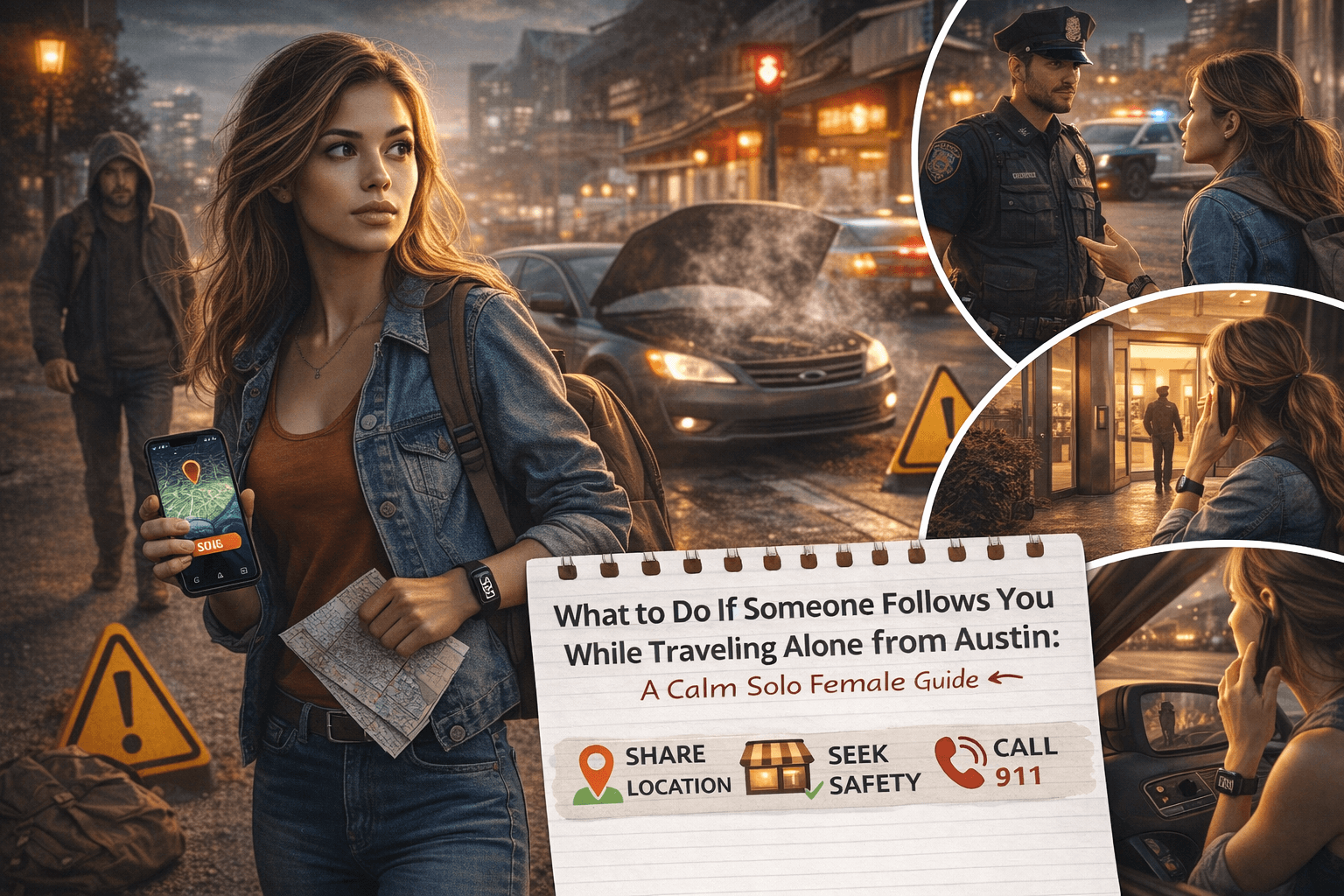
Traveling alone from Austin for a weekend trip should feel freeing, but the moment you suspect someone is following you can instantly tighten your chest and scramble your thoughts. I’ve seen many solo women describe this as one of the most unsettling travel fears, not because it always leads to danger, but because uncertainty itself is disorienting. In that moment, your brain wants a clear plan more than anything else.
This guide gives you a calm, practical framework for recognizing when someone may be following you and responding in a way that protects your safety without escalating the situation. You’ll learn how to test your instincts, move toward safer environments, use simple scripts, and regain emotional control afterward. The goal is steady confidence: knowing exactly what to do so you can continue your weekend trip feeling grounded and in charge.
Table of Contents
ToggleRecognizing When Someone Is Actually Following You
The fear of being followed is powerful because uncertainty leaves very little room for calm thinking. Not every repeated sighting of the same person means you are in danger. During weekend trips from Austin, especially in walkable downtown areas or tourist zones, it’s common to cross paths with the same people more than once. I’ve seen many solo women become anxious simply because they don’t know how to interpret these coincidences.
Your goal in this moment is not to jump to conclusions. It’s to observe patterns with quiet clarity. When you shift from fear to observation, you regain mental control. Instead of asking, “Am I in danger?” you ask, “What evidence do I actually see?” That small change stabilizes your thinking and helps you decide your next step with intention.
Normal Travel Coincidences vs Repeated Patterns
Travel environments create natural overlaps. People move between the same landmarks, cafés, and streets. A coincidence becomes concerning only when repetition starts to feel intentional rather than random.
Signs that suggest coincidence rather than pursuit often include:
-
Brief Sightings Without Directional Matching where the person moves independently
-
Different Speeds And Paths that separate quickly
-
No Attempt At Interaction or eye contact
-
Crowded Tourist Areas where overlap is expected
-
Short-Term Reappearances that stop after a few minutes
Patterns that deserve more attention look different. They show consistent alignment with your movements rather than shared destination flow.
Early Signs That Deserve Your Attention
When someone is following you, the pattern usually becomes visible through small consistencies. You are looking for repetition that continues after you intentionally change your behavior.
Early warning signs include:
-
The Person Mirrors Your Direction Changes more than once
-
They Maintain A Similar Distance Behind You across turns
-
They Slow Down Or Speed Up To Match Your Pace
-
They Reappear After You Enter And Exit A Store
-
They Focus Attention On You rather than their surroundings
None of these signs alone confirm intent. Together, they signal that it’s time to activate your safety plan calmly.
Trusting Your Instinct Without Panicking
Instinct is a quiet pattern-recognition system, not a dramatic alarm. Many solo women struggle here because they fear embarrassing themselves by misreading a situation. I’ve seen travelers hesitate far longer than necessary because they want certainty before acting.
You don’t need certainty. You need comfort. If your instincts suggest something is off, the safest response is a small test, not confrontation. Changing direction, entering a store, or pausing briefly gives you information without escalating the situation.
The key is emotional tone. You are not running. You are gathering data. Acting early keeps your options wide and your nervous system steady.
Your Immediate Action Plan If You Think You’re Being Followed
The moment you suspect someone may be following you, your priority is not to confirm their intentions beyond doubt. Your priority is to create safety while staying outwardly calm. I’ve seen many solo women freeze because they feel pressure to interpret the situation perfectly. In reality, you don’t need a perfect diagnosis. You need a simple sequence of actions that protects your space and keeps you moving toward support.
This action plan is designed for real weekend travel conditions near Austin, where you may be walking between shops, exploring downtown areas, or moving through outdoor attractions. The goal is to test the situation, increase visibility, and widen your options without confrontation. Each step builds on the previous one, allowing you to respond proportionally instead of reactively.
Step 1: Change Direction and Observe Calmly
Your first move is a subtle test. Changing direction gives you immediate information about whether the person is simply sharing your route or intentionally tracking your movement. The key is to make this change look natural rather than abrupt.
Calm directional tests include:
-
Crossing The Street At A Normal Intersection
-
Entering A Nearby Store Or Café Briefly
-
Slowing Down To Check Your Phone Or Window Shop
-
Turning Onto A Different Block
-
Pausing Near A Public Display Or Map
If the person mirrors these changes repeatedly, treat that pattern as useful information. You are not confirming danger. You are confirming that it’s time to escalate your safety steps.
Step 2: Move Toward Populated, Visible Spaces
Once you suspect intentional following, your next priority is visibility. Crowds and staffed environments create natural social protection. During Austin weekend trips, this often means gravitating toward active commercial areas rather than quiet residential streets.
Effective visibility moves include:
-
Heading Into A Busy Café Or Restaurant
-
Entering A Hotel Lobby With Staff Present
-
Walking Toward Well-Lit Main Streets
-
Joining Areas With Steady Foot Traffic
-
Positioning Yourself Near Security Or Service Counters
These spaces allow you to observe safely while blending into normal activity.
Step 3: Signal Awareness Without Confrontation
Sometimes simply signaling that you are aware of someone’s presence disrupts their behavior. This is not about staring or accusing. It’s about projecting alertness and confidence.
Subtle awareness signals include:
-
Making Brief Eye Contact And Continuing Forward
-
Holding Your Phone As If You Are On A Call
-
Standing Near Other People Instead Of Isolated Spots
-
Adjusting Your Posture To Look Alert And Intentional
-
Narrating Your Location Quietly During A Call
These signals communicate that you are not an easy target without escalating the interaction.
Step 4: Prepare to Ask for Help
If the person continues to follow you into visible spaces, it’s time to involve others. Preparing mentally to ask for help reduces hesitation if the situation persists.
Preparation steps include:
-
Identifying The Nearest Staff Member Or Group
-
Rehearsing A Simple Help Phrase In Your Mind
-
Positioning Yourself Close To Supportive People
-
Keeping Your Phone Ready For Immediate Use
-
Choosing A Clear Exit Route If Needed
Knowing exactly how you will ask for help keeps fear from freezing your voice.
Where to Go If You Need Instant Safety During Austin Weekend Trips
If your suspicion shifts into a clear need for safety, your next decision is location. Where you go matters more than how fast you move. I’ve seen many solo women instinctively try to outrun discomfort by walking faster, but speed without direction can lead you into quieter areas. What usually feels safest is choosing environments designed around visibility, staffing, and predictable social flow.
During weekend trips from Austin, most destinations offer built-in safety anchors if you know how to recognize them. These places are not hiding spots. They are structured environments where help is accessible and your presence is normal. Stepping into one of these spaces gives you time to observe, reset, and decide your next move without pressure.
Businesses That Offer Immediate Protection
Certain businesses are especially effective as instant safety zones because they combine staff presence with steady customer traffic. These environments make it easy to blend in while quietly signaling for support if needed.
Reliable protective businesses include:
-
Busy Restaurants Or Coffee Shops with visible staff and open seating
-
Hotels With Active Front Desks even if you are not a guest
-
Large Retail Stores where employees are easy to approach
-
Pharmacies Or Convenience Stores with service counters
-
Bookstores Or Boutiques that encourage lingering
Once inside, position yourself near staff rather than isolated corners. This keeps assistance within easy reach.
Public Buildings and Staffed Spaces
Public institutions often provide an added layer of structure and accountability. Staff members in these spaces are trained to assist visitors and maintain safe environments, which makes them strong regrouping points.
Supportive public spaces include:
-
Visitor Centers In Tourist Districts
-
Libraries And Community Buildings
-
Museums With Security Staff
-
Government Offices Open To The Public
-
University Buildings With Reception Areas
These locations allow you to pause without social pressure. You can sit, breathe, and assess the situation calmly.
Transportation Hubs as Safe Zones
Transportation hubs function as natural safety zones because they are built around helping travelers navigate movement. Even smaller Austin-area towns usually maintain structured transit points that feel organized and supervised.
Effective transportation safe zones include:
-
Staffed Train Or Bus Stations with information desks
-
Airport Terminals including regional facilities
-
Designated Ride-Share Pickup Areas near hotels
-
Parking Garages With Attendants instead of isolated lots
-
Tour Shuttle Stops in active districts
These hubs connect you directly to transportation while surrounding you with people whose role is to support travelers.
What to Say If You Need to Involve Other People (Safety Scripts)
One of the biggest barriers to asking for help is not danger itself — it’s hesitation. Many solo women worry about sounding dramatic or overreacting, especially during relaxed weekend trips from Austin where social interactions are usually friendly. I’ve seen travelers stay silent longer than they should simply because they don’t know what words to use. Having simple scripts removes that friction.
Safety scripts are not about making accusations. They are about clearly communicating discomfort so other people understand how to support you. Most staff and bystanders respond quickly when the situation is explained in plain language. Your tone can stay calm and steady. You are asking for assistance, not creating a scene.
Scripts for Asking Staff for Help
Staff members are often your strongest allies because they control the environment you’re standing in. A short, direct explanation helps them act without confusion.
Effective staff scripts include:
-
“Excuse Me, I Think Someone Is Following Me. Can I Stay Here For A Moment?”
-
“I Feel Uncomfortable. Could Someone Walk Me To My Ride?”
-
“Can I Stand Near You While I Call For Transportation?”
-
“That Person Has Been Following Me Outside.”
-
“I Need Help. I Don’t Feel Safe.”
These phrases give staff clear information and a simple request. Most will respond immediately with practical support.
Scripts for Engaging Bystanders
If staff are not immediately available, nearby people can provide social protection. Bystanders often want to help but need a clear signal that assistance is welcome.
Helpful bystander scripts include:
-
“Hi, Can I Stand With You For A Moment? I Think Someone Is Following Me.”
-
“Could You Pretend You Know Me While I Wait?”
-
“Would You Mind Walking With Me To That Door?”
-
“Can I Stay Near You Until My Ride Arrives?”
-
“I Need A Little Help. I Feel Uncomfortable.”
These requests are simple and human. Most people respond with quiet solidarity when asked directly.
Scripts for Calling Someone You Trust
Calling someone you trust can both stabilize you emotionally and signal awareness to the person following you. Narrating your situation out loud adds social visibility without confrontation.
Useful phone scripts include:
-
“Hey, I Think Someone Is Following Me. I’m At [Location].”
-
“Stay On The Phone With Me While I Go Inside.”
-
“I’m Heading Into A Hotel Lobby Now.”
-
“Can You Track My Location For A Few Minutes?”
-
Describing Your Surroundings Clearly while you move
Your voice becomes a bridge between you and your support system, reinforcing that you are not isolated.
How to Use Your Phone Strategically If Someone Is Following You
When you suspect someone is following you, your phone becomes more than a communication device. It becomes a quiet safety tool that can increase visibility, document your situation, and connect you to support — all without escalating the encounter. I’ve seen many solo women either grip their phones in panic or avoid using them because they don’t want to look distracted. The most effective approach sits in the middle: calm, intentional use.
During weekend travel from Austin, your phone gives you instant access to maps, contacts, and emergency features that widen your options. The goal is to use these tools in a way that supports awareness rather than pulling your attention away from your surroundings. You want to look purposeful, not absorbed.
Quiet Location Sharing and Emergency Features
Location sharing is one of the fastest ways to reduce the feeling of isolation. You are not announcing an emergency. You are creating a digital safety net that runs quietly in the background.
Smart location habits include:
-
Sharing Live Location With A Trusted Contact Immediately
-
Activating Emergency SOS Features if the situation escalates
-
Opening Your Map App To Identify Nearby Safe Buildings
-
Saving Your Current Location Pin in case you need to report it
-
Keeping Your Phone Unlocked And Ready for fast action
These steps happen in seconds and add an invisible layer of protection.
Using Calls to Create Social Visibility
A phone call changes the social dynamics around you. Even if the person following you cannot hear the conversation clearly, they can see that you are connected to someone. That visibility alone can discourage continued pursuit.
Effective call strategies include:
-
Calling A Trusted Person And Staying On The Line
-
Narrating Your Location Out Loud Calmly
-
Describing What You Are Doing Next
-
Speaking Clearly Enough To Be Heard Nearby
-
Avoiding Whispering Or Panicked Tone
Your voice signals awareness and connection without confrontation.
When to Contact Local Authorities
Most situations resolve once you enter visible spaces and involve other people. But if someone continues to follow you persistently or behaves aggressively, contacting local authorities becomes appropriate. This is a practical safety decision, not an overreaction.
Situations that justify calling authorities include:
-
The Person Follows You Into Multiple Buildings
-
They Ignore Staff Intervention
-
They Attempt Direct Confrontation
-
You Feel Unable To Reach A Safe Space Alone
-
Your Fear Is Escalating Despite Protective Steps
Clear, calm communication with authorities helps them respond effectively.
How to Avoid Leading Someone to Your Accommodation
One of the most important priorities when you suspect someone is following you is protecting your accommodation. Your hotel, rental, or guesthouse is your anchor point during a weekend trip from Austin. It’s where you sleep, reset, and store your belongings. I’ve seen many solo women instinctively head back to their rooms when they feel scared, but doing so can unintentionally reveal where you’re staying.
The safer strategy is to treat your accommodation as confidential information until you are certain you are no longer being followed. This is not about paranoia. It’s about keeping your private space separate from a public situation. A few calm routing decisions can prevent someone from connecting you to your lodging.
Redirecting Your Route Safely
If you were already heading back to your accommodation when you noticed someone behind you, your first step is to change that destination. Redirecting your route buys you time and breaks any direct line between the person and where you’re staying.
Safe redirection strategies include:
-
Turning Toward A Busy Commercial Area Instead Of Your Hotel
-
Entering A Well-Lit Business Near Your Route
-
Crossing Streets To Disrupt A Straight Path Home
-
Walking Into A Public Building And Pausing
-
Using A Ride-Share To A Neutral Destination First
These detours are temporary shields. Once you confirm the person is gone, you can return to your accommodation safely.
Using Detours and Public Stops
Detours work best when they are purposeful rather than random. You want to move between structured, populated spaces that allow you to observe whether the person continues following you.
Effective detour stops include:
-
Hotel Lobbies That Are Not Your Own
-
Restaurants With Visible Staff
-
Retail Stores With Open Counters
-
Visitor Centers Or Libraries
-
Transportation Hubs With Attendants
Each stop gives you a moment to scan your surroundings and reset your route.
Entering Your Accommodation Securely
Once you are confident you are no longer being followed, you can return to your accommodation with intention. The goal is a controlled, low-visibility entry that keeps your privacy intact.
Secure entry habits include:
-
Scanning The Area Before Approaching The Entrance
-
Entering Through Staffed Doors When Available
-
Avoiding Lingering Outside With Keys Or Phone
-
Going Directly Inside Without Hesitation
-
Not Sharing Your Room Number Publicly
These small actions preserve the sense of safety your accommodation is meant to provide.
What to Do If the Person Continues Following You
If someone continues following you after you’ve changed direction, entered buildings, and increased visibility, the situation shifts from uncertainty to action. At this point, your goal is no longer testing patterns. Your goal is containment and support. I’ve seen many solo women hesitate here because they hope persistence will fade on its own. Sometimes it does, but when it doesn’t, early escalation protects you.
This stage is about moving into controlled environments and clearly involving others. You are not overreacting by doing this. You are responding proportionally to repeated behavior. The more structured the space around you becomes, the fewer options the follower has to continue unnoticed.
Escalating to Staff or Security
When following continues across multiple spaces, it’s time to explicitly involve staff or security. Choose the closest staffed environment and communicate clearly. You do not need a long explanation. Simple, direct language is enough to trigger support.
Effective escalation actions include:
-
Telling Staff That Someone Has Been Following You Across Locations
-
Asking To Stay Near A Staff Member Or Security Desk
-
Requesting That Security Observe The Person
-
Standing In Clearly Monitored Areas with cameras
-
Following Staff Instructions Without Hesitation
Most venues take these reports seriously and will position you in safer zones immediately.
Entering Controlled Spaces
Controlled spaces are environments where entry and exit are monitored. These places limit the ability of someone to linger unnoticed and give you structured protection.
Strong controlled spaces include:
-
Hotel Lobbies With Security Or Reception
-
Museums Or Government Buildings with staff checkpoints
-
Transportation Terminals With Visible Personnel
-
Large Retail Stores With Security Presence
-
Police Or Fire Stations If Nearby
Once inside, remain visible and close to authority figures until you feel stable.
Documenting the Situation Safely
If the person continues to follow you within visible spaces, discreet documentation can support authorities if needed. Documentation is not about confrontation. It is about preserving details calmly.
Safe documentation habits include:
-
Noting Physical Descriptions In Your Phone
-
Remembering Clothing Or Distinctive Features
-
Saving Your Current Location And Time
-
Taking A Discreet Photo Only If It Feels Safe
-
Sharing Details With A Trusted Contact
Your safety comes first. Documentation is secondary and optional.
Emotional Recovery After Being Followed
Realizing someone may have been following you can leave a lingering emotional echo, even after the situation ends. Your body does not immediately recognize that the danger has passed. I’ve seen many solo women carry that tension into the rest of their weekend, replaying the moment and questioning their decisions. Emotional recovery is not optional here. It is part of restoring your sense of control.
A following incident is unsettling because it touches your sense of personal space and autonomy. The fastest way back to steadiness is intentional calming, not suppression. When you guide your nervous system back to baseline, your mind regains clarity and your trip can continue with confidence instead of fear.
Calming Your Nervous System
Your first task after reaching safety is helping your body exit adrenaline mode. Physical grounding techniques tell your nervous system that the threat is over.
Effective calming actions include:
-
Sitting In A Busy, Supportive Environment like a café or lobby
-
Drinking Water Slowly And Breathing Evenly
-
Placing Both Feet Firmly On The Floor and noticing pressure
-
Listening To Familiar Music Through Headphones
-
Texting Someone You Trust and briefly describing what happened
These actions reconnect you to normal sensory rhythms.
Deciding Whether to Continue or Pause Your Plans
After your body settles, you may wonder whether to keep exploring or return to rest. There is no universal right choice. What matters is selecting the option that restores your confidence fastest.
Helpful decision factors include:
-
Your Current Energy Level after calming down
-
The Time Of Day And Lighting Conditions
-
Distance To Your Accommodation
-
Whether Your Next Activity Feels Light Or Demanding
-
Your Desire For Quiet Versus Social Space
Choosing to rest is a strategy, not a retreat.
Protecting Your Confidence for the Rest of the Trip
The greatest risk after being followed is letting the experience shrink your sense of freedom. I’ve seen many solo travelers recover fastest when they consciously reframe the event as proof of their capability.
To reinforce confidence:
-
Acknowledge That You Handled The Situation Effectively
-
Avoid Replaying Worst-Case Scenarios
-
Return To A Familiar, Enjoyable Activity Soon
-
Stay In Well-Lit, Active Areas For A While
-
Remind Yourself Why You Chose Solo Travel
Confidence grows when you keep moving gently forward.
Preventive Habits That Reduce the Risk of Being Followed
Most following situations are rare, but prevention is still one of the strongest tools you carry. Prevention is not about walking in fear or scanning every shadow. It’s about designing your movement in ways that naturally discourage unwanted attention. I’ve seen many solo women travel confidently for years by building quiet habits that make them look aware, intentional, and hard to isolate.
During weekend trips from Austin, your movement patterns matter more than you might expect. People who follow others tend to look for distraction, predictability, or isolation. Small adjustments in how you navigate streets, evenings, and public spaces reduce those opportunities without changing the relaxed feel of your trip.
Route Awareness During Exploration
When you explore a new place, awareness of your route acts like an invisible shield. You don’t need to memorize maps, but you do want a general sense of direction and nearby anchor points.
Helpful route habits include:
-
Glancing At Your Map Before You Start Walking instead of mid-street
-
Favoring Main Streets Over Quiet Shortcuts
-
Noticing Landmarks You Can Return To Quickly
-
Keeping Your Head Up And Pace Steady
-
Avoiding Long Pauses In Isolated Areas
These habits signal that you are oriented and alert.
Evening Movement Strategies
Evenings change the social landscape. Energy concentrates into pockets, and empty stretches become more noticeable. Adjusting your movement rhythm at night protects your comfort without limiting enjoyment.
Supportive evening strategies include:
-
Staying Within Active Dining Or Entertainment Zones
-
Planning Short, Direct Routes Between Venues
-
Using Ride-Share For Longer Night Walks
-
Leaving Venues Before Areas Empty Out
-
Positioning Yourself Near Groups When Walking
Evening strategy is about flow, not restriction.
Positioning Yourself in Public Spaces
Where you stand or sit influences how visible and protected you feel. Experienced solo travelers instinctively choose positions that support awareness and easy exits.
Comfort-supportive positioning includes:
-
Sitting Where Entrances And Exits Are Visible
-
Choosing Seats Near Staff Or Counters
-
Avoiding Deep Corners Late At Night
-
Keeping Personal Items Close And Organized
-
Maintaining A Clear Path To Stand And Leave
These choices quietly reinforce control over your environment.
Creating a Personal Anti-Following Safety Ritual Before Trips
The calmest responses during travel usually come from preparation done at home. A personal anti-following ritual is not about expecting danger. It’s about rehearsing small actions so they feel automatic if you ever need them. I’ve seen many solo women from Austin describe a noticeable shift in confidence once they create a repeatable pre-trip routine. Instead of hoping they’ll remember what to do, they know they will.
This ritual is less about gear and more about mindset. When you mentally walk through scenarios and set up your communication and technology in advance, you remove hesitation. Your brain recognizes the situation as familiar territory rather than a crisis. That familiarity is what keeps your voice steady and your movements controlled.
Mental Rehearsal Techniques
Mental rehearsal builds muscle memory for your decisions. You are not visualizing worst-case scenarios in detail. You are calmly practicing the first few protective steps so they feel ordinary.
Useful rehearsal habits include:
-
Visualizing Yourself Entering A Busy Business Calmly
-
Practicing Direction Changes In Your Mind
-
Rehearsing A Simple Help Phrase Out Loud
-
Imagining Yourself Calling A Trusted Contact
-
Picture Ending The Scenario Safely
These short exercises make action feel familiar.
Communication Plans With Home
A clear communication plan reduces the emotional weight of uncertainty. You and your trusted contacts understand when and how you’ll check in, which creates quiet reassurance on both sides.
Healthy communication planning includes:
-
Sharing Your Accommodation And Itinerary
-
Agreeing On Evening Check-In Windows
-
Saving Emergency Contacts In Speed Dial
-
Discussing What To Do If You Call For Help
-
Keeping Expectations Realistic And Calm
This framework travels with you.
Technology Preparation
Technology works best when it’s prepared before you leave Austin. Small setup steps ensure that your tools respond instantly when needed.
Smart preparation steps include:
-
Testing Emergency SOS Features
-
Enabling Quick Location Sharing Settings
-
Updating Ride-Share And Map Apps
-
Charging Backup Battery Packs
-
Locking Your Phone With Simple Access Methods
Prepared technology removes friction in stressful moments.
Final Thoughts: Staying Calm and in Control When You’re Followed
Being followed, or even suspecting that you are, touches a very deep layer of instinct. It can make the world feel suddenly smaller and less predictable. But I’ve seen many solo women come through these moments with a stronger sense of capability than they had before. What defines the experience is not that it happened. It’s how you responded to it.
Everything in this guide comes back to one core idea: calm action expands your options. You tested your instincts, moved toward visible spaces, involved other people when needed, and protected your private information. Those are not small skills. They are the foundations of confident solo travel. When you carry a clear plan, uncertainty loses much of its power.
Solo weekend trips from Austin are still meant to feel expansive and restorative. A following incident does not cancel that purpose. It becomes one chapter in a larger story of learning how to navigate the world with awareness and steadiness. Each time you respond thoughtfully, you reinforce trust in your judgment. That trust is what allows you to keep exploring.
Related Posts
- Best Time of Year for Solo Female Weekend Trips from Austin (Comfort, Confidence & Ease)
- One-Night Solo Female Weekend Trips from Austin (Calm, Confident & Completely Doable)
- Best Time for Solo Female Weekend Trips From Austin (Seasons + Timing Guide)
- Is It Safe to Travel Alone Near Austin? Honest Answers for Women
- Safest Hotels Near Austin for Solo Female Travelers (Where Comfort Comes First)
- Solo Female Weekend Travel Budget Breakdown from Austin (Realistic, Calm & Confidence-First)
- Best Hotel Safety Items for Solo Female Travelers That Build Calm Confidence
- How Much Does a Solo Female Weekend Trip from Austin Cost? (Full Budget Guide)