
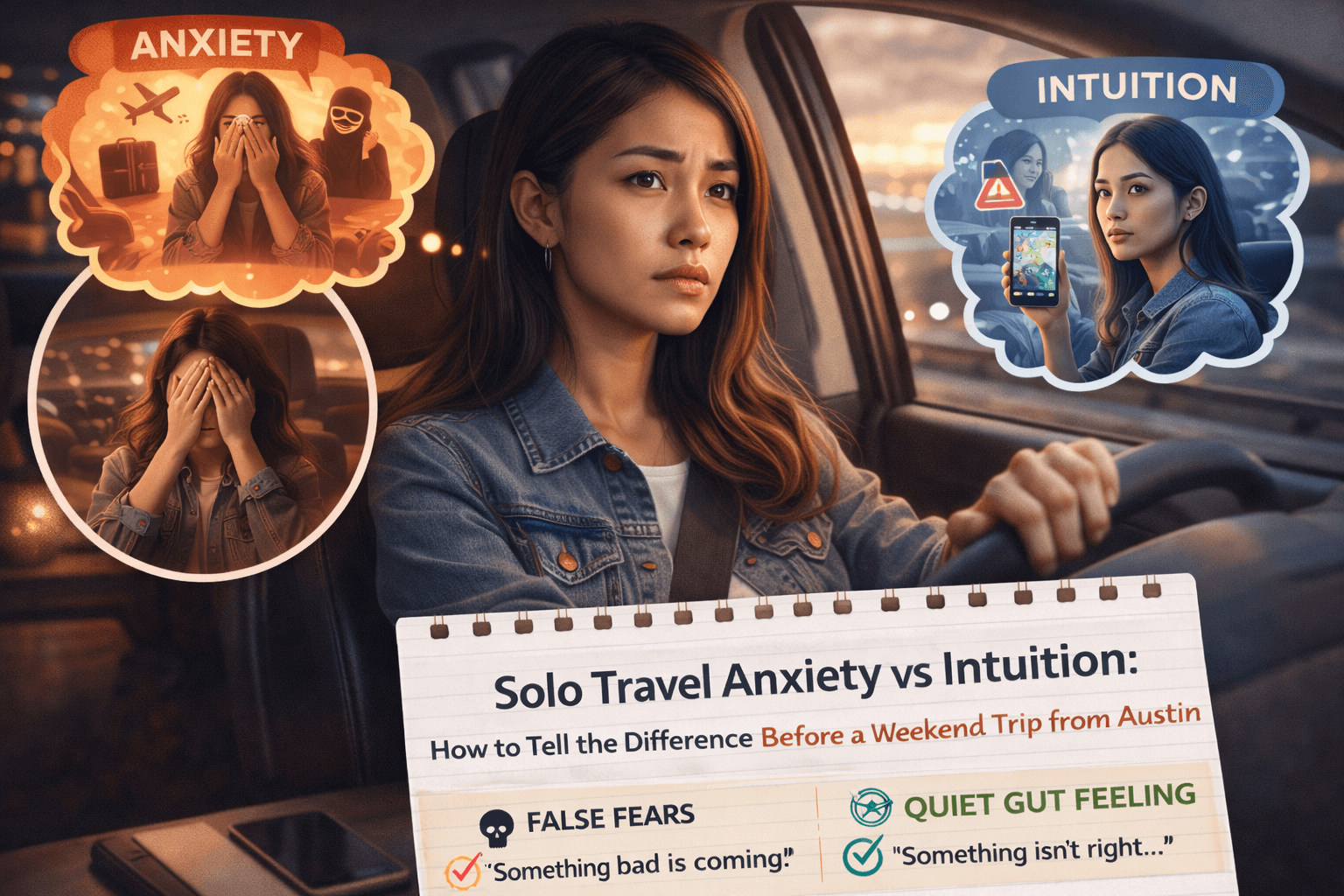
Before a solo weekend trip from Austin, it’s common to feel a swirl of internal signals that are hard to interpret. A tight chest, a restless mind, a sudden hesitation about plans — all of it can blur together until you’re unsure whether you’re sensing real intuition or just anxiety. I’ve seen many solo women struggle with this distinction and worry that misreading their feelings could lead to poor decisions. That uncertainty can make even simple choices feel heavier than they need to be.
This guide is a calm framework for separating travel anxiety from genuine intuition so you can move through solo weekends with clearer self-trust. We’ll explore how each signal tends to sound and feel, how to slow your thinking without freezing, and practical ways to respond in real situations. By the end, you’ll have tools to interpret your inner voice with more confidence, helping your trips away from Austin feel grounded instead of confusing.
Table of Contents
ToggleWhy Anxiety and Intuition Feel So Similar During Solo Travel
When you’re preparing for or actively taking a solo weekend trip from Austin, your internal signals tend to get louder. Sensations that might feel subtle at home suddenly feel amplified in a new environment. A quick spike in heart rate, a flicker of hesitation, or a strong emotional reaction can all blur together. I’ve seen many solo women assume that any strong internal feeling must be intuition, when often it’s anxiety reacting to unfamiliarity.
The confusion happens because anxiety and intuition both speak through the body. They use similar physical channels, but they carry very different messages. Learning why they overlap is the first step toward separating them. When you understand the mechanics, your reactions stop feeling mysterious and start feeling interpretable.
The Body Signals That Create Confusion
Both anxiety and intuition register as physical sensations before they become clear thoughts. Your nervous system reacts quickly to new environments, especially when you’re traveling alone. The problem is not the sensations themselves, but how easily they can be misread.
Common overlapping body signals include:
-
A Tightening In The Chest Or Stomach
-
A Sudden Spike In Alertness Or Tension
-
Restless Energy That Feels Urgent
-
Heightened Awareness Of Your Surroundings
Anxiety tends to flood the body with generalized tension. Intuition, by contrast, often appears as a brief, specific signal. But when you’re already keyed up from travel, it’s easy to interpret any discomfort as a warning.
How First-Time Solo Travel Amplifies Internal Noise
Solo travel removes familiar buffers. At home in Austin, routines and social anchors absorb much of your background stress. When those supports disappear temporarily, your internal volume increases. Thoughts that would normally pass quietly become more noticeable.
This amplification often shows up as:
-
Increased Self-Monitoring Of Your Thoughts And Feelings
-
Greater Sensitivity To Minor Uncertainties
-
A Tendency To Scan For Potential Problems
-
Difficulty Distinguishing Normal Nerves From Real Signals
This doesn’t mean something is wrong. It means your brain is adapting to independence in real time. With experience, this internal noise usually softens.
The Cost of Misreading Your Own Signals
When anxiety is mistaken for intuition, you may restrict yourself unnecessarily. You might cancel plans that are safe or avoid experiences that would have felt enriching. On the other hand, dismissing intuition as anxiety can push you into situations that genuinely feel off.
Misreading signals can lead to:
-
Over-Avoiding Harmless Situations Out Of Fear
-
Second-Guessing Decisions That Were Sound
-
Feeling Distrustful Of Your Own Judgment
-
Emotional Exhaustion From Constant Self-Debate
The goal is not to eliminate uncertainty. It’s to develop a calmer relationship with your internal cues. When you learn to interpret them with nuance, your solo weekends feel less like a guessing game and more like a conversation with yourself.
Understanding What Travel Anxiety Actually Sounds Like
Travel anxiety has a recognizable voice once you learn its patterns. It rarely speaks in calm, specific sentences. Instead, it tends to sound loud, repetitive, and urgent. Before or during a solo weekend trip from Austin, I’ve seen many women mistake this intensity for intuition simply because it feels strong. But strength does not equal accuracy. Anxiety’s volume often comes from its desire to eliminate uncertainty, not from a clear assessment of risk.
When you understand the tone of anxiety, you stop taking every anxious thought at face value. You begin to hear it as background noise that deserves acknowledgment but not automatic obedience. This shift is subtle, but it changes how you respond in real moments.
The Voice of Catastrophic Thinking
One of anxiety’s most consistent features is its tendency to jump to worst-case scenarios. It fills in gaps with dramatic conclusions, even when evidence is limited. The thoughts feel convincing because they arrive with emotional charge.
Catastrophic anxiety often sounds like:
-
Imagining Rare Outcomes As If They Are Likely
-
Assuming Small Uncertainties Will Spiral Into Big Problems
-
Framing Decisions As High-Stakes Or Irreversible
-
Treating Discomfort As Proof Of Danger
This voice is persuasive because it promises safety through avoidance. But its predictions are usually disproportionate to reality.
Repetition and Mental Looping
Anxiety repeats itself. It circles the same questions without producing new insight. I’ve seen many solo women spend hours mentally revisiting a single decision, hoping that more thinking will create certainty.
Mental looping typically includes:
-
Replaying The Same Concern Without Reaching Resolution
-
Seeking Reassurance And Then Doubting It
-
Revisiting Decisions That Were Already Settled
-
Feeling Stuck Between Options Without Movement
This repetition is a sign that the brain is trying to soothe itself through control. Unfortunately, the looping often increases tension instead of reducing it.
How Anxiety Escalates Without New Information
Another hallmark of anxiety is escalation in the absence of new facts. The emotional intensity grows even when the situation remains unchanged. Your body reacts to imagined scenarios as if they are unfolding in real time.
Escalation may appear as:
-
Rising Physical Tension While Sitting Still
-
A Growing Sense Of Urgency To Act Immediately
-
Interpreting Neutral Events As Confirmations Of Fear
-
Feeling Pressured To Make Quick Decisions
When you notice escalation without evidence, it’s a strong indicator that anxiety is driving the moment. Recognizing this pattern allows you to pause instead of reacting automatically.
Understanding anxiety’s voice gives you distance from it. You can listen without surrendering your judgment. That space creates room for intuition to become more audible.
Recognizing the Quiet Language of Intuition
If anxiety is loud and repetitive, intuition is usually quiet and precise. It doesn’t try to overwhelm you. Instead, it offers a simple internal nudge that feels steady rather than chaotic. I’ve seen many solo women overlook intuition because they expect it to sound dramatic. In reality, intuition often arrives as a calm knowing that contrasts sharply with anxiety’s urgency.
Learning to recognize intuition requires slowing down enough to notice its texture. It rarely argues or floods your mind with scenarios. It presents a direction and then waits. When you start paying attention to this difference, your internal signals become easier to sort.
Intuition as Calm, Specific Guidance
Intuition tends to be focused. It points to something concrete instead of generating a cascade of fears. Even when it signals caution, it usually does so without panic.
Intuitive guidance often feels like:
-
A Clear Sense That Something Is Or Isn’t Right
-
A Specific Preference Without Elaborate Justification
-
A Brief Internal Signal That Doesn’t Spiral
-
A Quiet Pull Toward Or Away From A Situation
This clarity is subtle but distinct. It doesn’t need to convince you through force. It simply presents information.
The Difference Between Urgency and Clarity
Anxiety pushes for immediate action. It insists that you decide quickly to relieve tension. Intuition, by contrast, allows space. It feels firm without being rushed. I’ve seen many solo women mistake urgency for importance, when urgency is often a marker of anxiety.
You can notice the difference through:
-
Anxiety Feeling Pressured While Intuition Feels Steady
-
Anxiety Demanding Instant Relief While Intuition Tolerates Pause
-
Anxiety Expanding Into Many Scenarios While Intuition Stays Narrow
-
Anxiety Creating Panic While Intuition Maintains Calm Awareness
This contrast becomes clearer with practice. When a signal allows you to breathe, it is more likely to be intuitive.
How Intuition Respects Your Autonomy
Intuition does not bully. It offers information and trusts you to interpret it. Even when it suggests caution, it leaves room for thoughtful response. This respectful tone is one of its defining features.
Intuition often supports autonomy by:
-
Presenting A Suggestion Without Catastrophic Consequences
-
Allowing You To Explore Alternatives Calmly
-
Coexisting With Curiosity Instead Of Fear
-
Encouraging Thoughtful Adjustment Rather Than Escape
When you experience an internal cue that feels supportive rather than coercive, you are likely hearing intuition.
Recognizing the language of intuition doesn’t mean dismissing anxiety. It means learning to differentiate tones so you can respond proportionately. That skill becomes especially valuable in real travel situations where quick interpretation matters.
A Practical Framework to Separate Anxiety from Intuition
In real travel moments, you don’t have the luxury of analyzing your feelings for hours. You need a simple framework you can use quickly, whether you’re booking a stay, deciding to enter a space, or adjusting plans mid-trip. I’ve seen many solo women gain confidence once they have a repeatable method for checking their internal signals. A framework turns vague emotion into a structured conversation with yourself.
The goal is not to suppress anxiety or blindly follow intuition. It’s to slow the moment just enough to interpret what you’re feeling. When you add gentle structure, your mind shifts from reaction to observation.
Asking Grounding Questions in the Moment
Grounding questions interrupt emotional momentum and introduce clarity. They move you from abstract fear to concrete evaluation. Even one well-chosen question can soften anxiety’s intensity.
Helpful grounding questions include:
-
What Specific Outcome Am I Afraid Of Right Now
-
What Evidence Supports Or Contradicts This Fear
-
Would I Give The Same Advice To A Friend In This Situation
-
Is This Feeling Expanding Into Many Worries Or Staying Focused
These questions don’t force an answer. They create space. Anxiety often weakens when it is asked to explain itself.
Checking Your Body’s Baseline State
Your body carries information about your emotional baseline. Anxiety tends to raise your general tension level, while intuition often appears as a localized signal within an otherwise calm body. Taking a few seconds to scan your physical state adds important context.
A quick body check might involve noticing:
-
Whether Your Entire Body Feels Activated Or Just One Area
-
If Your Breathing Is Shallow Or Naturally Steady
-
Whether Tension Persists Even When You Pause
-
If Calm Returns Quickly After A Few Slow Breaths
If your whole system feels agitated, anxiety is likely dominant. If calm is present with a specific nudge, intuition may be speaking.
Slowing Down Decisions Without Freezing
Separating anxiety from intuition requires a brief pause, not paralysis. The purpose of slowing down is to regain proportion. I’ve seen many solo women worry that pausing will make them indecisive, when in fact it usually sharpens their judgment.
You can slow decisions constructively by:
-
Giving Yourself A Short, Defined Window To Reflect
-
Stepping Away From The Immediate Stimulus If Possible
-
Reframing The Choice As Adjustable Rather Than Permanent
-
Returning To Simple Safety And Comfort Priorities
This pause prevents reactive choices while keeping you moving forward. Most travel decisions do not require instant resolution. Allowing a moment of stillness lets intuition surface more clearly.
A practical framework doesn’t eliminate uncertainty, but it transforms how you meet it. Instead of feeling trapped between anxiety and instinct, you gain a method for listening with discernment.
Real Solo Travel Scenarios Where the Difference Matters
The distinction between anxiety and intuition becomes most important in real, everyday travel decisions. These moments rarely look dramatic. They’re usually small choices that carry emotional weight because you’re navigating them alone. I’ve seen many solo women discover that clarity grows fastest when they practice separating signals in ordinary situations, not just in emergencies.
When you apply your framework to real scenarios, you build pattern recognition. Each interpreted moment becomes a reference point for the next one. Over time, your responses feel less reactive and more grounded.
Choosing Accommodation and Neighborhoods
Accommodation decisions often trigger a mix of excitement and nervousness. Anxiety tends to fixate on worst-case possibilities, while intuition focuses on overall fit and comfort. The challenge is telling whether your hesitation comes from real misalignment or generalized fear.
You can separate signals by noticing:
-
Whether Your Concern Is Specific To A Clear Feature Of The Stay
-
If Reviews And Information Calm Your Mind Or Fail To Settle It
-
Whether The Space Feels Emotionally Inviting When You Imagine Arriving
-
If Your Worry Expands Into Unrelated Catastrophic Scenarios
Intuition usually responds to concrete mismatches, such as location or atmosphere. Anxiety broadens into hypothetical danger.
Navigating Social Interactions While Traveling
Solo travel naturally includes moments of social contact with strangers. Most interactions are neutral or pleasant, but your internal signals may spike unpredictably. I’ve seen many women struggle to interpret whether discomfort is protective intuition or social anxiety.
In social situations, clarity grows when you observe:
-
Whether Discomfort Is Linked To A Specific Behavior Or Just Presence
-
If Your Body Calms When You Create A Small Boundary
-
Whether The Feeling Persists After Stepping Back
-
If You Can Articulate A Clear Reason For Unease
Intuition often attaches to identifiable cues. Anxiety tends to remain vague and generalized.
Adjusting Plans When Something Feels Off
Travel rarely unfolds exactly as planned. A restaurant feels wrong, a street seems uncomfortable, or your energy drops unexpectedly. These moments test your ability to respond without overreacting.
When adjusting plans, it helps to ask:
-
Is This Feeling Sharp And Focused Or Diffuse And Expanding
-
Does A Simple Change Reduce The Discomfort
-
Am I Reacting To Fatigue Rather Than Environment
-
What Is The Smallest Adjustment That Restores Ease
Intuition often resolves with a clear, proportional action. Anxiety pushes toward drastic shifts.
Practicing these distinctions in everyday scenarios strengthens your internal calibration. You begin to trust that you can interpret signals without constant second-guessing. Each handled situation reinforces your ability to move through solo weekends with steadier judgment.
Training Yourself to Trust Your Inner Signals Over Time
Trust in your inner signals doesn’t appear automatically. It develops through repetition, reflection, and gentle attention to how your decisions actually unfold. I’ve seen many solo women expect instant certainty from themselves, and then feel discouraged when their signals still feel mixed. In reality, learning to distinguish anxiety from intuition is a long conversation with your own experience.
The most reliable way to build trust is to treat each solo weekend trip from Austin as practice. You are not trying to become perfect at interpretation. You are building familiarity with your own patterns. Over time, your internal landscape becomes easier to read because you have more reference points.
Reflecting on Past Decisions
Reflection turns experience into usable knowledge. Without it, your brain forgets how often you handled situations well. After a trip, even a short review strengthens your sense of competence.
Useful reflection questions include:
-
Which Decisions Felt Calm And Correct In The Moment
-
When Did Anxiety Appear And How Did It Resolve
-
Were There Moments When Intuition Guided A Helpful Adjustment
-
What Surprised You About Your Own Capability
These reflections are not about critique. They are about recognizing evidence of judgment that worked.
Building a Personal Pattern Library
As you accumulate trips, patterns begin to emerge. You start noticing how anxiety typically behaves in your body and how intuition presents itself. This personal pattern library becomes one of your strongest tools.
You build this library by:
-
Noticing Recurring Physical Sensations Linked To Anxiety
-
Identifying The Tone Of Thoughts That Usually Prove Accurate
-
Remembering Situations Where You Misread Signals And Learned From It
-
Connecting Emotional States To Travel Contexts Like Fatigue Or Hunger
The more patterns you recognize, the less mysterious your reactions feel.
Strengthening Calm Self-Talk
Your internal dialogue shapes how you interpret signals. Harsh self-criticism amplifies anxiety, while calm self-talk creates space for intuition. I’ve seen many solo women dramatically improve their clarity simply by softening how they speak to themselves.
Supportive self-talk often includes:
-
Reminding Yourself That Uncertainty Is Normal During Travel
-
Acknowledging Fear Without Letting It Dominate
-
Speaking Internally As You Would To A Trusted Friend
-
Reinforcing Evidence Of Past Competence
This tone stabilizes your nervous system. When your inner voice is steady, your signals become easier to hear.
Training trust is an incremental process. Each reflection, pattern, and supportive thought adds another layer of familiarity. Over time, your internal signals stop feeling like a battlefield and start feeling like a conversation you know how to navigate.
What to Do When Anxiety Is Loud but Intuition Is Unclear
There will be moments during solo weekend travel when anxiety rises and intuition doesn’t immediately answer back. This can feel especially unsettling because you want a clear internal signal and instead get static. I’ve seen many solo women interpret this silence as a failure of judgment, when it’s often just a sign that your nervous system is overloaded. When anxiety is loud, intuition doesn’t disappear — it gets temporarily harder to hear.
In these moments, your goal is not to force clarity. It’s to create conditions where clarity can return. Think of this as emotional first aid. You are stabilizing the situation so your internal signals can rebalance.
Creating a Pause Instead of Forcing Action
When anxiety spikes, your instinct may be to act quickly just to escape the discomfort. Fast action can feel relieving in the short term, but it often bypasses useful information. A deliberate pause protects you from reactive decisions.
You can create a constructive pause by:
-
Physically Stopping Movement For A Few Seconds
-
Stepping Into A Quieter Or More Neutral Space
-
Naming The Feeling Without Trying To Solve It Immediately
-
Allowing Your Breathing To Slow Before Deciding
This pause is not indecision. It is recalibration. Even thirty seconds can shift your emotional state enough to restore perspective.
Using External Anchors Without Losing Agency
When internal clarity is low, external anchors can help you stabilize. These anchors are simple reference points that reduce cognitive load without taking control away from you. I’ve seen many solo women regain steadiness by leaning briefly on structure instead of pure instinct.
Helpful external anchors include:
-
Returning To Pre-Set Safety And Comfort Guidelines
-
Checking Practical Facts Instead Of Imagined Scenarios
-
Consulting A Trusted Person For Perspective
-
Referring To Your Travel Plan Or Accommodation Details
These anchors ground you in reality. They support your judgment rather than replacing it.
Returning to Simple, Safe Choices
When intuition feels distant, simplicity is your ally. Complex decisions amplify anxiety. Simple choices restore momentum and confidence. You don’t need the perfect option in these moments. You need a safe, workable next step.
Simple resets often involve:
-
Choosing Familiar Environments Over Novel Ones
-
Prioritizing Rest, Food, Or Hydration First
-
Selecting Activities With Predictable Outcomes
-
Allowing Yourself To Revisit Bigger Decisions Later
These choices stabilize your baseline. Once your system settles, intuition usually becomes more accessible again.
Final Thoughts: Trust Is Built Through Gentle Practice
Separating solo travel anxiety from intuition is not about mastering a rigid rule. It’s about developing a softer, more attentive relationship with your inner world. I’ve seen many solo women expect immediate certainty and overlook the value of gradual learning. Trust grows quietly through repetition, reflection, and patience with your own process.
Every solo weekend trip from Austin becomes an opportunity to refine this relationship. Some moments will feel clear and steady. Others will feel mixed and uncertain. Both are part of the practice. What matters is your willingness to pause, listen, and respond with care instead of judgment.
Over time, the distinction between anxiety and intuition becomes less intimidating. You learn that even when signals are messy, you are capable of navigating them. That realization is the foundation of confident solo travel. You are not waiting for perfect clarity. You are building trust in your ability to interpret yourself as you go.
Related Posts
- Quiet Cabins & Nature Stays Near Austin for Solo Women (Calm, Comfort-First)
- Best Airbnbs Near Austin for Solo Female Weekend Trips (Comfort-First, Joy-Ready)
- Local Food Experiences for Solo Female Travelers Near Austin
- Safest Weekend Getaways Near Austin for Solo Female Travelers
- Spring Weekend Trips from Austin for Women Traveling Alone
- Best Farm and Ranch Stays Near Austin for Solo Women Traveling Alone
- Best Hotel Safety Items for Solo Female Travelers That Build Calm Confidence
- Holiday Weekend Planning for Solo Women Travelers From Austin