
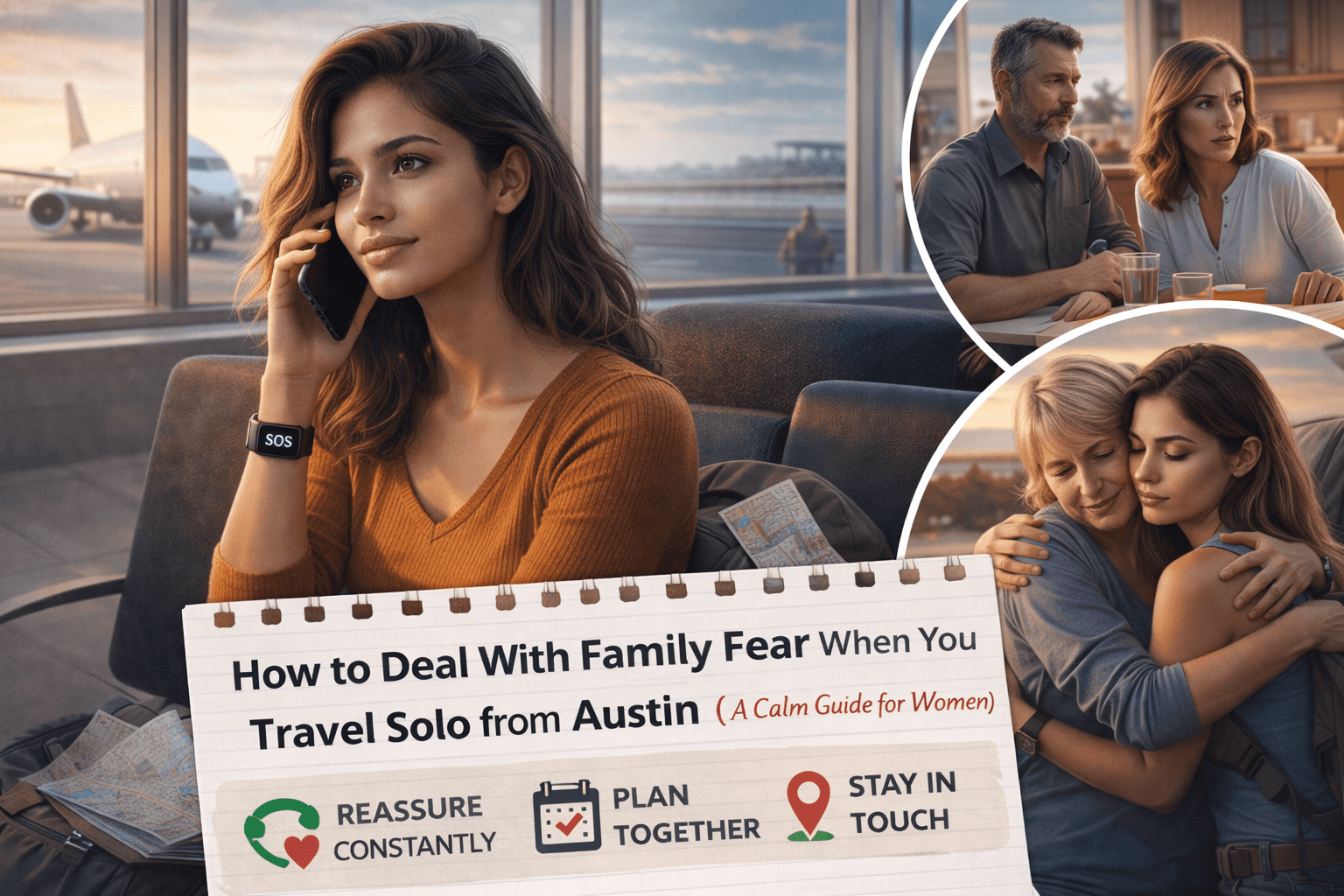
Telling your family you’re traveling alone can feel heavier than booking the trip itself. Even when you’re excited about a solo weekend away from Austin, their reactions can introduce a layer of fear, guilt, or second-guessing that wasn’t there before. I’ve seen many solo women absorb their family’s worry so deeply that it starts to sound like their own voice. What began as anticipation quietly turns into emotional negotiation.
This guide is a calm framework for handling family fear without dismissing their care or shrinking your independence. We’ll look at why their worry feels so powerful, how to separate their anxiety from your decisions, and the practical scripts that keep conversations steady instead of defensive. By the end, you’ll have tools to talk about solo travel in a way that reassures your family while protecting your confidence.
Table of Contents
ToggleWhy Family Fear Feels So Heavy Before a Solo Trip
Family reactions to solo travel rarely feel neutral. Even supportive families can express worry in ways that land with surprising weight. I’ve seen many solo women feel steady about their plans until a parent or sibling voices concern. Suddenly the trip carries emotional gravity that wasn’t there before. This heaviness doesn’t come from weakness. It comes from the deep wiring of family bonds and the way love and fear often arrive together.
When people who raised or care for you express anxiety, your nervous system registers it as important information. You are biologically tuned to respond to their emotional cues. Understanding why their fear feels so heavy helps you approach it with perspective instead of letting it quietly steer your decisions.
Love Expressed as Worry
For many families, worry is a primary language of love. Concern becomes a way of signaling attachment and protection. When your family imagines you traveling alone, their instinct is to scan for risks and voice them out loud.
This pattern often looks like:
-
Asking Repeated Questions About Safety
-
Highlighting Worst-Case Scenarios
-
Offering Unsolicited Advice About Precautions
-
Expressing Relief Only When You Promise Extra Caution
Underneath these behaviors is affection, not distrust. Recognizing that worry is a form of care softens the emotional sting without requiring you to accept their fear as fact.
How Family Anxiety Transfers to You
Emotions are contagious, especially within close relationships. I’ve seen many solo women start with calm excitement and gradually absorb their family’s tension until it feels like their own. This transfer happens quietly through tone, repetition, and emotional proximity.
Anxiety transfer often shows up as:
-
Replaying Family Warnings Internally
-
Questioning Decisions You Already Felt Good About
-
Feeling Responsible For Soothing Their Fear
-
Carrying A Sense Of Guilt Into Your Planning
This process is natural, but it can blur your internal clarity if you don’t notice it happening.
The Emotional Tug-of-War Between Independence and Loyalty
Solo travel sits at an intersection of autonomy and connection. Wanting independence does not erase your loyalty to family, but the two can feel temporarily in conflict. I’ve seen many women struggle with the idea that choosing their own experience might disappoint people they love.
This tug-of-war often includes:
-
Feeling Pulled Between Personal Growth And Family Comfort
-
Worrying That Independence Will Be Interpreted As Rejection
-
Wanting Approval While Also Wanting Freedom
-
Interpreting Disagreement As Emotional Distance
Naming this tension helps you see it as a shared human experience rather than a personal failing.
When you understand why family fear feels so heavy, you gain space to respond thoughtfully. The weight becomes something you can carry with awareness instead of something that silently dictates your choices.
Understanding What Your Family Is Really Afraid Of
When family members react strongly to your solo travel plans, their fear can sound broad and overwhelming. But underneath the surface, most worries fall into a few predictable categories. I’ve seen many solo women feel less defensive once they understand that their family’s fear is usually specific, even if it’s expressed dramatically. When you can name what they are actually afraid of, the conversation becomes easier to navigate.
Instead of hearing a wall of anxiety, you start hearing themes. Those themes are often less about your capability and more about their relationship to uncertainty. Recognizing this distinction helps you respond with reassurance instead of argument.
Fear of Safety Risks
Safety is the most visible layer of family concern. Loved ones tend to imagine rare but vivid scenarios because those images stick emotionally. Their brains are trying to protect you by anticipating danger, even when the trip itself is reasonable and planned.
This safety fear often includes:
-
Worry About Being Alone In Unfamiliar Places
-
Concern About Crime Or Accidents
-
Fear Of You Not Having Immediate Support
-
Anxiety About Communication Gaps
These fears are usually exaggerated by imagination, but they come from a protective instinct rather than distrust in your judgment.
Fear of the Unknown and Loss of Control
Travel removes you from your family’s sphere of influence. They cannot see your environment or intervene if something happens. For some relatives, this loss of visibility triggers discomfort that is less about the destination and more about their role.
This fear tends to show up as:
-
Wanting Detailed Itineraries And Constant Updates
-
Asking For Repeated Confirmation Of Plans
-
Expressing Unease About Spontaneity
-
Seeking Ways To Stay Involved From Afar
Their anxiety is often about relinquishing control, not about doubting your competence.
Cultural and Generational Expectations
Family reactions are also shaped by cultural narratives and generational experiences. Some relatives grew up in contexts where solo female travel was rare or discouraged. Their fear may reflect inherited beliefs rather than your actual situation.
These expectations may include:
-
Associating Travel With Group Or Family Settings
-
Viewing Independence As Risky Or Unnecessary
-
Carrying Stories Of Past Incidents That Still Influence Them
-
Measuring Safety By Older Standards
Understanding this background doesn’t require you to adopt their view. It simply clarifies where their fear originates.
When you identify the layers of fear beneath your family’s reaction, the conversation becomes more specific and less emotional. You are no longer debating abstract anxiety. You are addressing recognizable concerns with calm clarity.
Separating Their Anxiety from Your Own Decisions
One of the hardest parts of family fear is how easily it blends into your internal voice. After enough conversations, their worries can start sounding like your own thoughts. I’ve seen many solo women mistake borrowed anxiety for personal intuition and quietly scale back their plans because of it. Separating their emotions from your decisions is not about dismissing them. It’s about protecting the clarity you had before the noise entered.
This separation is an internal skill. You are learning to notice what belongs to you and what belongs to them. When you can make that distinction, you regain the ability to choose your actions based on grounded judgment rather than emotional contagion.
Recognizing Emotional Contagion
Emotional contagion happens when repeated exposure to someone else’s fear activates your own nervous system. You may start feeling tense without a clear personal reason. Naming this process helps interrupt it.
Signs of emotional contagion often include:
-
Hearing Their Warnings Echo In Your Thoughts
-
Feeling Sudden Doubt About Plans You Felt Good About
-
Experiencing Guilt When You Imagine Enjoying The Trip
-
Carrying A Sense Of Responsibility For Their Comfort
These signals point to transferred emotion, not new information about your safety.
Protecting Your Internal Clarity
Once you recognize contagion, the next step is creating space to hear your own reasoning again. I’ve seen many women regain steadiness by returning to the practical foundations of their plans.
You can protect clarity by:
-
Reviewing Your Trip Details Calmly And Logically
-
Writing Down Why You Chose To Travel Solo
-
Checking Facts Instead Of Imagined Scenarios
-
Spending Quiet Time Away From Repetitive Conversations
These actions reconnect you with your original perspective.
Staying Compassionate Without Absorbing Fear
Separation does not require emotional distance. You can acknowledge your family’s concern while keeping it from steering your decisions. Compassion and independence can coexist.
This balance often looks like:
-
Listening Without Immediately Defending Yourself
-
Thanking Them For Their Care Without Agreeing With Their Fear
-
Responding Calmly Instead Of Matching Their Intensity
-
Returning To Your Own Judgment After The Conversation
When you hold compassion and clarity together, family fear becomes easier to carry without internalizing it.
Separating their anxiety from your decisions restores a sense of ownership. You are still connected to your family, but your choices remain anchored in your own reasoning.
Core Principles for Talking to Family About Solo Travel
Conversations about solo travel can easily slide into debate if you approach them defensively. I’ve seen many solo women prepare arguments when what they actually need is a calmer structure for communication. The goal is not to convince your family that their fear is irrational. It’s to create a tone where reassurance and boundaries can coexist. When you lead with steadiness, the conversation becomes less about winning and more about mutual understanding.
These principles act as a framework you can return to whenever the topic resurfaces. They keep discussions from spiraling into emotional loops and help you stay anchored in your own confidence.
Leading with Reassurance, Not Defense
Families often escalate when they feel dismissed. Beginning with reassurance acknowledges their care and lowers emotional intensity. You are signaling that you understand why they worry, even if you don’t share the same level of fear.
Reassuring communication often includes:
-
Acknowledging That You Understand Their Concern
-
Sharing That You Have Thought Carefully About Safety
-
Speaking Calmly Instead Of Matching Their Urgency
-
Emphasizing Preparation Rather Than Reacting To Scenarios
This tone invites cooperation instead of resistance.
Sharing Plans Without Oversharing
Transparency builds trust, but oversharing can unintentionally feed anxiety. Detailed contingency planning sometimes gives worried relatives more material to fixate on. I’ve seen many solo women find balance by sharing key information without narrating every possibility.
Balanced sharing usually involves:
-
Providing Clear Basics About Location And Timing
-
Mentioning General Safety Measures Without Dramatic Detail
-
Avoiding Hypothetical Worst-Case Discussions
-
Keeping Explanations Concise And Matter-Of-Fact
This approach reassures without amplifying fear.
Setting Gentle Boundaries Around Repeated Worry
Some families revisit the same concerns repeatedly. Without boundaries, these loops can erode your confidence. A gentle boundary signals that the topic has been addressed and doesn’t need constant reopening.
Boundary-setting in conversation can look like:
-
Calmly Repeating That You Have Considered Their Concern
-
Redirecting The Conversation After A Brief Response
-
Saying You Don’t Want To Dwell On Worst-Case Scenarios
-
Affirming Your Decision Without Apology
These boundaries protect your emotional space while keeping the relationship intact.
When you apply these principles consistently, conversations become more predictable and less draining. You are shaping the dialogue instead of reacting to it.
Scripts for Common Family Conversations
Even with the right mindset, family conversations can catch you off guard. Emotions run high, and it’s easy to fall into defending yourself or overexplaining. I’ve seen many solo women feel relief when they have ready-made language for predictable moments. Scripts don’t make conversations robotic. They give you a steady starting point when emotions spike.
These phrases are designed to keep the tone calm, respectful, and grounded. You’re not trying to win an argument. You’re guiding the conversation toward reassurance and closure.
Responding to Safety Concerns
Safety is the most common entry point for family worry. A script that combines acknowledgment and preparation can settle the conversation quickly.
Helpful safety scripts include:
-
I Understand Why You’re Worried, And I’ve Planned This Carefully
-
I’ve Chosen Places That Feel Safe And I’m Staying Aware Of My Surroundings
-
I Appreciate Your Concern, And I’m Taking Practical Precautions
-
I’ve Thought Through The Safety Side And I Feel Comfortable With My Plan
These responses validate their care without surrendering your decision.
Handling Guilt or Emotional Pressure
Sometimes concern shifts into guilt-based language, such as suggesting you’re selfish or reckless. In these moments, calm clarity protects both you and the relationship.
Supportive scripts for guilt pressure include:
-
I Know This Is Hard For You, But This Trip Is Important To Me
-
I’m Not Traveling To Worry You, I’m Traveling To Grow
-
I Care About How You Feel And I Also Need To Follow My Plans
-
We Can Disagree And Still Respect Each Other
These phrases acknowledge emotion without absorbing blame.
Ending Circular Arguments Calmly
When conversations start looping, repetition drains energy. A closing script signals that the discussion has reached its limit.
Effective loop-ending scripts include:
-
I Think We’ve Talked This Through And I’m Comfortable With My Decision
-
I Don’t Want To Keep Going In Circles About This
-
I’ve Heard Your Concerns And I’m Still Moving Forward
-
Let’s Talk About Something Else For Now
These lines create closure without confrontation.
Scripts transform unpredictable conversations into manageable exchanges. You’re not improvising under pressure. You’re returning to language that protects your calm.
Creating a Communication Plan That Reassures Everyone
Family fear often intensifies when communication feels uncertain. I’ve seen many solo women accidentally fuel worry by being vague about check-ins or changing plans without context. A simple communication plan reduces anxiety on both sides. It gives your family a predictable rhythm of contact while preserving your independence during the trip.
The goal is not constant reporting. It’s structured reassurance. When expectations are clear, your family doesn’t have to imagine worst-case scenarios in the silence between messages.
Check-In Rhythms That Feel Healthy
Check-ins work best when they are agreed upon in advance. This removes pressure to respond instantly and prevents your phone from becoming a leash.
A healthy rhythm often includes:
-
Sending A Short Arrival Message When You Reach Your Destination
-
Sharing One Daily Check-In At A Predictable Time
-
Letting Them Know Roughly When You’ll Be Offline
-
Keeping Messages Brief And Reassuring Rather Than Detailed
Predictability calms anxious minds more than constant updates.
Using Technology Without Feeling Monitored
Technology can reassure your family without turning into surveillance. The key is choosing tools intentionally instead of reacting to requests in the moment.
Balanced tech use may involve:
-
Sharing Your Location Temporarily If It Feels Comfortable
-
Sending Photos That Show You’re Relaxed And Safe
-
Using Messaging Apps Instead Of Constant Calls
-
Agreeing On Emergency-Only Contact Outside Check-Ins
These tools support connection without eroding autonomy.
Balancing Transparency and Independence
Transparency builds trust, but oversharing can blur boundaries. I’ve seen many solo women feel trapped when every decision becomes a family discussion. Your trip is still yours.
A balanced approach includes:
-
Sharing General Plans Without Reporting Every Change
-
Updating Them On Major Shifts Rather Than Small Details
-
Keeping Conversations Positive And Forward-Looking
-
Remembering That Independence Is Part Of The Purpose
This balance reassures your family while protecting your sense of ownership.
A communication plan transforms uncertainty into structure. Everyone knows what to expect, which lowers emotional intensity and frees you to focus on the experience.
Managing Your Own Emotions During Family Pushback
Even when you communicate clearly and calmly, family pushback can stir complicated feelings. Guilt, frustration, and self-doubt often appear together. I’ve seen many solo women feel emotionally pulled in two directions: wanting to honor their family’s feelings while also protecting their own plans. The key is learning to process those emotions internally instead of letting them quietly steer your decisions.
Managing your emotions is not about suppressing them. It’s about giving them space without giving them control. When you do this well, family conversations stop feeling like emotional battles and start feeling like manageable waves.
Processing Guilt Without Letting It Control You
Guilt is one of the strongest emotions tied to independence. It often appears when your choices create discomfort for people you love. Feeling guilty does not mean you are doing something wrong. It means you care about your relationships.
You can process guilt by:
-
Naming The Feeling Without Interpreting It As A Verdict
-
Reminding Yourself That Care And Independence Can Coexist
-
Noticing That Guilt Softens When You Sit With It Calmly
-
Separating Emotional Reaction From Actual Harm
This approach allows guilt to pass through without dictating your actions.
Strengthening Your Confidence Internally
External reassurance is helpful, but long-term steadiness comes from internal validation. I’ve seen many solo women become more resilient when they intentionally reconnect with their reasons for traveling.
You can strengthen confidence by:
-
Revisiting Why The Trip Matters To You
-
Remembering Past Situations You Navigated Successfully
-
Speaking To Yourself With The Same Support You Offer Friends
-
Visualizing The Positive Experiences Ahead
These practices anchor you in your own perspective.
Returning Focus to Your Reasons for Traveling
Family fear can pull attention away from your motivation and toward their anxiety. Redirecting focus restores emotional balance. Your trip is not just an event; it is part of your personal growth.
Refocusing often involves:
-
Writing Down What You Hope To Gain From The Experience
-
Imagining The Calm Moments You’re Looking Forward To
-
Connecting The Trip To Your Broader Life Goals
-
Holding Both Excitement And Compassion Simultaneously
This shift keeps your purpose visible.
Final Thoughts: Traveling Solo While Staying Connected
Traveling solo does not require emotional distance from your family. It asks for a more nuanced balance between connection and independence. I’ve seen many solo women discover that honest communication and steady boundaries actually deepen trust over time. When your family sees that you can travel thoughtfully and return safely, their fear gradually softens.
The tools in this guide are not about winning conversations. They are about preserving relationships while honoring your autonomy. You can reassure your family without shrinking your plans. You can listen to their worry without absorbing it as your own.
Solo travel is a practice in self-trust that exists alongside love for the people who raised you. Holding both at once is not a contradiction. It is maturity.
Related Posts
- Best Brunch Spots Near Austin for Solo Women Who Want a Calm, Comfortable Weekend Morning
- Solo Female Travel Mistakes to Avoid on Austin Weekend Trips
- Best Anti-Theft Bags for Solo Female Weekend Travel from Austin That Feel Secure and Comfortable
- Best Tours & Experiences Near Austin for Solo Female Travelers (Calm, Confidence-Building)
- Solo Female Road Trips from Austin: Routes That Feel Comfortable Alone
- Spring Weekend Trips from Austin for Women Traveling Alone
- Solo Travel Anxiety vs Intuition: How to Tell the Difference Before a Weekend Trip from Austin
- Solo Female-Friendly Festivals & Events Near Austin That Feel Comfortable Alone