
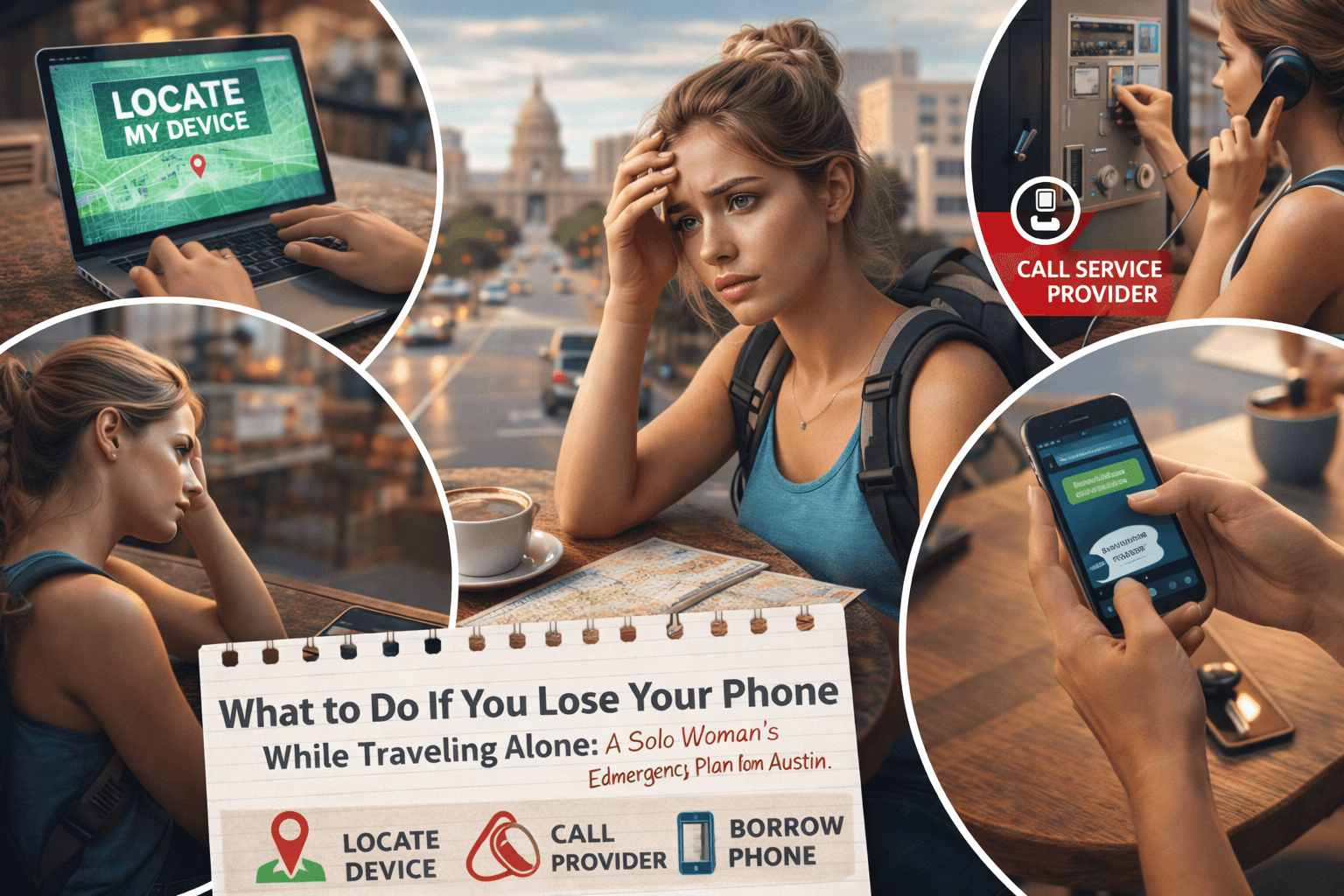
Losing your phone while traveling alone can feel like the ground suddenly shifting under your feet. For many solo women leaving Austin for a weekend trip, a phone is more than a device — it’s your map, your ticket wallet, your contact list, and your sense of connection to home. I’ve seen how quickly panic can rise in that moment, not because the situation is unsolvable, but because it feels like you’ve lost your main safety anchor.
This guide gives you a calm, step-by-step emergency plan designed specifically for solo female travelers. You’ll learn what to prioritize in the first minutes after realizing your phone is gone, how to protect your safety and accounts, how to contact help without your device, and how to continue your trip with steady confidence. The goal is simple: clear actions that restore control so a lost phone becomes a manageable interruption, not a ruined weekend.
Table of Contents
ToggleThe First Realization: When You Notice Your Phone Is Missing
The moment you realize your phone is missing often comes with a sharp wave of panic. Your mind jumps ahead to worst-case scenarios: no maps, no contacts, no way to call for help. I’ve seen many solo women freeze in this moment, standing still and replaying the last hour in their head. The most important thing to understand is that your safety has not disappeared with your phone. You are still physically present, surrounded by people and places that can support you.
This first stage is about slowing your reaction enough to think clearly. A lost phone is a logistical problem before it is anything else. When you handle the first few minutes calmly, you prevent small mistakes that make recovery harder. Your goal is to confirm what actually happened and stabilize your emotions before taking action.
Slowing the Panic Response
Panic creates urgency that feels real but rarely helps. When your breathing speeds up, your brain narrows its focus and skips obvious steps. A short pause restores your ability to observe.
To slow the panic response:
-
Stop Walking And Stand In A Safe Spot away from crowds or traffic
-
Take Three Slow, Even Breaths and notice your surroundings
-
Place A Hand On Something Solid like a table or railing to ground yourself
-
Remind Yourself That Phones Are Replaceable and your safety comes first
-
Focus Only On The Next Small Step, not the entire problem
This reset takes less than a minute but changes how you approach everything that follows.
Confirming Whether It’s Lost or Temporarily Misplaced
Before assuming the worst, do a structured check. Many phones are misplaced rather than permanently lost. A systematic search prevents wasted motion.
A quick confirmation routine includes:
-
Checking All Pockets And Bags Slowly instead of rushing
-
Looking At The Last Place You Used Your Phone
-
Scanning Nearby Surfaces like tables or counters
-
Retracing Your Last Few Minutes Mentally
-
Asking Staff If A Phone Was Turned In
Treat this like a checklist, not a frantic search. Calm repetition is more effective than speed.
Protecting Your Emotional Balance First
Even if your phone is truly gone, your emotional state determines your next decisions. I’ve seen many solo travelers recover their footing quickly once they accept the situation instead of fighting it.
To protect your emotional balance:
-
Acknowledge That Losing A Phone Is Stressful But Fixable
-
Choose A Visible, Staffed Place To Sit while you think
-
Avoid Isolating Yourself In Quiet Corners
-
Tell Yourself You Have A Plan and will follow it step by step
-
Commit To Moving Slowly And Deliberately
Emotional steadiness is your strongest tool in the first phase.
Your Immediate Safety Priorities Without a Phone
Once you accept that your phone is not in your hand, your next priority is not recovery. It is safety. A missing phone can make you feel suddenly exposed, especially during a solo trip from Austin where you rely on your device for navigation and communication. I’ve seen many solo women rush into searching unfamiliar streets or retracing steps too quickly. What usually feels safest is pausing and strengthening your environment first.
Think of this stage as rebuilding your safety net using the physical world around you. You are surrounded by staffed spaces, public infrastructure, and people whose job is to support travelers. When you position yourself well, the absence of your phone becomes far less destabilizing.
Securing Your Physical Environment
Before you start solving the lost-phone problem, make sure you are physically comfortable and protected. Your environment influences how clearly you think.
To secure your environment:
-
Move Into A Well-Lit, Populated Area such as a café or lobby
-
Sit Where You Can See Entrances And Staff
-
Keep Your Bag And Belongings Close and organized
-
Avoid Standing In Busy Walkways where you feel rushed
-
Choose A Seat That Allows You To Pause Calmly
A stable environment reduces mental noise.
Staying in Visible, Staffed Spaces
Staffed spaces act as temporary anchors. They give you access to help, seating, and a sense of social protection. I’ve seen solo travelers regain composure almost immediately once they settle into a supportive environment.
Strong anchor locations include:
-
Hotel Lobbies With Active Front Desks
-
Busy Cafés Or Restaurants
-
Visitor Centers Or Tourist Offices
-
Libraries And Public Buildings
-
Retail Stores With Service Counters
These places normalize your presence while you plan.
Using Nearby People and Businesses for Support
Losing your phone does not mean you are alone. Most businesses are accustomed to helping travelers with small emergencies. Asking for assistance is practical, not dramatic.
Supportive actions include:
-
Explaining Calmly That You Lost Your Phone
-
Asking To Use A Store Phone Briefly
-
Requesting Directions Or Written Information
-
Inquiring About Lost-And-Found Services
-
Letting Someone Know You Need A Few Minutes
Clear, simple requests invite cooperation.
Step-by-Step Plan to Recover or Secure Your Phone
Once your environment is stable, you can shift from emotional response to practical recovery. This stage is about methodical action, not speed. I’ve seen many solo women exhaust themselves by searching randomly or retracing too many places at once. What works best is a structured plan that narrows possibilities step by step.
Your goal is twofold: try to recover the phone if it’s nearby, and secure your information in case it’s gone for good. These actions can happen in parallel. Even if recovery fails, you will already be protecting your accounts and preparing for the rest of your trip.
Retracing Your Last Known Locations
Start with your most recent confirmed memory of using your phone. Work backward in a tight, logical radius rather than expanding outward too quickly.
A focused retracing plan includes:
-
Returning To The Last Place You Clearly Remember Using It
-
Checking Seating Areas, Counters, And Restrooms Carefully
-
Asking Staff If A Phone Was Turned In
-
Describing The Phone Clearly And Calmly
-
Limiting Your Search Radius At First to avoid disorientation
Short, deliberate loops are more effective than long wandering searches.
Using Borrowed Phones or Public Devices
If your phone isn’t immediately found, your next step is accessing digital tools through another device. Most businesses are willing to help when you explain calmly.
Ways to access backup devices include:
-
Borrowing A Staff Phone To Call Yourself
-
Using A Library Or Hotel Computer
-
Logging Into Your Email On A Public Terminal
-
Asking A Trusted Stranger To Dial Your Phone
-
Contacting Someone You Trust For Assistance
These actions reconnect you to your digital safety net.
Accessing Cloud Accounts and Tracking Tools
Modern phones include tracking and remote security features. Accessing these tools quickly helps you determine whether recovery is possible.
Important tracking actions include:
-
Logging Into Your Phone’s Cloud Tracking Service
-
Checking The Last Known Location On A Map
-
Triggering A Ring Or Alert If Nearby
-
Activating Lost Mode Or Device Lock
-
Preparing For Remote Erase If Necessary
Even partial information helps guide your next move.
How to Contact Someone You Trust Without Your Phone
One of the most unsettling parts of losing your phone is the sudden feeling of isolation. Your contact list, messages, and familiar communication tools disappear at once. I’ve seen many solo women assume they are cut off, when in reality there are still multiple ways to reconnect with people who support them. The key is slowing down and using the systems around you.
Contacting someone you trust is not just about logistics. It stabilizes your emotions and gives you a second set of eyes on your decisions. During a solo trip from Austin, that connection reminds you that you are supported even without your device.
Memorized Contacts and Backup Lists
Many travelers underestimate how helpful even partial memory can be. You may not remember every digit, but you often remember enough to trigger recognition.
Ways to use memorized information include:
-
Dialing Any Phone Numbers You Remember Fully Or Partially
-
Logging Into Email To Access Saved Contacts
-
Checking Social Media Messages For Familiar Names
-
Using Shared Family Accounts Or Cloud Contacts
-
Referring To Written Backup Contact Lists If You Carry One
Even imperfect memory can reconnect you quickly.
Asking Staff for Communication Help
Staff in public places are accustomed to helping travelers navigate small emergencies. Clear, calm requests usually receive practical support.
Helpful staff interactions include:
-
Explaining That You Need To Contact Someone Urgently
-
Asking To Use A Business Phone Briefly
-
Requesting Access To A Public Computer Or Tablet
-
Asking Staff To Help Look Up Contact Information
-
Thanking Them Clearly For Their Assistance
Most people respond positively to direct, respectful requests.
Using Email and Messaging From Shared Devices
Shared devices provide access to cloud-based communication even without your phone. Email often acts as a bridge to other accounts and services.
Effective shared-device strategies include:
-
Logging Into Your Email Account First
-
Sending A Clear Update To Trusted Contacts
-
Accessing Messaging Platforms Through Web Versions
-
Saving Important Information Temporarily On Paper
-
Logging Out Of All Accounts When Finished
Digital access restores much of your communication capacity.
Protecting Your Accounts and Personal Information
Once you’ve stabilized your environment and reconnected with someone you trust, your next priority is protecting your digital identity. A lost phone is not just a missing object. It is a container of personal information, financial access, and travel tools. I’ve seen many solo women delay this step because they are focused on recovery, but securing your accounts early reduces long-term stress.
Think of this stage as locking the doors to your digital house. Even if your phone is later recovered, acting quickly protects your privacy and finances. These steps are procedural, not technical. You don’t need advanced expertise — just calm sequencing.
Locking or Erasing the Device Remotely
Modern phones are designed with remote protection features that activate within minutes. These tools prevent unauthorized access and signal that the device is no longer available.
Important remote security actions include:
-
Activating Lost Mode Or Device Lock Immediately
-
Displaying A Contact Message On The Screen If Possible
-
Tracking The Phone’s Last Known Location
-
Triggering A Remote Ring Only If Nearby
-
Preparing For Remote Erase If Recovery Fails
Early locking protects sensitive information.
Securing Banking and Travel Apps
Your phone likely contains access to financial and travel services. Even if the device is locked, reinforcing account security adds another layer of protection.
Key account security steps include:
-
Logging Into Banking Apps From A Safe Device
-
Temporarily Locking Payment Cards If Available
-
Reviewing Recent Transactions Calmly
-
Contacting Banks If Anything Looks Unusual
-
Securing Travel Booking Accounts
These actions reduce financial risk.
Updating Passwords Calmly
Password changes should be deliberate rather than rushed. Focus first on the accounts connected directly to your phone.
Priority password updates include:
-
Email Accounts Linked To Your Phone
-
Cloud Storage And Device Accounts
-
Banking And Payment Platforms
-
Social Media Accounts
-
Travel And Booking Services
Work through accounts methodically instead of all at once.
Navigating the Rest of Your Day Without a Phone
Once the immediate security steps are complete, you still have a practical question in front of you: how to move through the rest of your day without the device you normally depend on. I’ve seen many solo women assume their plans must stop entirely, when in reality travel is still possible with small adjustments. A missing phone changes your tools, not your ability to navigate the world.
The goal for the rest of the day is simplicity. Instead of trying to maintain your original pace, you temporarily shift to slower, more structured movement. This reduces stress and helps you stay oriented while you work toward replacing or recovering your device.
Using Physical Maps and Written Directions
Paper information becomes surprisingly powerful when your phone is gone. Most staffed travel environments still maintain physical resources designed for visitors.
Helpful navigation habits include:
-
Requesting A Paper Map From Visitor Centers Or Hotels
-
Writing Down Key Addresses And Directions
-
Highlighting Your Accommodation On A Map
-
Carrying Written Transit Instructions
-
Keeping Important Locations In Your Wallet
Physical references reduce mental load.
Relying on Staffed Transportation Options
Transportation without a phone feels easier when you choose systems built around human interaction. Staffed services provide guidance and reassurance.
Supportive transportation choices include:
-
Using Taxi Stands Instead Of App-Based Rides
-
Asking Hotel Staff To Arrange Transportation
-
Using Public Transit With Information Counters
-
Traveling Between Well-Known Landmarks
-
Confirming Routes Verbally With Drivers
Human systems replace digital ones effectively.
Adjusting Your Itinerary for Safety
A phone-free day is not the time for complex exploration. Simplifying your schedule protects your energy and safety.
Smart itinerary adjustments include:
-
Staying Within Walkable, Central Areas
-
Choosing Activities Near Your Accommodation
-
Limiting Long Solo Detours
-
Returning Earlier In The Evening
-
Prioritizing Rest And Organization
Simplicity restores confidence quickly.
What to Do If the Phone Is Permanently Lost or Stolen
There is a point where you may need to accept that your phone is not coming back, at least not during this trip. That realization can feel heavy, especially when you’re traveling alone. I’ve seen many solo women interpret permanent loss as the end of their weekend, when in reality it’s a logistical reset. Once you shift from recovery mode to replacement mode, your path forward becomes clearer.
The goal at this stage is restoring essential access: identification, payments, communication, and navigation. You are rebuilding your toolkit in a practical, step-by-step way. Even without your original phone, you can recreate the core systems that support safe travel.
Filing Reports and Insurance Claims
Documentation protects you financially and creates a record of the loss. Even if the process feels administrative, it adds structure to the situation.
Important reporting steps include:
-
Filing A Lost Or Stolen Property Report If Appropriate
-
Contacting Your Phone Insurance Provider
-
Requesting Written Confirmation Of Reports
-
Saving Claim Numbers On Paper
-
Keeping Copies Of Any Receipts
Clear documentation simplifies replacement.
Replacing Essential Access Tools
Your next priority is restoring minimal communication and payment ability. You don’t need a perfect replacement immediately. You need a functional bridge.
Essential replacement actions include:
-
Purchasing A Temporary Phone If Necessary
-
Accessing SIM Or Carrier Support
-
Restoring Key Accounts On A New Device
-
Securing Payment Methods
-
Saving Emergency Contacts On Paper
Function matters more than perfection.
Resetting Your Travel Plan
A permanent phone loss may require adjusting expectations for the rest of your trip. Resetting your plan protects your energy.
Helpful reset strategies include:
-
Simplifying Your Itinerary
-
Focusing On Familiar, Staffed Areas
-
Scheduling Time To Reorganize
-
Communicating Updates To Contacts At Home
-
Prioritizing Rest Over Exploration
A reset is strategic, not a failure.
Emotional Recovery After Losing Your Phone
Even after you’ve handled the logistics, losing your phone can leave a lingering emotional ripple. A phone is not just a tool. It holds memories, routines, and a sense of connection. I’ve seen many solo women feel embarrassed, exposed, or unusually vulnerable after losing a device, especially while traveling alone. That emotional response is normal, and acknowledging it is part of recovery.
Emotional recovery is not about dismissing what happened. It’s about gently restoring your sense of capability. A lost phone is disruptive, but it does not erase your independence or your ability to navigate the world. When you intentionally steady your emotions, your confidence returns faster.
Managing the Sense of Vulnerability
Losing a phone can make the world feel briefly larger and less predictable. Grounding yourself in your immediate surroundings helps counter that feeling.
Helpful grounding actions include:
-
Sitting In A Calm, Populated Environment
-
Drinking Water Or A Warm Beverage Slowly
-
Noticing Familiar Sensory Details Around You
-
Talking To A Trusted Contact
-
Reminding Yourself That You Are Physically Safe
These small steps restore emotional balance.
Rebuilding Confidence Quickly
Confidence returns through action, not perfection. Each practical step you take reinforces your competence.
Ways to rebuild confidence include:
-
Acknowledging The Steps You’ve Already Handled Well
-
Completing One Small Task At A Time
-
Returning To A Familiar Activity
-
Choosing Simple Wins For The Rest Of The Day
-
Allowing Yourself To Move Slowly
Progress replaces doubt.
Turning the Incident Into a Learning Moment
Every travel disruption carries information you can use later. Viewing the incident as experience rather than failure changes its emotional weight.
Constructive reflections include:
-
Noticing What Systems Helped You Recover
-
Identifying Gaps You Can Prepare For Next Time
-
Recognizing Your Emotional Resilience
-
Writing Down Key Lessons
-
Letting Go Of Self-Blame
Learning converts stress into growth.
Preventive Habits That Reduce the Impact of Phone Loss
The easiest lost-phone emergency is the one that has already been softened by preparation. I’ve seen many solo women travel with far less stress simply because they assume that a phone could disappear at any time and build quiet backups into their system. These habits don’t require paranoia or heavy gear. They are small redundancies that protect your independence.
When your travel setup includes layers — digital, physical, and social — a lost phone becomes inconvenient rather than destabilizing. Prevention here is about resilience. You are designing your trip so that no single object carries all your access.
Backup Communication Plans
A phone concentrates your contacts into one place. Breaking that concentration creates flexibility.
Strong backup communication habits include:
-
Memorizing At Least One Emergency Phone Number
-
Carrying A Small Written Contact List
-
Saving Key Contacts In Email Drafts
-
Sharing Your Itinerary With Someone At Home
-
Agreeing On Check-In Expectations Before Departure
Redundant communication reduces isolation.
Cloud and Security Preparation
Digital backups protect your information even if the device disappears.
Helpful cloud preparation includes:
-
Enabling Automatic Cloud Backups
-
Turning On Device Tracking Features
-
Using Strong Lock Screens And Biometrics
-
Setting Up Remote Lock And Erase Tools
-
Testing Recovery Options Before Traveling
Preparation turns recovery into procedure.
Carrying Physical Redundancies
Physical backups replace digital dependence in small but meaningful ways.
Useful physical redundancies include:
-
A Paper Map Of Your Destination
-
Printed Accommodation Details
-
Written Transit Instructions
-
A Backup Credit Card Stored Separately
-
Emergency Information Cards
Paper tools quietly stabilize travel.
Creating a Personal Lost-Phone Safety Ritual Before Trips
The most confident solo travelers treat preparation as ritual rather than checklist. A personal lost-phone ritual is a repeatable routine you follow before every trip from Austin. It removes guesswork and signals readiness to your brain. I’ve seen many women describe a noticeable drop in travel anxiety once this ritual becomes habit.
A ritual is not about expecting loss. It is about normalizing preparedness so that if something does happen, your response feels familiar.
Mental Rehearsal Techniques
Mental rehearsal removes the shock of surprise. You calmly imagine your first few recovery steps so they feel ordinary.
Effective rehearsal habits include:
-
Visualizing Yourself Noticing The Missing Phone Calmly
-
Imagining Moving Into A Staffed Space
-
Rehearsing Asking For Help Clearly
-
Picture Accessing Backup Contacts
-
Ending The Scenario With Resolution
Familiarity builds calm.
Emergency Information Cards
Small physical cards act as anchors when digital tools vanish.
Helpful card information includes:
-
Emergency Contact Numbers
-
Accommodation Address
-
Medical Information If Relevant
-
Insurance Details
-
Important Email Addresses
These cards live in your wallet, not your phone.
Technology Setup
Technology preparation ensures your digital systems respond instantly.
Smart setup steps include:
-
Confirming Device Tracking Is Active
-
Testing Cloud Login From Another Device
-
Updating Password Recovery Options
-
Charging Backup Power Banks
-
Saving Important Files Offline
Prepared technology reduces friction.
Final Thoughts: Staying Capable Without Your Phone
Losing your phone while traveling alone can feel like losing your compass, but it does not erase your ability to navigate the world. I’ve seen many solo women come through this experience with a stronger sense of independence than they expected. What defines the moment is not the loss itself. It’s the calm structure you bring to your response.
This guide is built on one central principle: capability survives disruption. You secured your environment, protected your information, rebuilt communication, and adjusted your plans with intention. Those actions prove that your safety and confidence are not stored inside a device. They live in your decision-making.
Solo travel from Austin is ultimately about trusting yourself in unfamiliar situations. A lost phone is one chapter in that story, not the ending. Each time you respond with steadiness, you reinforce a deeper belief: you can handle what happens. And that belief is what keeps you exploring.
Related Posts
- Best Brunch Spots Near Austin for Solo Women Who Want a Calm, Comfortable Weekend Morning
- Photography Spots Near Austin for Solo Female Travelers
- Safest Weekend Getaways Near Austin for Solo Female Travelers
- Best Lakefront Stays Near Austin for Solo Women (Cabins + Resorts + Glamping)
- Car vs Bus vs Train for Solo Women Traveling from Austin
- How to Handle Loneliness During Solo Weekend Travel from Austin and Still Enjoy Your Time Alone
- Best Tiny House Stays Near Austin for Solo Female Weekend Trips (Privacy + Comfort)
- Best Glamping Near Austin for Solo Female Weekend Trips (Safe + Comfortable Picks)