
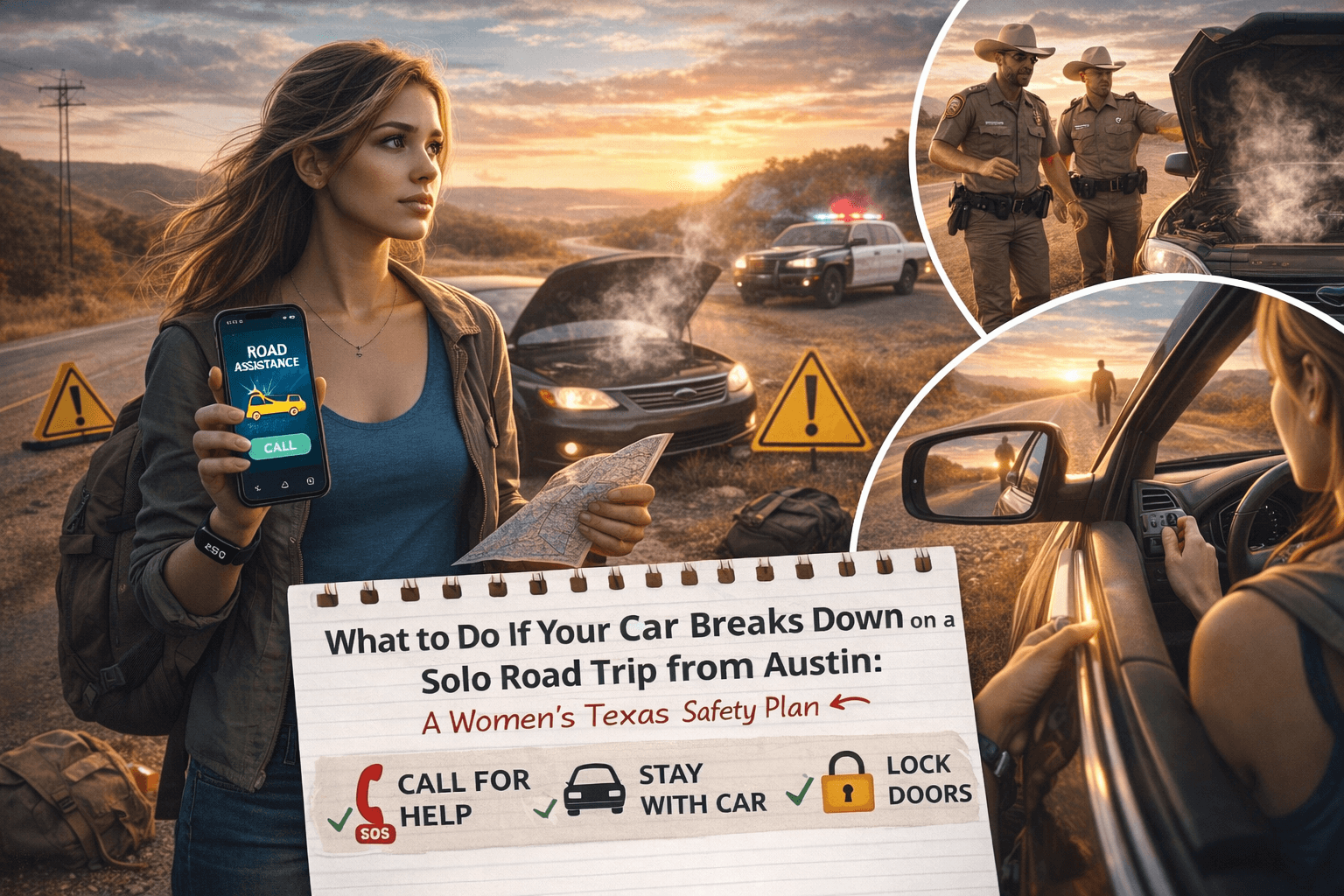
A car breakdown during a solo road trip from Austin can feel especially unsettling because it interrupts both your movement and your sense of independence at the same time. I’ve seen many solo women describe the first few minutes as the hardest part — not because the situation is unmanageable, but because uncertainty makes everything feel bigger than it is. With a calm plan, a breakdown becomes a logistical pause rather than a crisis.
This guide walks you through a practical Texas-focused safety plan designed specifically for solo female drivers. You’ll learn exactly what to do in the first moments after your car stops, how to position yourself safely on different types of roads, what to say when calling for help, and how to stay steady while you wait. The goal is simple: clear steps that help you protect your safety, preserve your confidence, and continue your trip feeling capable.
Table of Contents
ToggleStaying Calm in the First Moments After a Breakdown
The first moments after your car breaks down often feel louder and more chaotic than they actually are. Traffic noise, dashboard warnings, and the sudden loss of momentum can trigger a spike of adrenaline. I’ve seen many solo women interpret that adrenaline as proof that the situation is dangerous, when in reality it is your body preparing you to act. The most important step is slowing your reaction just enough to think clearly.
On Texas roads near Austin, breakdowns are usually logistical problems, not emergencies. Other drivers continue moving, roadside services operate routinely, and help is available. Your task in these first moments is not to solve everything at once. It is to stabilize your environment and your breathing so you can move through a simple sequence of actions.
Why Panic Makes Roadside Situations Harder
Panic narrows your focus and speeds up your decisions in ways that can work against you. When your mind races, it becomes harder to notice safe shoulder space, traffic patterns, or nearby landmarks. I’ve watched many experienced solo drivers regain control simply by pausing for a few seconds before moving.
Panic tends to create these challenges:
-
Rushed Decisions About Where To Stop instead of choosing the safest shoulder
-
Forgetting Simple Safety Steps like hazard lights
-
Tunnel Vision That Hides Nearby Safe Options
-
Faster Breathing That Clouds Judgment
-
Difficulty Communicating Clearly When Calling For Help
Recognizing these effects helps you counter them deliberately.
The First 60 Seconds That Matter Most
The first minute after your vehicle loses power or shows serious warning signs sets the tone for everything that follows. Your goal is to transition from motion to controlled positioning.
Key priorities during the first 60 seconds include:
-
Turning On Your Hazard Lights Immediately
-
Guiding Your Car Toward The Right Shoulder Smoothly
-
Avoiding Sudden Braking In Traffic
-
Scanning For Wide, Stable Stopping Areas
-
Keeping Both Hands Steady On The Wheel
These actions protect both you and surrounding drivers.
Grounding Yourself Before Taking Action
Once your car is safely stopped, give yourself a brief grounding pause. This is not wasted time. It resets your nervous system and prevents reactive decisions.
A quick grounding reset includes:
-
Taking Three Slow, Even Breaths
-
Noticing Your Surroundings Without Judgment
-
Reminding Yourself That Help Is Available
-
Checking Your Physical Safety First
-
Focusing On The Next Single Step Only
Grounding turns the breakdown from a shock into a manageable sequence.
Your Immediate Roadside Safety Plan (Step-by-Step)
Once your car is stopped and you’ve taken a breath, your next priority is creating a controlled roadside setup. I’ve seen many solo women feel pressure to fix the mechanical problem immediately, but your safety comes before diagnostics. Think of this stage as building a protective bubble around yourself and your vehicle.
Texas roads around Austin vary widely, from fast interstates to quieter rural stretches. A clear step-by-step plan removes guesswork and lets you act with confidence no matter where you are. Each step focuses on visibility, positioning, and communication — the three pillars of roadside safety.
Step 1: Move Your Car to the Safest Possible Spot
If your car still rolls or has limited power, use that momentum to improve your position. Even a few extra feet can make a meaningful difference in safety.
Safer positioning actions include:
-
Pulling As Far Onto The Shoulder As Possible
-
Choosing Flat, Stable Ground Over Slopes
-
Stopping Away From Curves Or Blind Hills
-
Avoiding Narrow Bridges Or Tight Shoulders
-
Aligning Your Wheels Straight to prevent rolling
A well-positioned car reduces risk from passing traffic.
Step 2: Increase Your Visibility to Other Drivers
Visibility protects you by giving other drivers more time to react. The goal is to make your presence unmistakable.
Ways to increase visibility include:
-
Keeping Hazard Lights On Continuously
-
Turning On Interior Dome Lights At Night
-
Using Reflective Warning Triangles If You Have Them
-
Raising Your Hood If It’s Safe To Do So
-
Wearing Bright Clothing If You Exit The Vehicle
These signals communicate clearly that your car is disabled.
Step 3: Secure Yourself Inside the Vehicle
In most roadside situations, your car is your safest shelter. Staying inside reduces exposure to traffic and environmental hazards.
Protective in-car habits include:
-
Locking All Doors Immediately
-
Keeping Your Seatbelt On If Traffic Is Close
-
Remaining Seated Rather Than Standing Outside
-
Cracking A Window Slightly Only If Needed
-
Keeping Your Phone And Essentials Within Reach
Your vehicle acts as a barrier between you and passing cars.
Step 4: Contact Help Clearly and Efficiently
Once you are positioned and secure, communication becomes your focus. Clear information speeds up assistance and reduces uncertainty.
Effective contact steps include:
-
Calling Roadside Assistance Or Emergency Services
-
Sharing Your Exact Location Using Map Pins
-
Describing Nearby Landmarks Or Mile Markers
-
Explaining The Vehicle Issue Briefly
-
Confirming Estimated Arrival Time
Clarity turns waiting into a predictable process.
Where Breakdowns Feel Most Different Across Texas
Not all breakdowns feel the same, and your environment shapes how you respond. Texas roads around Austin range from high-speed interstates to quiet rural stretches and dense urban streets. I’ve seen many solo women feel more anxious simply because the setting is unfamiliar, not because the situation is objectively more dangerous. Understanding how different environments behave helps you adjust your safety plan calmly.
Your goal is not to memorize dozens of rules. It’s to recognize the rhythm of the road you’re on and make small adjustments that support visibility and protection. Each setting carries its own advantages and challenges.
Highways and Interstates Near Austin
Highways feel intimidating because of speed. Traffic moves quickly, and the noise can amplify stress. But highways also offer wide shoulders and frequent patrols, which work in your favor.
Highway-specific safety priorities include:
-
Pulling As Far From Traffic As The Shoulder Allows
-
Staying Inside Your Vehicle With Doors Locked
-
Keeping Your Seatbelt On If Cars Are Passing Close
-
Avoiding Standing Outside Near Traffic
-
Using Mile Markers To Report Your Location
On highways, your car is your safest shelter.
Rural Roads and Small Town Routes
Rural roads feel quieter, which can trigger a different kind of unease. The main difference here is response time. Help may take longer to arrive, but traffic is usually lighter.
Rural safety adjustments include:
-
Choosing Visible Pull-Off Areas Over Hidden Spots
-
Staying In Well-Lit Zones If Possible
-
Sharing Your Location With A Trusted Contact
-
Conserving Phone Battery While Waiting
-
Watching For Local Businesses Or Homes Nearby
Visibility and communication matter most in rural areas.
Urban Areas and Parking Lots
Urban breakdowns often happen in traffic-heavy streets or parking areas. While traffic may be slower, congestion can add pressure.
Urban safety strategies include:
-
Moving Into Parking Lots If Your Car Can Roll
-
Avoiding Blocking Traffic Lanes
-
Positioning Near Building Entrances
-
Remaining Aware Of Pedestrian Flow
-
Seeking Staffed Buildings If You Exit The Car
Urban environments offer faster access to help and shelter.
What to Say When Calling for Help (Roadside Scripts)
Calling for help during a breakdown can feel more stressful than the breakdown itself, especially if you’re shaken or unsure what details matter. I’ve seen many solo women apologize excessively or over-explain when they call, which can blur the key information responders actually need. A simple script keeps your communication clear and efficient.
Roadside calls are not about storytelling. They are about delivering precise facts that help services find you and understand your situation quickly. When you know what to say ahead of time, your voice steadies and the call becomes procedural instead of emotional.
Scripts for Roadside Assistance Services
Roadside assistance operators are trained to work quickly, but they rely on the information you provide. A structured message speeds up dispatch and reduces follow-up confusion.
A clear roadside assistance script sounds like:
-
“My Car Has Broken Down And I’m Safely On The Shoulder.”
-
“I’m On [Road Name] Near Mile Marker [Number] Or [Landmark].”
-
“The Car Is A [Color, Make, Model].”
-
“I Am Alone And Inside The Vehicle.”
-
“The Issue Appears To Be [Brief Description].”
Delivering these points calmly gives operators everything they need.
Scripts for Calling a Trusted Contact
Calling someone you trust is as much about emotional grounding as logistics. Your goal is reassurance and backup awareness.
A supportive contact script includes:
-
“My Car Broke Down But I’m Safe On The Shoulder.”
-
“I’ve Called Roadside Assistance And They’re On The Way.”
-
“I’m At [Location]. I’ll Update You Soon.”
-
“Can You Stay On The Phone For A Minute?”
-
“I’ll Text When Help Arrives.”
This keeps loved ones informed without alarming them unnecessarily.
Scripts if a Stranger Stops to Help
If a stranger approaches your vehicle, communication should stay polite but bounded. You do not owe detailed explanations.
Safe stranger scripts include:
-
“Thank You, I’ve Already Called For Help.”
-
“I’m Waiting For Roadside Assistance.”
-
“I’m Okay Inside The Car.”
-
“Help Is On The Way.”
-
A Friendly Wave Through A Closed Window
These phrases acknowledge goodwill while maintaining your boundaries.
How to Interact Safely With Strangers Who Approach
When your car is stopped on the roadside, it’s common for strangers to slow down or approach to offer help. Most of these people are well-intentioned, especially on Texas roads where roadside courtesy is part of the culture. Still, I’ve seen many solo women feel torn between politeness and caution in this moment. You can honor both. The goal is respectful distance, not suspicion.
Your car is your protective space. Interactions should happen on your terms, with physical barriers intact. You are not required to accept assistance from anyone you did not call. A calm, consistent approach keeps the situation socially smooth while protecting your safety.
When to Accept Help and When to Decline
There are situations where accepting help may be practical, such as visible law enforcement or clearly marked roadside service vehicles. In most other cases, declining politely is the safest default.
Helpful decision guidelines include:
-
Accepting Assistance From Uniformed Officers Or Marked Service Vehicles
-
Declining Help From Unidentified Private Drivers
-
Trusting Your Comfort Level Over Social Pressure
-
Avoiding Accepting Rides From Strangers
-
Preferring Help You Requested Yourself
You are choosing predictability, not rejecting kindness.
Safe Communication Through a Closed Window
If someone approaches, communication should happen through a mostly closed window. This allows you to acknowledge them without compromising your barrier.
Safe interaction habits include:
-
Lowering The Window Only A Small Amount
-
Keeping Doors Locked At All Times
-
Speaking Calmly And Briefly
-
Repeating That Help Is Already On The Way
-
Avoiding Sharing Personal Details
Short, neutral exchanges end interactions quickly.
Positioning Yourself for Quick Exit if Needed
Even while seated inside your car, positioning matters. You want to remain aware of your surroundings and able to act if necessary.
Protective positioning includes:
-
Keeping Your Keys Easily Reachable
-
Sitting Upright And Alert
-
Watching Mirrors For Approaching Vehicles
-
Maintaining Clear Sightlines Around You
-
Preparing To Call For Help Immediately If Behavior Changes
Awareness supports calm control.
Using Your Phone as a Roadside Safety Tool
Your phone is your strongest connection to help during a breakdown, but it’s also a resource you need to manage carefully. I’ve seen many solo women drain their batteries quickly by stress-checking maps and messages, only to worry later about losing power while waiting. A calm, strategic approach turns your phone into a steady safety anchor rather than another source of anxiety.
During a roadside pause on Texas routes near Austin, your phone supports three priorities: communication, location accuracy, and battery preservation. When you treat it as a tool instead of a distraction, you widen your options and keep your mind focused.
Location Sharing and Emergency Features
Accurate location sharing shortens response time and reassures people who care about you. Modern phones make this process simple, but it works best when done intentionally.
Helpful location habits include:
-
Sharing Live Location With A Trusted Contact
-
Dropping A Map Pin And Saving It
-
Using Emergency SOS Features If Needed
-
Keeping Your Screen Brightness Moderate
-
Confirming Your Reported Location Matches Road Signs
These steps ensure help can find you quickly.
Battery Management During a Breakdown
Waiting for assistance can take longer than expected, especially on rural Texas roads. Conserving battery life protects your ability to communicate.
Smart battery habits include:
-
Switching To Low Power Mode Immediately
-
Closing Background Apps
-
Lowering Screen Brightness
-
Avoiding Unnecessary Browsing
-
Using A Backup Battery Pack If You Have One
Battery awareness reduces secondary stress.
Navigation and Landmark Awareness
Even after you’ve reported your location, staying aware of landmarks helps if you need to update responders. Texas highways often use mile markers and service signs that provide precise references.
Useful navigation awareness includes:
-
Watching For Mile Markers Or Exit Numbers
-
Noting Nearby Business Signs
-
Observing Directional Travel (Northbound/Southbound)
-
Checking Road Names On Your Map App
-
Updating Contacts If You Move Slightly
Clear landmarks make communication efficient.
What to Do if Help Is Delayed
Even with good planning, roadside assistance can sometimes take longer than expected, especially on rural Texas stretches or during busy travel weekends. Waiting is often the hardest emotional part of a breakdown. I’ve seen many solo women feel their anxiety rise not because the situation is worsening, but because uncertainty stretches time. A delayed response does not mean you are forgotten. It simply means you need a steady waiting strategy.
Your car remains your safest base while you wait. The goal during delays is to protect your comfort, manage environmental conditions, and keep your mind engaged in calm, practical ways. When waiting becomes structured instead of open-ended, it feels far more manageable.
Staying Comfortable and Alert in Your Car
Comfort and alertness can exist at the same time. You don’t need to sit rigidly on edge, but you do want to remain aware of your surroundings.
Helpful in-car waiting habits include:
-
Keeping Your Doors Locked At All Times
-
Adjusting Your Seat For Physical Comfort
-
Sipping Water If You Have It
-
Scanning Traffic Periodically Without Fixating
-
Keeping Your Phone Within Easy Reach
These small actions support both safety and calm.
Managing Heat, Cold, and Weather
Texas weather can change quickly, and environmental comfort is part of safety. Temperature management should be balanced with fuel conservation.
Weather management strategies include:
-
Running The Engine Briefly For Climate Control if fuel allows
-
Using Window Shades Or Clothing For Insulation
-
Avoiding Continuous Engine Idling In Extreme Heat
-
Watching For Signs Of Overheating Or Exhaust Issues
-
Staying Hydrated Whenever Possible
Your goal is steady, sustainable comfort.
Keeping Yourself Emotionally Steady
Long waits invite overthinking. Giving your mind gentle structure prevents spiraling.
Emotional steadiness techniques include:
-
Listening To Music Or A Podcast
-
Texting Updates To A Trusted Contact
-
Practicing Slow, Even Breathing
-
Reading Or Journaling If You Have Materials
-
Reminding Yourself That Help Is In Progress
Structure turns waiting into active recovery time.
Preventive Habits That Reduce Roadside Risk
The safest breakdown is the one that never happens, or at least happens under the most manageable conditions possible. I’ve seen many solo women dramatically reduce roadside stress simply by building a few preventive habits into their travel routine. These habits are not about mechanical expertise. They are about preparation that makes unexpected pauses easier to handle.
Preventive thinking turns your road trip from reactive to proactive. When your vehicle is checked, your route is intentional, and your supplies are organized, you carry a quiet margin of safety with you. That margin does not eliminate surprises, but it softens their impact.
Pre-Trip Vehicle Checks
A short vehicle check before leaving Austin can prevent many common breakdown triggers. You don’t need to be a mechanic. A few visible inspections go a long way.
Smart pre-trip checks include:
-
Checking Tire Pressure And Tread
-
Confirming Oil And Coolant Levels
-
Testing Headlights And Brake Lights
-
Ensuring Your Fuel Tank Is Sufficiently Filled
-
Listening For Unusual Engine Sounds
These checks catch simple issues early.
Route Planning Across Texas
Texas distances can be longer than they appear on a map. Intentional route planning reduces the chance of getting stranded in unsupported areas.
Helpful route habits include:
-
Reviewing Fuel Stops Along Your Route
-
Noting Towns And Service Areas In Advance
-
Avoiding Extremely Isolated Shortcuts
-
Downloading Offline Maps
-
Sharing Your Planned Route With Someone At Home
Prepared routes add predictability.
Packing a Solo Road Trip Safety Kit
A compact safety kit turns inconvenience into manageability. You don’t need excessive gear, just practical essentials.
A useful roadside kit includes:
-
Reflective Warning Triangles Or Flares
-
A Portable Phone Charger
-
Water And Non-Perishable Snacks
-
A Flashlight With Extra Batteries
-
Basic First Aid Supplies
These items support comfort and visibility.
Creating a Personal Roadside Safety Ritual Before Trips
The calmest roadside responses rarely come from improvisation. They come from preparation that feels familiar and repeatable. I’ve seen many solo women from Austin develop small pre-trip rituals that make breakdowns feel like manageable scenarios instead of frightening unknowns. A ritual is not a checklist you rush through. It’s a routine that signals to your brain that you are ready.
When you repeat the same preparation steps before every road trip, your confidence compounds. You don’t leave safety to memory or luck. You build it into your departure rhythm. That rhythm travels with you long after you leave your driveway.
Mental Rehearsal for Breakdowns
Mental rehearsal removes the shock factor from unexpected stops. You are not imagining disaster. You are calmly practicing your first few safety moves so they feel automatic.
Useful rehearsal habits include:
-
Visualizing Yourself Pulling Safely Onto The Shoulder
-
Practicing Turning On Hazard Lights Immediately
-
Rehearsing A Calm Call To Roadside Assistance
-
Imagining Sitting Securely Inside Your Car
-
Picture Help Arriving Smoothly
These short rehearsals build familiarity.
Communication Plans With Home
A clear communication plan reduces emotional isolation. When people at home understand your travel rhythm, you carry a quiet support system with you.
Healthy communication planning includes:
-
Sharing Your General Route And Destination
-
Agreeing On Check-In Points During Long Drives
-
Saving Emergency Contacts In Speed Dial
-
Discussing What To Do If You Call From The Roadside
-
Keeping Expectations Calm And Practical
This framework adds reassurance without pressure.
Technology Preparation
Technology works best when it’s configured before you start driving. Small setup steps prevent friction during stressful moments.
Smart preparation steps include:
-
Testing Emergency SOS Features On Your Phone
-
Updating Navigation And Roadside Apps
-
Charging Backup Battery Packs Fully
-
Saving Roadside Assistance Numbers
-
Setting Up Quick Location Sharing
Prepared technology responds instantly when needed.
Final Thoughts: Turning a Breakdown Into a Manageable Pause
A car breakdown during a solo road trip can feel like a sudden interruption of freedom, but it does not have to steal your confidence. I’ve seen many solo women come through roadside pauses with a stronger sense of capability than they had before. What defines the experience is not that your car stopped. It’s how you responded when it did.
Everything in this guide returns to one core principle: calm structure creates safety. You positioned your car thoughtfully, protected yourself inside it, communicated clearly, and managed your waiting time with intention. Those actions transform a breakdown from a crisis into a pause. A pause is something you can handle.
Solo road trips across Texas are meant to feel expansive and empowering. A temporary mechanical issue is just one moment in a much larger journey. Each time you navigate an unexpected stop with steadiness, you reinforce trust in your judgment. That trust is what allows you to keep exploring with confidence.
Related Posts
- Best Time of Year for Solo Female Weekend Trips from Austin (Comfort, Confidence & Ease)
- Luxury Solo Female Weekend Getaways from Austin (Calm, Indulgent, and Effortlessly Safe)
- Holiday Weekend Planning for Solo Women Travelers From Austin
- Small Towns Near Austin That Feel Comfortable for Solo Female Travelers
- Winter Weekend Trips from Austin for Women Traveling Alone Who Want Quiet, Cozy Escapes
- Is It Safe to Travel Alone Near Austin? Honest Answers for Women
- Quiet Cabins & Nature Stays Near Austin for Solo Women (Calm, Comfort-First)
- How to Plan a Safe Solo Female Weekend Trip from Austin