
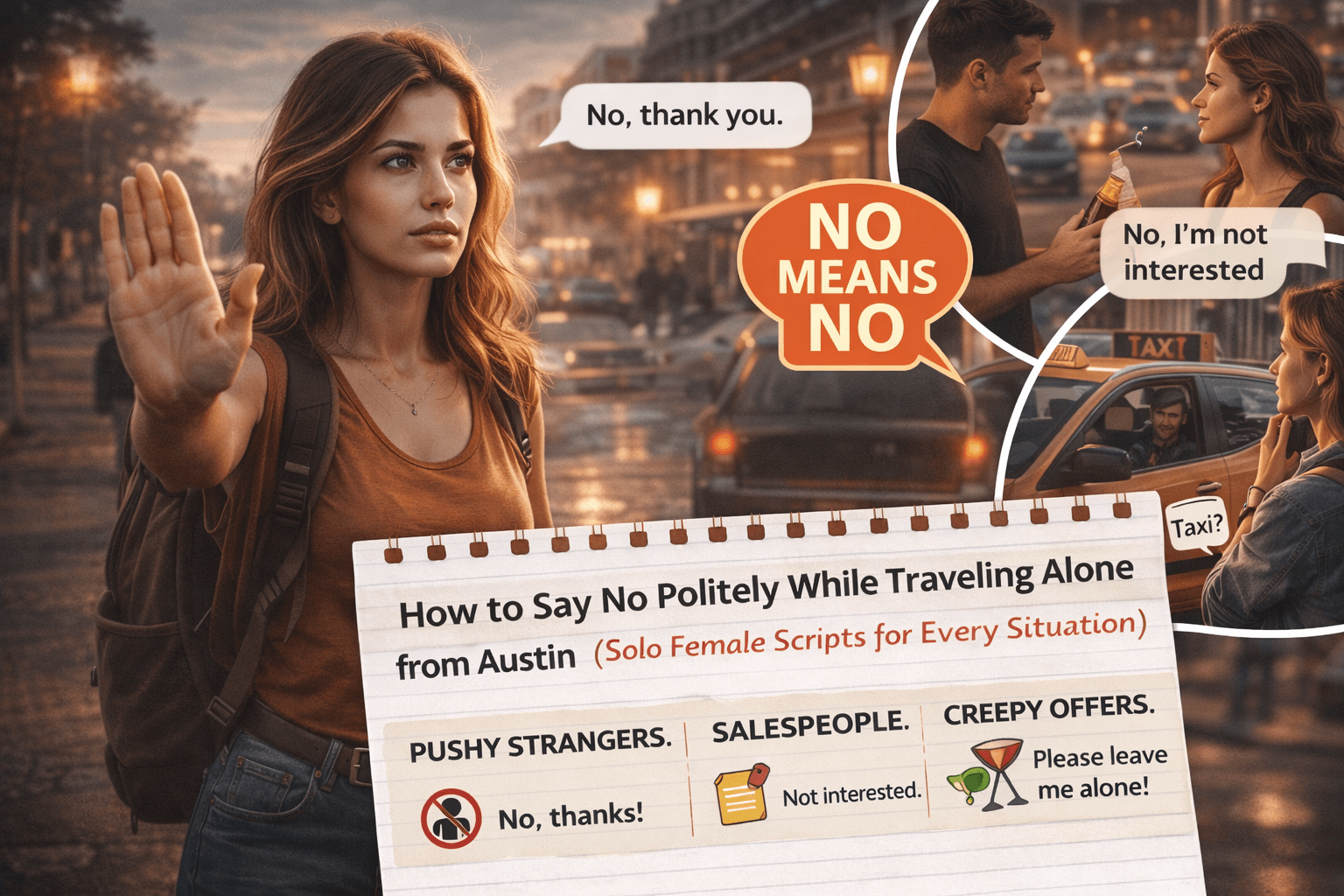
Saying no can feel unexpectedly difficult when you’re traveling alone, especially in a new place where you want to stay polite and open. Many solo women from Austin tell me they worry about seeming rude, overreacting, or misjudging a situation. In unfamiliar environments, even small boundary decisions can feel heavier because you don’t have your usual social reference points. That pressure can make it tempting to agree to things you’re unsure about just to keep the interaction smooth.
This guide is a calm, practical framework for saying no politely while traveling alone, without losing your sense of warmth or confidence. We’ll explore why boundaries feel harder on the road, the mindset shifts that make refusal easier, and simple scripts you can use in real situations. By the end, you’ll have steady language and strategies that help you protect your comfort while still moving through your trip with ease.
Table of Contents
ToggleWhy Saying No Feels Harder When You’re Traveling Alone
When you’re traveling solo, every interaction carries a little more emotional weight. At home in Austin, you move through familiar social patterns and shared expectations. On the road, those patterns disappear. I’ve seen many solo women feel a quiet pressure to compensate by being extra polite, extra agreeable, or extra accommodating. Saying no in that context can feel like breaking an unspoken rule.
What makes this challenging is that your brain is balancing two priorities at once: maintaining social harmony and protecting your comfort. When you’re alone, the responsibility for both sits squarely with you. Understanding why this tension exists helps you approach boundaries with more compassion for yourself instead of frustration.
The Pressure to Be Polite in Unfamiliar Places
Travel often activates a desire to be a “good guest” in a new environment. You may feel responsible for representing yourself well, especially as a solo woman navigating unfamiliar spaces.
This pressure can show up as:
-
Wanting To Avoid Any Interaction That Feels Confrontational
-
Smiling Or Agreeing Automatically Before You Think
-
Feeling Responsible For Other People’s Comfort
-
Hesitating To Interrupt Or Disengage From Conversations
Politeness is valuable, but when it overrides your instincts, it becomes a burden. Recognizing this tendency is the first step toward balancing courtesy with self-respect.
Fear of Appearing Rude or Unfriendly
Many women are socialized to prioritize likability. While traveling alone, that conditioning can intensify because you lack the buffer of companions. I’ve seen solo travelers worry that a firm no will label them as unfriendly or difficult.
This fear often includes:
-
Imagining Negative Judgments From Strangers
-
Equating Boundary-Setting With Personal Rejection
-
Overestimating The Social Consequences Of Refusal
-
Feeling Guilty For Protecting Your Own Time Or Space
In reality, most brief travel interactions are transactional and quickly forgotten. Your refusal rarely carries the emotional significance your anxiety predicts.
How Solo Travel Amplifies Boundary Anxiety
Being alone heightens awareness of vulnerability. Even neutral interactions can feel loaded because you are solely responsible for navigating them. This heightened vigilance can make every no feel like a high-stakes decision.
Boundary anxiety tends to increase when:
-
You Are In A Physically Unfamiliar Environment
-
You Feel Observed Or Outnumbered
-
You Are Managing Fatigue Or Sensory Overload
-
You Lack Immediate Social Support
These factors don’t mean you are incapable. They simply explain why saying no can feel heavier on the road. When you understand the amplification effect, you can respond with steadier intention instead of self-criticism.
Recognizing why refusal feels difficult reframes the challenge. You are not failing at politeness. You are learning to balance kindness with clarity in a context that temporarily raises the emotional stakes.
Reframing “No” as a Safety and Self-Respect Skill
Many solo women carry an invisible rule that says being nice should come before being clear. When you travel alone, that rule can quietly work against you. I’ve seen many women agree to conversations, invitations, or small requests they didn’t want simply to avoid discomfort. The turning point comes when you start seeing “no” as a skill that protects your energy, not a social failure.
Saying no politely is not about pushing people away. It’s about managing access to your time, attention, and space. When you reframe refusal as a form of self-respect, the emotional charge around it softens. You stop seeing boundaries as walls and start seeing them as filters that let you move through your trip more calmly.
The Difference Between Kindness and Compliance
Kindness is about treating people with respect. Compliance is about abandoning your preferences to avoid friction. These two are often confused, especially by women who value harmony.
The distinction becomes clearer when you notice:
-
Kindness Allows You To Speak Clearly Without Apology
-
Compliance Prioritizes Other People’s Comfort Over Your Own
-
Kindness Can Include A Calm Refusal
-
Compliance Often Leads To Quiet Resentment
You can be warm and respectful while still declining. The tone matters more than the agreement.
Why Clear Boundaries Create Calm Confidence
Boundaries reduce internal negotiation. When you know you are allowed to say no, your nervous system relaxes. I’ve seen many solo travelers feel visibly steadier once they give themselves permission to refuse without overthinking.
Clear boundaries support confidence by:
-
Reducing Mental Debate During Interactions
-
Preventing Situations That Drain Your Energy
-
Reinforcing Trust In Your Own Judgment
-
Creating A Sense Of Personal Stability
Each practiced refusal becomes evidence that you can protect your comfort without escalating conflict.
Letting Go of the Need to Over-Explain
One of the biggest traps in polite refusal is over-explaining. Long justifications often come from anxiety rather than necessity. In most travel interactions, a short, neutral no is enough.
You can ease out of over-explaining by remembering:
-
You Do Not Owe Strangers Detailed Reasons
-
Simple Responses Are Socially Acceptable
-
Extra Words Often Invite More Negotiation
-
Calm Brevity Signals Confidence
A concise no is not cold. It is clear. Clarity tends to end interactions more smoothly than elaborate excuses.
When you reframe refusal as a practical skill instead of a personal flaw, saying no becomes lighter. You are not rejecting people. You are choosing how to engage with the world around you.
Core Principles for Saying No Calmly and Politely
When you’re in a real interaction, you don’t have time to analyze philosophy. You need a few simple principles that guide your tone, words, and body language automatically. I’ve seen many solo women feel more confident once they realize polite refusal is not about finding the perfect sentence. It’s about delivering a clear message in a steady way.
These principles act like guardrails. They keep your response calm and contained, even if the other person is surprised or disappointed. When you rely on structure instead of improvisation, saying no becomes less emotionally draining.
Using Tone and Body Language to Support Your Words
Your tone and posture communicate as much as your sentence. A calm voice and grounded body reduce the chance of escalation. You don’t need to sound harsh. You need to sound settled.
Supportive nonverbal cues include:
-
Speaking In A Neutral, Even Tone
-
Keeping Your Volume Steady Instead Of Whispering
-
Standing Or Sitting Upright Without Leaning Away Excessively
-
Making Brief Eye Contact Before Looking Away Naturally
These signals show confidence without aggression. Your body tells the story before your words finish it.
Keeping Responses Short and Neutral
Long explanations often create openings for negotiation. A short, neutral sentence closes the loop politely. I’ve seen many solo travelers feel relief when they realize brevity is socially acceptable.
Effective short refusals often look like:
-
A Simple No Thank You
-
I’m Not Interested, But I Appreciate It
-
That Won’t Work For Me
-
I’m Going To Pass
Each phrase is complete on its own. You don’t need to decorate it.
Repeating Yourself Without Escalation
Some people will test your boundary by asking again. This is where many women feel pressured to soften or change their answer. Repetition is a skill. You can restate your no calmly without raising your intensity.
Calm repetition works when you:
-
Use The Same Sentence Or A Slight Variation
-
Keep Your Tone Consistent
-
Avoid Adding New Justifications
-
Pause Instead Of Filling Silence
This steady repetition signals that your decision is final without turning the interaction into a confrontation.
When you internalize these principles, saying no stops feeling like a performance. It becomes a predictable sequence: steady tone, short words, calm repetition. That predictability frees your energy for enjoying the trip instead of managing every interaction.
Scripts for Declining Conversations with Strangers
Casual conversations with strangers are a normal part of travel, and many of them are pleasant. The difficulty arises when a conversation continues longer than you want or starts to feel intrusive. I’ve seen many solo women stay engaged far past their comfort level because they don’t know how to exit gracefully. Having prepared scripts removes that hesitation. You’re not inventing language under pressure; you’re selecting from phrases you’ve already practiced.
The goal of these scripts is not to shut people down harshly. It’s to close the interaction cleanly while preserving a polite tone. A clear ending is often kinder than lingering awkwardly.
Ending Casual Small Talk
Sometimes a conversation is friendly but simply longer than you want. In these moments, a soft closing signal is enough.
Helpful small-talk exit scripts include:
-
It Was Nice Talking With You, I’m Going To Get Back To My Plans
-
I’m Going To Continue Exploring, But Enjoy Your Day
-
I Should Head Out Now, Take Care
-
I’m Going To Move Along, But It Was Good To Chat
Each phrase acknowledges the interaction and then redirects your movement.
Responding to Persistent Questions
If someone continues asking personal or probing questions, you can narrow your responses and gently shut down the line of inquiry.
Useful boundary scripts for questions include:
-
I Prefer To Keep That Private
-
I’m Not Comfortable Sharing That
-
I’d Rather Not Get Into That
-
I’m Keeping My Plans Flexible Today
These phrases are neutral and complete. They don’t invite further explanation.
Exiting Interactions Gracefully
When you want to leave an interaction entirely, combining words with movement is effective. Your body helps carry the message.
Graceful exit scripts often involve:
-
I Need To Go Now, Have A Good Evening
-
I’m Heading Out, Take Care
-
Excuse Me, I’m Going To Continue On
-
I Have To Run, Enjoy The Rest Of Your Day
As you say the phrase, begin to step away. Movement reinforces closure without aggression.
Scripts for declining conversations work because they normalize endings. Conversations are allowed to conclude. You are not responsible for sustaining them indefinitely. Each clean exit strengthens your ability to manage social energy calmly.
Scripts for Refusing Invitations or Offers
Invitations and offers can feel flattering, especially when you’re traveling alone. Someone invites you to join them, offers to show you around, or insists on helping. Even when your instincts say no, the social pressure to accept can be strong. I’ve seen many solo women agree in the moment and then feel trapped by their own politeness. Prepared scripts make it easier to decline without hesitation.
The purpose of these scripts is to honor the gesture while protecting your boundary. You are acknowledging the offer without committing to it. A polite refusal is socially normal, and most people expect it as a possibility.
Declining Social Invitations
When someone invites you to join them for an activity or outing you don’t want, a warm but firm response closes the door without creating tension.
Effective invitation refusals include:
-
Thank You For The Invite, But I’m Going To Spend Some Time On My Own
-
I Appreciate It, But I Already Have Plans
-
That Sounds Nice, But I’m Going To Pass
-
I’m Keeping My Evening Quiet, But Thank You
These phrases signal appreciation while clearly declining.
Saying No to Help You Don’t Want
Sometimes people offer assistance you didn’t ask for. Even well-meaning help can feel intrusive. A simple refusal keeps the interaction respectful.
Helpful scripts for unwanted help include:
-
No Thank You, I’ve Got It
-
I’m All Set, But I Appreciate The Offer
-
Thank You, I Can Handle It
-
I’m Okay For Now, Thanks
Short responses reduce the chance of continued insistence.
Turning Down Sales Pressure
Travel environments often include vendors or promoters who are trained to persist. Polite firmness is especially important here.
Useful scripts for sales situations include:
-
No Thank You, I’m Not Interested
-
I’m Just Looking Today
-
I’m Going To Pass, Thanks
-
Not Today, But I Appreciate It
Repeating the same phrase calmly is usually more effective than inventing new excuses.
Refusing invitations and offers becomes easier when you see it as a normal social exchange. You are participating in the rhythm of offer and decline, not breaking it. Each practiced refusal reinforces your ability to choose engagement intentionally.
Scripts for Handling Uncomfortable or Pushy Behavior
Most travel interactions are neutral or pleasant, but occasionally you may encounter behavior that feels uncomfortable or persistent. These moments can trigger a freeze response, especially if you’re trying to stay polite while also protecting yourself. I’ve seen many solo women blame themselves afterward for not responding the way they wished they had. The truth is that discomfort narrows your thinking. Scripts exist to widen it again.
In situations that feel pushy, your priority shifts slightly. You are still being polite, but you are also being protective of your space. The tone becomes firmer, and your body language becomes more decisive. You are not escalating conflict. You are clarifying a boundary.
Escalating Your Firmness When Needed
If a gentle no is ignored, the next step is to increase clarity without increasing aggression. Firmness is about removing ambiguity, not raising your voice.
Escalation scripts include:
-
I Said No, Please Respect That
-
I’m Not Interested, Please Stop Asking
-
That’s Not Okay With Me
-
I Don’t Want To Continue This Conversation
These phrases are direct and complete. They communicate finality.
Creating Physical and Verbal Distance
Words are more effective when paired with movement. Distance reduces emotional pressure and signals the interaction is ending.
Helpful distancing actions include:
-
Stepping Back While Repeating Your Refusal
-
Turning Your Body Toward An Exit Or Public Area
-
Moving Closer To Other People Or Staff
-
Breaking Eye Contact And Continuing To Walk
These actions reinforce your boundary without confrontation.
Seeking Support from Nearby Staff
If someone continues to push after a firm refusal, involving others is appropriate. You are not overreacting by asking for help. Public spaces are shared environments.
Support-seeking scripts might be:
-
Excuse Me, This Person Is Making Me Uncomfortable
-
Can I Stand Here For A Moment
-
I Need Some Help With This Situation
-
Please Ask Them To Leave Me Alone
Staff are accustomed to managing disruptions. You are using available resources, not creating trouble.
Handling pushy behavior is not about winning an argument. It is about ending an interaction safely and cleanly. Prepared language reduces hesitation and restores your sense of control.
Practicing Boundaries Without Losing Warmth
Many solo women worry that setting boundaries will make them feel cold or closed off. In reality, warmth and assertiveness can exist in the same sentence. I’ve seen many travelers become more relaxed once they realize they don’t have to choose between being kind and being clear. Boundaries don’t erase your personality. They shape how your energy is shared.
Practicing boundaries is less about memorizing scripts and more about developing an internal posture. You are allowed to be friendly and firm at the same time. When those qualities coexist, your interactions feel natural instead of forced.
Balancing Friendliness and Assertiveness
Warmth comes from tone and demeanor, not from saying yes. You can decline while still sounding human and respectful.
A balanced boundary often includes:
-
A Calm Voice Paired With A Neutral Facial Expression
-
Brief Politeness Without Over-Smiling Or Apologizing
-
Clear Words Delivered At A Natural Pace
-
A Small Nod Or Thank You Before Ending The Exchange
These cues soften the edge of refusal without weakening it.
Recovering Emotionally After Saying No
Even when a refusal goes smoothly, you might feel a lingering ripple of guilt or self-doubt. This reaction is common, especially if you are used to prioritizing harmony. I’ve seen many solo women misinterpret this feeling as proof they were too harsh.
Emotional recovery becomes easier when you:
-
Remind Yourself That Boundaries Are Normal Social Behavior
-
Acknowledge The Discomfort Without Judging It
-
Focus On The Calm That Follows Clear Communication
-
Treat The Moment As Practice Rather Than Performance
The emotional echo fades quickly when you don’t feed it with criticism.
Building Boundary Confidence Over Time
Confidence with boundaries grows through repetition. Each successful refusal becomes a reference point your brain can return to. Over time, saying no feels less like a confrontation and more like a routine part of travel.
You strengthen confidence by:
-
Practicing Scripts In Low-Stakes Situations
-
Reflecting On Interactions That Went Well
-
Noticing How Rarely Refusals Lead To Conflict
-
Trusting That Discomfort Decreases With Experience
These small reinforcements accumulate into steady self-trust.
Final Thoughts: Saying No Is Part of Traveling Well
Saying no politely while traveling alone is not a defensive act. It is part of moving through the world with intention. I’ve seen many solo women discover that clear boundaries actually make travel feel lighter, not heavier. When you are not carrying the burden of unwanted interactions, your attention returns to exploration and enjoyment.
The scripts and principles in this guide are tools, not rigid rules. They exist to support you in moments when words feel hard to find. Each time you use them, you reinforce the idea that your comfort matters. That belief becomes the foundation of confident solo travel.
You are allowed to be warm. You are allowed to be clear. And you are allowed to say no.
Related Posts
- Best Road Trip Safety Kit for Solo Women from Austin for Calm Texas Weekends
- Ultimate Guide to Solo Female Weekend Trips from Austin
- Packing Checklist for Solo Female Weekend Trips from Austin
- Best Farm and Ranch Stays Near Austin for Solo Women Traveling Alone
- Nature & Quiet Weekend Escapes Near Austin for Women Traveling Alone
- Wimberley Solo Female Getaway Guide from Austin
- Holiday Weekend Planning for Solo Women Travelers From Austin
- How to Tell If a Weekend Trip Is Right for Solo Female Travel