
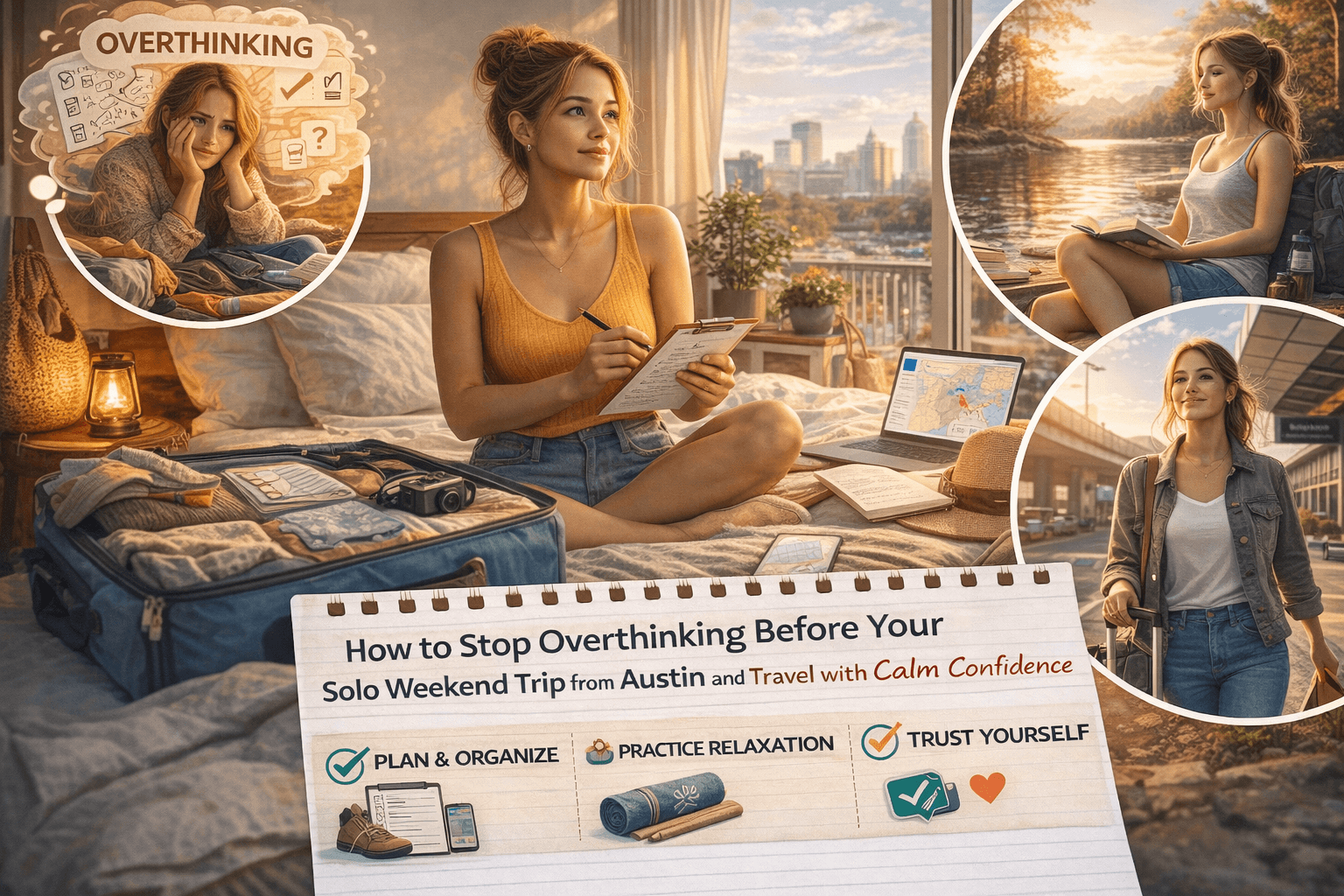
If overthinking has ever made you hesitate before a solo weekend trip from Austin, you’re not alone. I’ve seen many solo women feel excited about getting away and then suddenly flooded with questions right before booking or packing. Your mind starts trying to predict every possible outcome, not because you’re incapable, but because traveling alone matters to you. It represents independence, safety, and the quiet hope of enjoying your own company in a new place. That emotional weight can easily turn simple planning into mental noise.
This guide is a calm, practical confidence plan designed to help you step out of that spiral and move toward steady clarity. We’ll walk through why overthinking happens, what it’s really trying to do for you, and the specific mindset and planning tools that make solo weekend trips feel emotionally manageable. By the end, you’ll have a grounded framework you can return to before any Austin-area getaway, so your energy shifts from worry to quiet anticipation.
Table of Contents
ToggleWhy Overthinking Happens Before a Solo Weekend Trip
Overthinking before a solo weekend trip isn’t a flaw in your personality; it’s your brain trying to create certainty in a situation that feels emotionally important. When you’re planning to leave Austin alone for a couple of days, you’re stepping outside your normal routines and social safety nets. Even if the destination is only a few hours away, your mind treats the trip as a meaningful shift. I’ve seen many solo women interpret this mental noise as a sign they’re not ready, when in reality it’s a very human response to doing something brave and new.
What makes this stage tricky is that overthinking disguises itself as productivity. You might feel like you’re being responsible by researching endlessly or replaying scenarios in your head. But after a certain point, that mental looping stops helping and starts draining your confidence. Understanding the mechanics behind it helps you separate useful preparation from spiraling.
The Hidden Pressure of Traveling Alone as a Woman
Solo travel carries an invisible layer of pressure that many women don’t talk about openly. You’re not just planning logistics; you’re managing expectations about safety, enjoyment, and self-reliance. That combination can make a simple weekend trip feel like a performance you have to execute perfectly.
Several quiet pressures tend to feed overthinking:
-
The Desire To Prove To Yourself That You Can Handle Being Alone Comfortably
-
The Fear Of Making A Visible Mistake Without A Travel Companion To Buffer It
-
The Internalized Messages About How Women “Should” Travel Safely
-
The Hope That The Trip Will Feel Restful And Worth The Emotional Effort
When these pressures stack up, your brain starts scanning for problems to solve. It believes that if it can predict every issue in advance, it can protect you from discomfort. In small doses, that instinct is useful. In excess, it creates tension that makes the trip feel heavier than it needs to be.
How Austin-Based Weekend Trips Trigger Decision Fatigue
Weekend trips from Austin often come with an overwhelming number of choices. Within a few hours’ drive, you have hill country towns, quiet nature stays, boutique hotels, and spa retreats. Each option asks you to make decisions about distance, budget, pace, and atmosphere.
Decision fatigue builds when your brain keeps juggling questions like:
-
How Far Should I Drive So I Don’t Feel Exhausted On Arrival
-
Will This Destination Feel Calm Enough For Solo Evenings
-
Is The Stay Comfortable And Easy To Navigate Alone
-
Am I Choosing The “Best” Option Or Settling Too Quickly
The more you try to optimize every variable, the louder overthinking becomes. What usually feels best for solo weekends is not the perfect destination on paper, but a choice that feels emotionally simple and easy to commit to. Your brain relaxes when it senses clarity.
The Difference Between Healthy Planning and Mental Spiraling
Healthy planning has a steady, forward-moving quality. You research, make a decision, and feel a small sense of relief. Mental spiraling feels circular. You revisit the same questions without reaching closure, and each pass adds more doubt instead of reassurance.
A few signals help you tell the difference:
-
Healthy Planning Leads To Clear Decisions And A Sense Of Progress
-
Spiraling Reopens Settled Choices And Creates New Hypothetical Worries
-
Healthy Planning Focuses On What You Can Control
-
Spiraling Fixates On Rare Or Unlikely Scenarios
When you recognize spiraling early, you can gently redirect your energy back to practical steps. This shift is important because confidence doesn’t come from eliminating every unknown. It comes from trusting your ability to handle the weekend as it unfolds.
What Overthinking Is Really Trying to Protect You From
When your mind starts racing before a solo weekend trip, it’s not trying to sabotage you. It’s trying to protect something vulnerable. Overthinking is often a protective instinct that has drifted out of proportion. Instead of focusing on what might go right, your brain zooms in on what could feel uncomfortable or uncertain. I’ve seen many solo women feel frustrated with this reaction, but once you understand what your mind is guarding, it becomes easier to respond with patience instead of resistance.
At its core, overthinking is less about danger and more about emotional safety. Your brain wants reassurance that you won’t feel stranded, embarrassed, or overwhelmed in a new place. When you name those fears clearly, they lose some of their power and become practical things you can prepare for in a calm, measured way.
Fear of Discomfort vs Fear of Danger
One of the biggest sources of confusion is the way discomfort and danger blur together in your thoughts. Your brain often treats minor social or logistical discomfort as if it were a safety threat. For example, eating alone at a restaurant or navigating an unfamiliar check-in process can trigger the same stress response as more serious concerns.
Common discomfort fears that fuel overthinking include:
-
Worrying About Feeling Awkward In Solo Dining Or Public Spaces
-
Uncertainty About Navigating A New Hotel Or Town Layout
-
Fear Of Having Too Much Unstructured Time Alone
-
Concern That The Trip Won’t Feel As Enjoyable As Imagined
These are valid emotional concerns, but they are very different from actual danger. When you separate the two, you can address discomfort with gentle planning instead of letting it escalate into generalized anxiety. What usually feels best is creating small anchors of familiarity that make new environments feel manageable.
Social Expectations and Self-Doubt
Overthinking is also shaped by quiet social expectations about how travel is supposed to look. Many women grow up seeing trips framed as group experiences. Traveling alone can stir subtle questions about whether you’ll look out of place or be judged by others.
This layer of self-consciousness often sounds like:
-
Wondering If Others Will Notice Or Question Why You’re Alone
-
Doubting Whether You’ll Know How To Fill Your Time Meaningfully
-
Comparing Your Trip To Idealized Social Media Narratives
-
Questioning If You’re “Brave Enough” To Enjoy The Experience
These thoughts don’t mean you lack confidence. They reflect a natural adjustment to stepping outside familiar social scripts. The key is recognizing that most people around you are absorbed in their own experiences. Your solo presence is far less visible to others than it feels internally.
The Brain’s Need for Control Before Departure
In the days leading up to a trip, your brain craves a sense of control. Travel introduces variables you can’t fully predict, and that uncertainty can feel unsettling. Overthinking becomes an attempt to script the weekend in advance so nothing catches you off guard.
This control-seeking instinct often shows up as:
-
Rechecking Plans And Reservations Multiple Times
-
Mentally Rehearsing Arrival And Check-In Scenarios
-
Imagining Backup Plans For Minor Inconveniences
-
Overloading Your Itinerary To Avoid Idle Time
A small amount of preparation is stabilizing, but too much can crowd out the spontaneity that makes solo weekends restorative. Confidence grows when you allow space for flexibility. You don’t need a perfect script; you need a gentle structure that supports you if things shift.
When you understand that overthinking is your brain’s attempt to create emotional safety, you can respond with compassion instead of frustration. That mindset opens the door to practical tools that calm your thoughts and restore a steady sense of readiness.
A Simple Confidence Framework to Calm Your Mind Before You Go
When overthinking starts to feel loud, what helps most is a simple structure that brings your attention back to what you can actually influence. Confidence before a solo weekend trip doesn’t come from eliminating uncertainty. It comes from creating a small, steady framework that supports you emotionally and practically. I’ve seen many solo women relax almost immediately when their planning shifts from trying to perfect everything to focusing on a few grounding decisions.
This framework works because it reduces the size of the trip in your mind. Instead of seeing the weekend as one big unknown, you treat it as a series of manageable moments. Each small decision becomes a reassurance that you know how to take care of yourself.
Shrinking the Trip Into Manageable Decisions
Overthinking thrives on big, vague questions like “What if something goes wrong?” Confidence grows when you translate those into specific, solvable choices. Your brain settles when it sees clear steps instead of abstract worries.
A helpful way to shrink the trip is to focus on a few anchor decisions:
-
Choosing A Destination Within A Comfortable Driving Radius From Austin
-
Confirming One Or Two Activities That Gently Structure Your Days
-
Identifying A Reliable Place For Your First Meal After Arrival
-
Planning A Calm Evening Routine That Feels Familiar
These anchors don’t restrict your freedom. They create a soft framework that makes the weekend feel approachable. Once these pieces are in place, the rest of the trip can stay flexible without triggering as much mental noise.
Creating a Personal Safety and Comfort Baseline
Every solo traveler has a different threshold for what feels secure. Instead of copying generic advice, it helps to define your own baseline for comfort. This is less about preparing for worst-case scenarios and more about making sure your essentials are covered in a way that reassures you.
Your personal baseline might include:
-
Staying In Accommodations With Clear Reviews And Easy Check-In Processes
-
Sharing Your Basic Itinerary With A Trusted Person At Home
-
Keeping Transportation Plans Simple And Predictable
-
Packing A Few Familiar Comfort Items That Help You Relax
When these basics are handled, your nervous system receives a quiet signal that you are prepared. That signal reduces the urge to keep scanning for new worries.
Visualizing Your First Evening Away
The first evening of a solo trip often carries the most emotional weight. It’s the moment when the reality of being away settles in. Visualizing this part of the weekend ahead of time can dramatically soften overthinking.
Instead of imagining the entire trip, picture a gentle sequence:
-
Arriving And Settling Into Your Room Without Rushing
-
Taking A Short Walk To Orient Yourself To The Area
-
Enjoying A Simple Dinner In A Place That Feels Welcoming
-
Returning To Your Space For A Quiet, Restful Night
This mental rehearsal isn’t about scripting every detail. It’s about giving your brain a reassuring preview of calm, ordinary moments. I’ve seen many solo women feel their anxiety ease when they realize the trip is made up of familiar actions in a new setting, not a constant stream of high-stakes decisions.
When you use this framework, overthinking loses some of its intensity because your mind can see a clear path forward. You’re not trying to control the entire weekend. You’re simply creating enough structure to feel steady as you step into it.
Practical Planning Moves That Quiet Overthinking
Once your confidence framework is in place, the next step is translating it into concrete planning choices. Overthinking tends to fade when your plans feel simple, intentional, and aligned with how you actually like to travel. I’ve seen many solo women feel immediate relief when they stop chasing the “perfect” itinerary and start building a weekend that feels emotionally easy to live inside.
Practical planning is not about adding more tasks. It’s about making a few smart decisions that reduce friction. When your logistics support your comfort, your mind has less reason to keep spinning through worst-case scenarios.
Choosing Destinations That Feel Emotionally Easy
Not every beautiful destination is automatically a good fit for a solo weekend. Emotional ease matters more than novelty. Places that are straightforward to navigate and welcoming to solo travelers naturally quiet mental noise.
When evaluating destinations from Austin, it helps to prioritize:
-
Towns With Walkable Centers That Reduce Transportation Stress
-
Stays Located Close To Cafés And Quiet Evening Spots
-
Environments That Feel Calm Rather Than Overstimulating
-
Driving Distances That Leave You Energized On Arrival
What usually feels best is choosing a place where daily logistics are obvious and low-effort. When you’re not constantly figuring out how to get around, your attention shifts from problem-solving to enjoyment.
Structuring Your First Day for Stability
Your first day sets the emotional tone of the trip. A stable arrival rhythm reassures your brain that you are grounded and capable in the new environment. This doesn’t require a packed schedule; it requires gentle sequencing.
A steady first-day structure might include:
-
Arriving With Enough Daylight To Check In Without Rushing
-
Scheduling One Simple Activity That Encourages Exploration
-
Leaving Space For Rest Before Evening Plans
-
Choosing A Familiar Style Of Dinner Experience
This rhythm creates a sense of momentum without pressure. Instead of wondering what to do next, you move through a soft flow that supports your energy.
Packing for Calm Instead of Perfection
Packing often becomes a hotspot for overthinking because it feels like your last chance to control the unknown. The goal is not to anticipate every possibility. It’s to pack in a way that supports emotional comfort.
A calm-focused packing approach emphasizes:
-
Clothing That Feels Familiar And Easy To Wear
-
One Outfit That Makes You Feel Especially Confident
-
A Few Personal Comfort Items That Support Relaxation
-
Essentials Organized So They Are Easy To Access
When your belongings feel predictable and supportive, your environment feels more stable. You spend less mental energy managing small inconveniences and more energy enjoying your surroundings.
Practical planning quiets overthinking because it replaces vague worries with tangible preparation. Each thoughtful decision becomes a quiet vote of confidence in your ability to handle the weekend. Over time, those small votes add up to a steady sense of readiness.
How to Interrupt Overthinking Spirals in the Final 48 Hours
The last two days before a solo weekend trip are often when overthinking gets loudest. Your plans are mostly set, but your brain suddenly starts scanning for gaps. I’ve seen many solo women feel calm for weeks and then experience a spike of doubt right before departure. This timing is normal. As the trip becomes real, your nervous system tries one last time to create certainty.
The goal in this window is not to eliminate nerves. It’s to interrupt spirals before they build momentum. When you recognize overthinking as a temporary surge rather than a meaningful warning, you can respond with steady, practical resets that bring your mind back into balance.
Recognizing the Signs of Mental Looping
Overthinking has a distinct texture. It feels repetitive and urgent, even when the questions themselves are small. Learning to spot these patterns early helps you step out of them faster.
Common signs that you’re looping include:
-
Replaying The Same “What If” Questions Without New Information
-
Rechecking Reservations Or Maps More Than Necessary
-
Feeling A Sudden Urge To Change Previously Settled Plans
-
Interpreting Normal Nervousness As A Sign To Cancel
When you notice these signals, pause and name what’s happening. Simply recognizing, “This is my brain looping,” creates a small gap between you and the spiral. That gap is where you regain choice.
Grounding Techniques That Actually Work
Grounding techniques are effective because they pull your attention out of abstract future scenarios and back into your body and environment. The most helpful ones are simple and repeatable.
A few reliable grounding resets include:
-
Taking A Slow Walk While Noticing Specific Details Around You
-
Using Steady Breathing With A Longer Exhale Than Inhale
-
Naming Five Concrete Things You Can See Or Touch
-
Drinking Water Or Tea Slowly And With Full Attention
These actions send a quiet message to your nervous system that you are safe in the present moment. Overthinking softens when your body feels settled.
Reset Rituals Before Leaving Austin
Creating a small departure ritual gives your brain a sense of closure. It marks the transition from preparation to movement. I’ve seen many solo women benefit from repeating the same gentle routine before each trip.
A calming pre-departure ritual might involve:
-
Tidying Your Home So You Return To A Peaceful Space
-
Playing Familiar Music While Doing Final Packing
-
Sending A Simple Check-In Message To Someone You Trust
-
Taking A Few Quiet Minutes To Acknowledge Your Excitement
These rituals don’t remove uncertainty, but they anchor you emotionally. They remind you that travel is an extension of your everyday life, not a leap into chaos.
When you interrupt overthinking in these final hours, you protect your energy for the trip itself. Instead of arriving drained from mental rehearsal, you arrive steady and open to the experience ahead.
Building a Personal Pre-Trip Routine That Trains Confidence
Confidence before a solo weekend trip isn’t something you wait to feel. It’s something you train gently over time. A personal pre-trip routine gives your brain a familiar pathway to follow every time you leave Austin. I’ve seen many solo women become noticeably calmer after repeating the same small sequence before a few trips. The routine itself becomes a signal that says, I’ve done this before, and I know how to handle it.
What matters most is consistency, not complexity. A simple routine reduces decision load and replaces uncertainty with rhythm. When your brain recognizes the pattern, it stops treating each trip as a completely new challenge.
Repeatable Habits That Signal Safety to Your Brain
Certain habits act like emotional seatbelts. They don’t remove nerves entirely, but they keep them contained. When repeated before each trip, these habits build a quiet sense of familiarity.
Helpful repeatable habits include:
-
Reviewing Your Key Plans Once At A Set Time Instead Of Constantly Rechecking
-
Packing In The Same Order So Nothing Feels Rushed
-
Confirming Transportation And Arrival Details The Day Before
-
Setting Aside A Short Window For Calm, Uninterrupted Preparation
These habits create a predictable container around your departure. Your brain relaxes when it knows what to expect.
Small Wins That Stack Emotional Momentum
Confidence grows through accumulation, not sudden breakthroughs. Small, successful actions before a trip generate emotional momentum that carries into your weekend.
You can intentionally create these wins by:
-
Completing One Simple Task Early Instead Of Procrastinating
-
Making A Clear Final Decision And Letting It Stay Settled
-
Finishing Packing With Time To Spare
-
Acknowledging Each Step As Progress Rather Than Minimizing It
Each completed action reinforces a sense of capability. Overthinking weakens when you can point to tangible evidence that you are prepared.
Turning Weekend Trips Into Confidence Practice
Every solo weekend trip is also a rehearsal for the next one. When you treat travel as an evolving practice instead of a test, pressure decreases. You’re not trying to prove anything; you’re gathering experience.
This mindset shift becomes easier when you:
-
Reflect Briefly After Each Trip On What Felt Smooth
-
Notice Moments Where You Handled Uncertainty Well
-
Carry Forward One Lesson Into Your Next Planning Cycle
-
Allow Imperfections Without Treating Them As Failures
Over time, these reflections build a personal archive of success. Your brain starts referencing past competence instead of imagined risks.
A personal routine trains confidence because it replaces unpredictability with rhythm and evidence. Each trip strengthens the pathway your mind uses to interpret solo travel as familiar and manageable rather than threatening.
What Usually Happens After You Arrive (And Why It Matters)
Arrival is the moment many solo women quietly fear during the planning stage. Your mind imagines stepping into a new place and feeling exposed or disoriented. In reality, what usually happens after you arrive is far more ordinary and grounding. I’ve seen many solo women feel their anxiety drop within the first hour, simply because the trip shifts from imagination to lived experience. Your senses engage with real details, and the abstract worries lose their intensity.
Understanding this arrival pattern matters because it helps you trust the emotional arc of your weekend. The first few hours are not a test of bravery. They are a gentle transition from movement to presence. When you expect this shift, you move through it with more patience and less self-judgment.
The Emotional Shift of Arrival
The drive from Austin carries anticipation and tension. Once you park and step inside your accommodation, your nervous system begins recalibrating. The unfamiliar becomes tangible. You notice textures, sounds, and small comforts that anchor you.
During this phase, many women experience:
-
A Quick Drop In Mental Noise As The Environment Becomes Concrete
-
A Sense Of Relief After Completing The Hardest Step, Which Is Arriving
-
Mild Fatigue From Travel That Encourages Slower Pacing
-
Growing Curiosity About The Space And Surroundings
This shift is subtle but powerful. Your brain stops forecasting and starts observing. That change alone softens overthinking.
Settling Into Your Space Without Pressure
The way you spend your first hour in a new space sets the tone for the evening. There is no need to rush into activities or prove that you’re maximizing the trip. What usually feels best is allowing yourself to settle without expectation.
A gentle settling rhythm might look like:
-
Unpacking A Few Essentials So The Room Feels Lived In
-
Taking A Short Walk To Orient Yourself Without A Destination
-
Sitting Quietly With A Drink And Letting Your Body Rest
-
Noticing Small Comforts That Make The Space Feel Safe
These actions communicate stability to your nervous system. They transform the accommodation from a temporary stop into a personal base.
Letting the Weekend Unfold Naturally
One of the quiet lessons of solo travel is that enjoyment often comes from unstructured moments. After arrival, your weekend doesn’t need to perform. It unfolds through small choices and sensory experiences.
You may notice:
-
A Growing Ease In Being Alone In Public Spaces
-
Pleasure In Simple Activities Like Reading Or Exploring Slowly
-
A Shift From Self-Consciousness To Presence
-
An Expanding Sense Of Personal Autonomy
These experiences build confidence not through dramatic events but through repetition of calm independence. Each ordinary moment reinforces your ability to exist comfortably on your own terms.
Recognizing this pattern changes how you approach the trip before it even begins. Instead of fearing arrival, you start to see it as the doorway into steadiness. Your brain learns that the imagined intensity rarely matches reality.
Final Thoughts: Overthinking Is a Sign You Care, Not a Stop Sign
Overthinking before a solo weekend trip is not evidence that you are unprepared or unsuited for traveling alone. It’s a sign that the experience matters to you. I’ve seen many solo women reinterpret their nerves as a form of care rather than weakness. When you care about your safety, comfort, and enjoyment, your mind naturally tries to engage deeply with the decision.
The key is learning to guide that energy instead of fighting it. Each framework, routine, and planning choice in this guide is designed to convert overthinking into steady preparation. You don’t need to silence your thoughts completely. You only need to keep them proportionate to the reality of a short, manageable weekend away from Austin.
With repetition, your brain starts recognizing solo trips as familiar territory. The volume of overthinking lowers, and what remains is a healthy awareness that supports you instead of overwhelming you. Confidence doesn’t arrive all at once. It accumulates through small departures, calm arrivals, and the quiet realization that you can trust yourself in new places.
Related Posts
- Best Tours & Experiences Near Austin for Solo Female Travelers (Calm, Confidence-Building)
- Best Glamping Near Austin for Solo Female Weekend Trips (Safe + Comfortable Picks)
- Fredericksburg Solo Female Weekend Guide from Austin
- How to Track Your Weekend Trip Budget & Stay Organized
- Best Solo-Friendly Cafés and Quiet Places Near Austin for Women Who Need a Calm Recharge
- Best Lakefront Stays Near Austin for Solo Women (Cabins + Resorts + Glamping)
- Solo Dining Safety Tips & Recommended Restaurants for Weekend Trips Near Austin
- Texas Hill Country Weekend Trips from Austin for Solo Women