
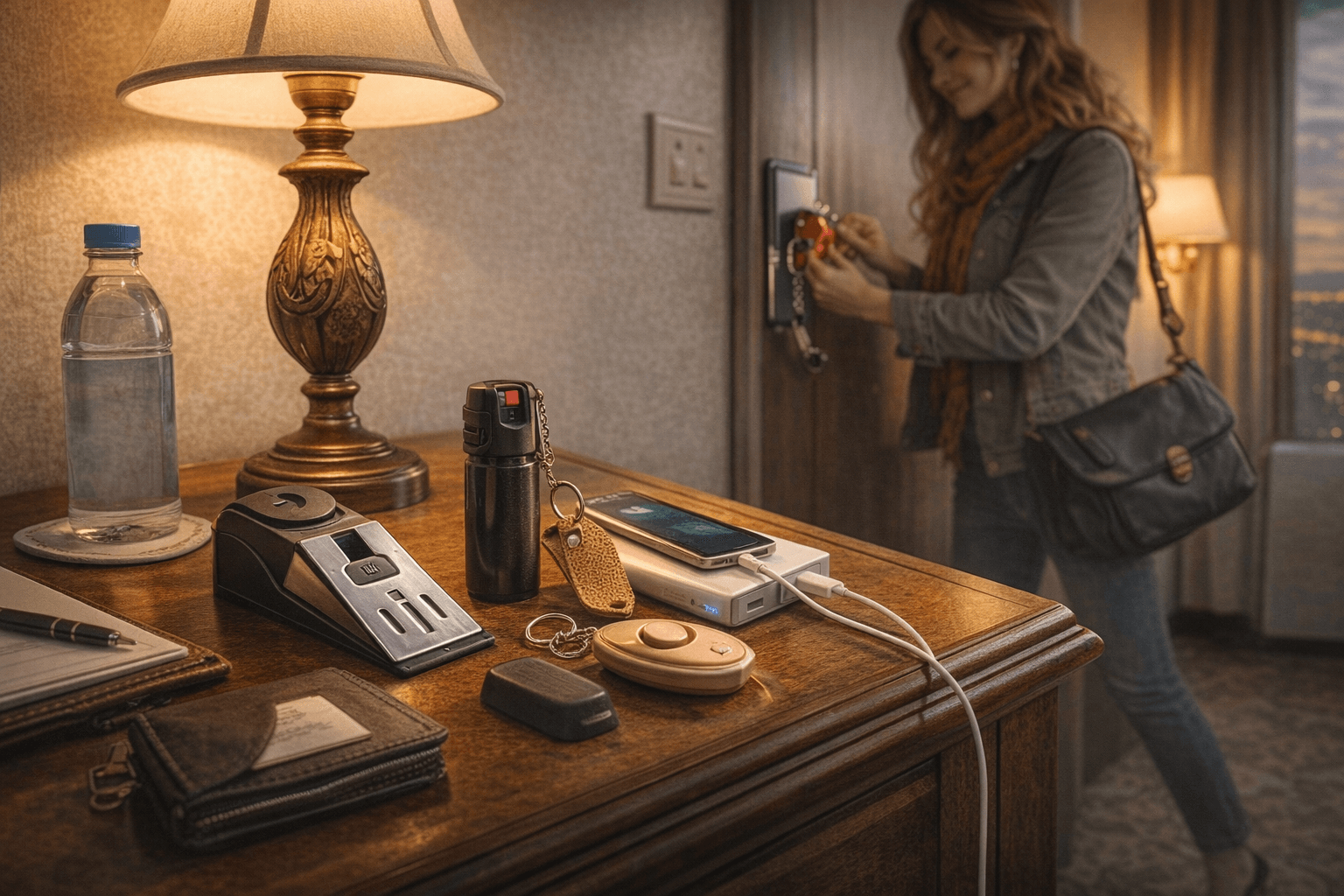
Traveling alone as a woman can be deeply empowering, but the first few minutes inside a hotel room often carry a quiet adjustment period. You’re in a new space, learning its layout, and settling into an unfamiliar rhythm. Many solo women tell me that a few small safety items help them relax faster, not because they expect danger, but because they create a sense of personal control. That early feeling of steadiness sets the tone for the entire stay.
This guide explores the most useful hotel safety items for solo female travelers, focusing on portable door locks, travel alarms, and compact lights that support calm confidence. We’ll look at how these tools actually fit into real travel routines, what to prioritize when packing, and how to use them in a way that feels natural rather than anxious. The goal is to help you walk into any hotel room and settle in with clarity, comfort, and peace of mind.
Table of Contents
ToggleWhy Thoughtful Hotel Safety Items Matter for Solo Female Travel
Walking into a hotel room alone for the first time can bring a brief moment of alertness. You scan the space, notice the door, the windows, and the general layout. That instinct is natural. It isn’t about fear. It’s about orienting yourself in a new environment. Thoughtful hotel safety items support that orientation process by giving you a few simple tools to establish personal boundaries and settle in faster.
I’ve seen many solo women relax noticeably once they complete a short arrival routine. When you add a portable lock, place a small light, or set a travel alarm, the room begins to feel less temporary and more like your own space. That shift matters. It allows your nervous system to settle so you can focus on rest, planning your next day, or simply enjoying quiet time.
The difference between preparedness and fear
Preparedness is calm and intentional. It’s about creating conditions where you feel steady, not about anticipating worst-case scenarios. A small safety item is similar to carrying a first-aid kit. You hope you never need it, but knowing it’s there removes a layer of uncertainty.
For solo female travelers, that preparedness often translates into better sleep and clearer thinking. When your environment feels controlled, your mind doesn’t circle around “what if” questions. Instead, it recognizes that you’ve taken reasonable steps to support your comfort. That recognition builds quiet confidence.
How small tools reduce mental load on the road
Travel already asks your brain to process new information constantly: directions, schedules, unfamiliar sounds, and social cues. Adding uncertainty about your room can increase that mental load. Small safety tools act like anchors. They standardize part of your environment, even when everything else changes.
A portable door lock or alarm becomes a familiar ritual. You install it the same way each time. That repetition creates predictability. Predictability reduces cognitive effort. Many experienced solo travelers rely on these routines because they conserve energy. When you’re not expending attention on background worries, you have more capacity to enjoy the trip.
Common hotel room scenarios where safety items help
Most hotel stays are uneventful, but certain everyday situations can feel smoother with simple tools in place. Safety items don’t change the nature of these moments. They just add a layer of reassurance.
-
Settling into a room late at night after a long travel day
-
Sleeping deeply in an unfamiliar building with hallway noise
-
Staying in older hotels with variable door hardware
-
Sharing accommodations such as guesthouses or rentals
In each case, the goal is not to escalate concern. It’s to support rest and relaxation. When your room feels secure and organized, it becomes a reliable base for your solo travels. That foundation allows you to wake up refreshed and ready to explore.
What to Consider Before Packing Hotel Safety Gear
Packing hotel safety items is less about assembling a toolkit and more about choosing a few pieces that genuinely support how you travel. Many solo women start with enthusiasm and quickly realize they don’t want to carry a pouch full of gadgets they rarely use. What usually feels best is a small, intentional selection that integrates smoothly into your routine.
Before adding anything to your bag, it helps to think about how often you’ll use the item and how naturally it fits into your arrival ritual. The most effective safety gear is the gear you actually deploy every time you enter a room. If something feels complicated or bulky, it tends to stay packed away, which limits its value.
Portability and ease of use
Portability is the first filter. Hotel safety items should be compact, lightweight, and durable enough to handle frequent packing. A device that takes up significant space or requires careful handling can create friction, especially on short weekend trips from Austin where you want to travel light.
Ease of use is equally important. After a long day of travel, you don’t want to decipher instructions or struggle with installation. The best tools operate intuitively. You should be able to set them up in seconds, even when you’re tired. This simplicity encourages consistency. When an item is quick to use, it becomes part of your automatic routine rather than an optional extra.
Hotel types and door hardware variability
Not all hotel doors are built the same. Some have modern electronic locks, others use older latch systems, and rental properties can vary widely. A versatile safety item adapts to different door styles without requiring modifications.
Before packing a portable lock or alarm, it helps to understand its compatibility range. Many solo travelers prefer gear designed to work with standard inward-opening doors because these are most common. Flexibility reduces surprises. When you know your safety item will function in most environments, you approach each new stay with steadier expectations.
Balancing comfort with functionality
Safety gear should support comfort, not compete with it. A hotel room is a temporary personal space where rest and relaxation matter. Items that are overly loud, intrusive, or visually cluttered can disrupt that atmosphere.
The best balance comes from tools that operate quietly in the background. A discreet door lock, a small alarm placed thoughtfully, or a soft bedside light can enhance your sense of control without turning the room into a technical setup. For many solo women, this balance is what transforms safety gear from a precaution into a comfort object. It reinforces the feeling that the space is yours, even if only for a night or two.
Portable Door Locks: Choosing the Right One for Your Trip
Many solo travelers describe a noticeable shift after using a portable lock for the first time. The door feels more solid. The room feels quieter. Even if the hotel already has good security, the extra step reinforces your arrival routine. It signals to your mind that you’ve completed your setup and can begin to relax.
Types of portable door locks and how they work
Most travel door locks fall into a few simple categories, and understanding them helps you choose what feels intuitive. The most common style is a small metal device that fits into the door latch and prevents it from opening inward. Products like Addalock Portable Door Lock are popular because they’re compact and require no tools.
There are also wedge-style locks that brace against the floor and door, creating resistance if someone tries to enter. These tend to be slightly bulkier but can add a different kind of reinforcement. For many solo women, latch-based locks feel more precise and easier to integrate into a quick arrival routine.
What usually matters most is simplicity. A lock that installs in seconds and removes just as quickly encourages consistent use. You don’t want to negotiate with your gear every time you enter or leave the room.
What solo women should look for in a door lock
When choosing a portable door lock, a few practical qualities make a significant difference in daily use. The device should feel sturdy without being heavy, and its mechanism should operate smoothly without forcing the door.
Key features that tend to support confidence include:
-
Compatibility with standard inward-opening hotel doors
-
A compact size that fits easily in a small pouch
-
Durable materials that resist bending or wear
-
A design that installs and removes quietly
Quiet operation is often overlooked, but it contributes to comfort. A lock that clicks into place smoothly reinforces the calm tone of your routine.
Installation tips for different door styles
Not every door will behave exactly the same, and a short moment of adjustment is normal. When you first enter a room, take a few seconds to examine the latch and hinges. Installing your portable lock slowly the first time helps you understand how it interacts with that specific door.
If a door feels tight, avoid forcing the device. A gentle repositioning usually solves the issue. Over time, this process becomes automatic. Many experienced solo travelers treat installation as part of a grounding ritual. You close the door, set the lock, and take a breath. That small sequence marks the transition from travel mode to rest.
When your portable door lock fits naturally into this rhythm, it becomes less about the object itself and more about the calm it creates. It’s a simple tool, but in the context of solo travel, it carries a reassuring weight.
Travel Alarms That Add Calm, Not Noise
Travel alarms can sound intimidating in theory, but in practice the best ones are quiet tools that exist mostly as reassurance. Their purpose isn’t to fill your trip with tension. It’s to create a gentle safety net that lets you rest more deeply in unfamiliar spaces. For many solo women, simply knowing an alarm is in place reduces background alertness and supports better sleep.
The key is choosing alarms that feel intuitive and proportionate to your needs. You’re not trying to build a fortress around a hotel room. You’re adding a small layer of awareness that integrates smoothly into your arrival routine. When an alarm feels easy to use and easy to ignore once set, it becomes a supportive presence rather than a source of stress.
Door and window alarms that deter unwelcome entry
Door and window alarms are designed to activate only if the entry point is disturbed. Many compact models attach with gentle adhesive or hang from the door handle, creating a simple trigger system. Devices like the SABRE HS-DSA Wedge Door Stop Alarm combine a physical door wedge with an alert function, adding both resistance and notification.
For solo travelers, the main benefit is deterrence. Even the presence of an alarm can discourage unwanted interference. In everyday use, these alarms sit quietly in the background. You install them once when you arrive and remove them when you leave. That consistency builds a predictable rhythm that supports calm.
Personal alarms for close-range alerts
Personal alarms are small handheld devices that emit a loud sound when activated. Models such as the She’s Birdie Personal Safety Alarm are often carried on a keychain or clipped inside a bag. While they’re not specific to hotel rooms, many solo women like having one within reach as an added layer of preparedness.
The value of a personal alarm lies in accessibility. It’s a tool you hope never to use, but its presence can increase confidence when moving through hallways or unfamiliar buildings. Because these devices are compact and lightweight, they fit easily into an existing packing system without adding clutter.
Choosing alarms that feel non-alarmist and intuitive
The emotional tone of your safety gear matters. An alarm that feels overly aggressive or complicated can heighten anxiety instead of easing it. What usually works best are devices with simple activation methods and clear feedback. You should understand exactly how they function without studying instructions each time.
Many experienced solo travelers favor alarms that integrate quietly into their environment. Neutral colors, compact shapes, and straightforward controls help the device blend into your routine. When an alarm feels like a natural extension of your habits rather than an emergency tool waiting to be triggered, it supports the calm mindset that makes solo travel restorative.
Portable Lights That Enhance Safety and Comfort4
Lighting is one of the most underestimated comfort tools in a hotel room. When you arrive somewhere new, your brain is mapping the space: where the bathroom is, how far the door is from the bed, what obstacles sit in the dark. A small portable light shortens that adjustment period. It gives you gentle orientation and reduces the disorientation that can come with waking up in an unfamiliar room.
For solo female travelers, portable lights are less about guarding against threats and more about creating a sense of spatial clarity. Soft, controlled light allows you to move confidently at night without turning on harsh overhead fixtures. That subtle control over your environment contributes to better rest and a calmer state of mind.
Doorway and motion-activated lights
Motion-activated lights are especially helpful near doorways or pathways to the bathroom. When placed thoughtfully, they create a soft visual guide that activates only when needed. Devices like the Vont Lyra LED Motion Sensor Night Light are compact and rechargeable, making them easy to position temporarily without altering the room.
What usually feels best is a light that emits a warm, low-intensity glow. Bright white light can feel jarring in the middle of the night. A softer tone preserves your sleep rhythm while still providing enough visibility to orient yourself. For many solo women, this gentle illumination transforms an unfamiliar room into a space that feels navigable and calm.
Compact bedside lights for orientation
A small bedside light serves as a personal anchor point. Whether it’s a clip-on lamp or a rechargeable puck light, having a dedicated light source within arm’s reach adds a layer of reassurance. You can quickly check the time, locate essentials, or adjust your environment without fumbling in darkness.
Compact options such as the Energizer Rechargeable LED Book Light are designed for portability and intuitive use. Their simplicity encourages consistent placement. When you arrive in a new room, setting your bedside light becomes part of your settling-in ritual. That repetition builds familiarity, even in changing environments.
Hands-free options for ease and calm
Hands-free lighting, such as small headlamps or wearable clip lights, can be surprisingly useful in travel contexts. They allow you to keep both hands free while organizing your bag or navigating tight spaces. The goal isn’t to flood the room with light, but to create focused illumination exactly where you need it.
Many solo travelers appreciate lightweight wearable lights like the Petzl Bindi Headlamp for their versatility. They tuck easily into a pouch and provide instant, controlled brightness. When used sparingly, these tools support efficiency without disrupting the quiet atmosphere of a hotel room.
Portable lights ultimately serve a simple purpose: they make unfamiliar spaces feel understandable. That understanding reduces hesitation and supports a steady sense of presence. When you can see clearly and move comfortably, your hotel room becomes a place of rest rather than uncertainty.
How to Use Safety Items Without Anxiety
Safety items work best when they feel like quiet rituals rather than defensive measures. The intention isn’t to heighten your alertness. It’s to create a short, repeatable sequence that signals to your mind that the space is settled and under your control. Many solo women find that when safety routines are calm and consistent, they actually reduce anxiety instead of feeding it.
The key is moderation. You’re not trying to layer every possible tool onto a single hotel stay. You’re selecting a few meaningful actions and performing them in the same gentle order each time. Over time, this sequence becomes grounding. It marks the transition from travel mode to rest.
Simple arrival routine for every hotel room
The first few minutes in a room set the emotional tone of your stay. A simple arrival routine helps you orient yourself without rushing. Close the door fully, engage the hotel lock, and install your portable lock or alarm in one smooth flow. Place your bag in a consistent spot and do a quick visual scan of the room.
This process doesn’t need to feel investigative. Think of it as familiarization. You’re learning the layout and establishing where your essentials will live. Many experienced solo travelers perform the same sequence in every room. The repetition builds a sense of continuity that carries from trip to trip.
Evening rituals that support peace of mind
Evenings are when your body begins to unwind from the day. A short ritual reinforces the feeling that the space is secure before sleep. Confirm your door setup, position your light, and return key items to their designated places. This reset takes less than a minute but creates psychological closure.
When these actions become habitual, they stop feeling like tasks. They feel like part of preparing for rest, similar to brushing your teeth or setting an alarm clock. The room becomes quieter in your mind. You’re signaling to yourself that everything is in order.
Using gear in shared spaces or rentals
Shared accommodations and rentals can introduce slightly different dynamics. In these environments, discretion and simplicity matter even more. Choose safety items that install quietly and remove cleanly without altering the space.
Focus on the tools that integrate most naturally. A portable lock or small light often provides enough reassurance without creating visual clutter. The goal is to maintain your personal routine while respecting the temporary nature of the space. When your gear fits smoothly into the environment, it supports calm rather than drawing attention.
Using safety items without anxiety is ultimately about intention. You’re not reacting to fear. You’re practicing a form of mindful preparation. Each small step reinforces the idea that you are capable, organized, and in control of your surroundings. That mindset is what allows solo travel to feel restorative instead of stressful.
Integrating Hotel Safety Items Into Your Travel Rhythm
Safety items are most effective when they blend into the natural flow of how you travel. They shouldn’t feel like a separate system you have to remember. Instead, they become part of the same rhythm as unpacking your toiletries or charging your phone. When your gear fits into existing habits, it supports consistency without effort.
Many solo women eventually develop a personal travel cadence. There’s a sequence to arriving, settling in, and preparing for the next day. Integrating safety items into that cadence turns them into quiet anchors. They reinforce familiarity across different hotels, which can make each new room feel less foreign.
What to pack for short vs longer stays
The length of your trip influences how much gear you truly need. For short weekend trips, simplicity usually wins. A portable door lock and a small light often provide enough reassurance without adding weight. These items cover the basics of boundary and orientation.
For longer stays or multi-city travel, you might choose to add a compact alarm or an extra light source. The key is scaling thoughtfully. Packing more equipment than you’ll realistically use can create clutter and decision fatigue. Many experienced travelers prefer a minimal kit they know well over a larger collection of rarely used tools.
Combining tools for layered reassurance
Layering safety items doesn’t mean stacking complexity. It means selecting a few complementary tools that address different aspects of comfort. A door lock reinforces physical boundaries. A light supports spatial awareness. An alarm adds a quiet alert system.
When these elements work together, they create a balanced environment. Each tool has a clear purpose, and none competes for attention. For solo women, this layered approach often feels steady rather than excessive. It mirrors the way you naturally build comfort in any new space.
When to rely on habits vs gear
Gear is supportive, but habits are foundational. Simple behaviors such as locking doors consistently, keeping essentials organized, and maintaining awareness of your environment remain the core of personal safety. Tools enhance these habits; they don’t replace them.
Many seasoned solo travelers find that their routines carry more weight than any single device. The act of performing familiar steps builds confidence that travels with you. Safety items become extensions of that confidence. They reinforce what you already know how to do.
Integrating hotel safety items into your travel rhythm is ultimately about balance. You’re creating a system that feels sustainable and calm. When your gear supports your habits and your habits support your mindset, each new hotel room becomes easier to inhabit. You settle in faster, rest more deeply, and carry a steady sense of control throughout your trip.
Final Thoughts
Hotel safety items for solo female travelers are less about guarding against danger and more about cultivating ease. A portable lock, a small alarm, or a gentle light can transform an unfamiliar room into a space that feels personal and understandable. That transformation happens quietly, through repetition and intention.
I’ve seen many solo women discover that these small tools act as bridges between places. No matter where you stay, your arrival routine remains the same. That continuity creates a sense of home that travels with you. It reduces the friction of transition and supports a calmer state of mind.
The most effective safety setup is the one that feels natural enough to use every time. When your gear aligns with your habits and your habits align with your need for rest, you create an environment where solo travel feels steady and restorative. From that foundation, you’re free to focus on what drew you to travel in the first place: curiosity, independence, and the quiet satisfaction of navigating the world on your own terms.
Related Posts
- What to Avoid as a Solo Female Traveler Near Austin
- Budget vs Luxury Weekend Trips from Austin for Solo Women: Choosing What Feels Right
- Biking & Scenic Routes for Solo Weekend Trips from Austin
- Quiet Cabins & Nature Stays Near Austin for Solo Women (Calm, Comfort-First)
- Spring Weekend Trips from Austin for Women Traveling Alone
- Social vs Quiet Solo Weekend Trips from Austin For Women
- Best Boutique Resorts Near Austin for Solo Female Travelers (Comfort-First & Safe)
- What Solo Women Should Expect Emotionally on a First Weekend Trip