
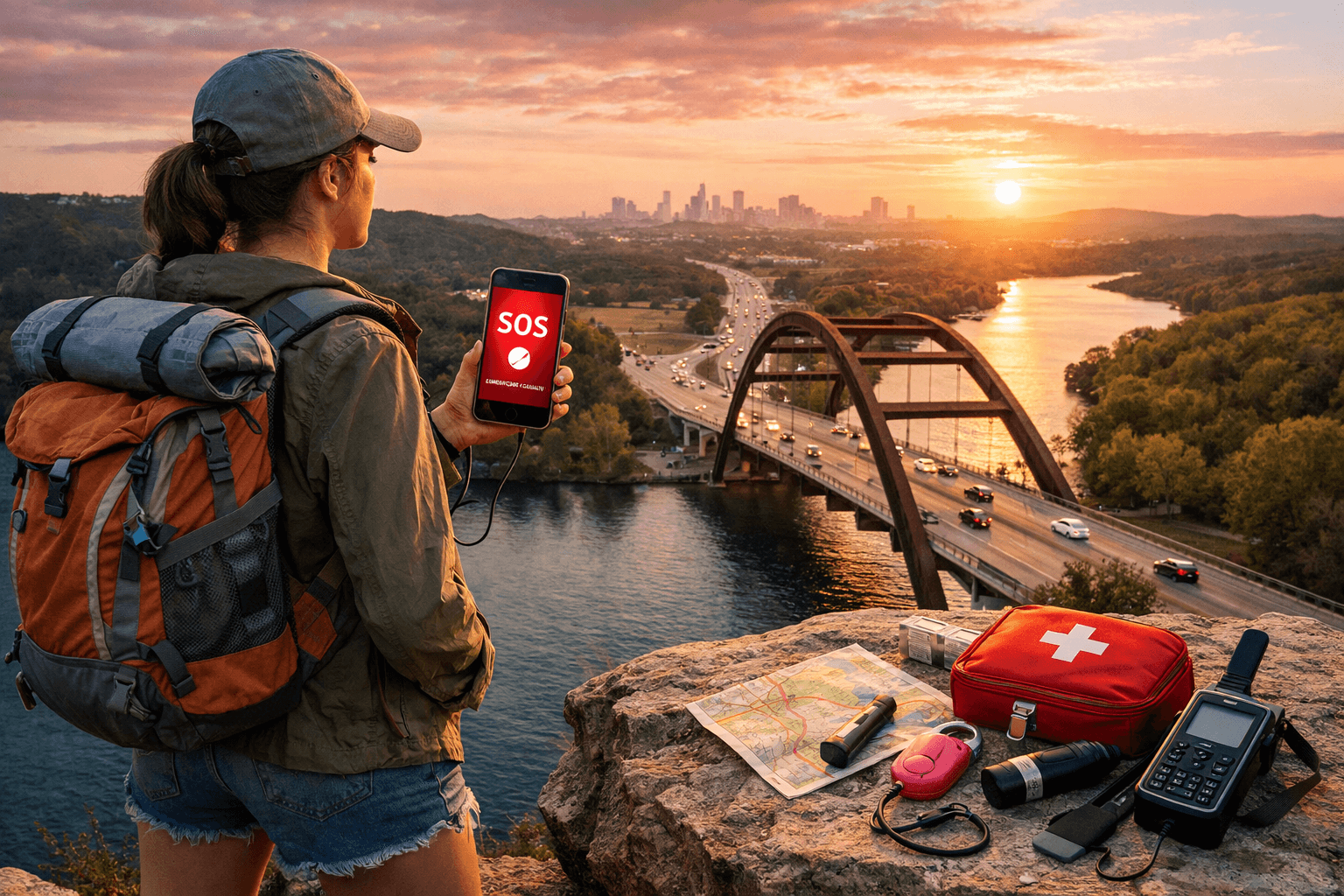
Unexpected moments are part of travel, even on short weekend trips that feel carefully planned. For many solo women leaving Austin, the quiet fear is not dramatic emergencies but the uncertainty of not knowing how to signal for help quickly if something feels wrong. I’ve seen travelers relax noticeably once they realize an emergency plan doesn’t have to be complicated. It just has to be predictable.
This guide gives you a calm, practical SOS framework built around a simple check-in system and ready-to-use message templates. You’ll learn how to design communication levels, choose safety contacts, and use technology to create a safety net that travels with you. The goal is reassurance through structure — a plan that sits quietly in the background so you can enjoy your weekend with confidence.
Table of Contents
ToggleWhy Every Solo Weekend Trip Needs a Simple SOS Plan
Most solo weekend trips unfold exactly as planned. You check in, explore, rest, and return home with new memories. But travel always carries small pockets of unpredictability: delayed rides, unfamiliar neighborhoods, sudden illness, or moments when something simply feels off. I’ve seen many solo women assume they will improvise if anything happens. What usually feels more reassuring is knowing that improvisation is not required.
A simple SOS plan is not about expecting disaster. It is about creating a quiet safety net that activates only when needed. When that net exists, your brain stops running background “what if” scenarios. Instead of carrying low-level anxiety, you carry a clear structure. That structure travels with you like an invisible companion.
The emotional value of an SOS plan is often underestimated. Knowing that someone understands your check-in rhythm and can respond if you go silent reduces the feeling of isolation that sometimes accompanies solo travel. You are still independent, but you are not unsupported. Independence and connection are not opposites. They reinforce each other.
What makes a weekend SOS plan especially powerful is its simplicity. You are not designing a complex emergency manual. You are creating predictable communication patterns that your safety contact can recognize instantly. When patterns are predictable, reactions are faster and calmer. Everyone involved knows what a missed message means and what the next step is.
In this way, an SOS plan becomes less about emergencies and more about confidence. It is a framework that allows you to move freely because you trust the system behind you. And when trust is present, solo travel feels expansive rather than uncertain.
The Core Principle of a Good SOS System: Predictability Over Panic
The strongest emergency systems are not the most complicated. They are the most predictable. I’ve seen many solo women try to design elaborate safety plans with dozens of contingencies, only to feel overwhelmed by their own structure. In real situations, complexity slows you down. What usually works best is a system so simple that you can follow it even when you’re stressed.
Predictability is what allows your safety contact to act quickly without guessing. When your communication rhythm is clear, silence has meaning. A missed check-in is not ambiguous. It triggers a defined response. That clarity removes the hesitation that often delays help.
A good SOS system is built on a few essential qualities:
-
Clear Communication Levels That Everyone Understands
-
Consistent Timing For Check-Ins
-
Simple Messages That Require No Interpretation
-
One Primary Safety Contact Instead Of Many
-
Defined Actions For Missed Signals
Each element exists to reduce mental friction.
Simple systems outperform complex ones because they survive stress. In moments of uncertainty, your brain narrows its focus. You will default to habits, not instructions. When your SOS plan feels like routine rather than protocol, it activates automatically. I’ve seen travelers execute simple check-in systems flawlessly even when shaken, precisely because there was nothing extra to remember.
Predictability also protects your emotional state. Panic thrives in ambiguity. When you know exactly what happens next, your nervous system stays steadier. You are not wondering whether someone will notice your silence. You know they will, and you know what they will do.
This principle — predictability over panic — turns an SOS plan into a quiet anchor. It does not hover in your thoughts during the trip. It simply exists, ready to support you if needed. And that quiet presence is what allows you to travel with ease.
Building Your Personal Check-In Framework
A check-in framework is the backbone of your SOS plan. It turns vague intentions like “I’ll text when I arrive” into a clear system that both you and your safety contact understand. I’ve seen many solo women assume their loved ones will notice if something is wrong, but without structure, silence is easy to misread. A defined framework removes guesswork.
Your goal is not constant monitoring. It is predictable touchpoints that mark transitions in your trip. When those touchpoints are consistent, everyone involved relaxes. You know when to check in. Your contact knows when to expect you. The system runs quietly in the background.
Choosing Your Primary Safety Contact
Your safety contact is the anchor of your SOS plan. Choosing the right person matters more than choosing multiple people.
A strong safety contact is someone who:
-
Answers Messages Reliably
-
Stays Calm Under Pressure
-
Respects Your Independence
-
Understands Basic Travel Logistics
-
Agrees To The Responsibility Clearly
One dependable person is more effective than a group.
Setting Realistic Check-In Windows
Check-ins should match the rhythm of a weekend trip, not interrupt it. Overly frequent messages create fatigue and make missed signals harder to interpret.
Balanced check-in windows include:
-
Arrival At Your Destination
-
Evening Confirmation Before Sleep
-
Morning Reset Message
-
Major Location Changes
-
Return Travel Start
These moments map naturally onto travel flow.
Defining What Counts as a Missed Check-In
A missed check-in must have a shared definition. Without one, your contact may hesitate, unsure whether to act.
Clear definitions include:
-
A Specific Time Buffer After A Scheduled Check-In
-
A Second Attempt Message From Your Contact
-
A Waiting Period Before Escalation
-
A Pre-Agreed Escalation Action
-
Documentation Of Your Last Known Location
Agreement prevents confusion.
The 3 Levels of SOS Communication
An effective SOS plan works best when it separates everyday communication from true emergencies. I’ve seen many solo women use a single channel for everything — casual updates and urgent messages mixed together. The problem is that urgency gets lost in familiarity. A layered system creates clarity. Each level carries a different meaning, and your safety contact knows exactly how to interpret it.
Think of these levels as signals rather than alarms. Most of your trip stays comfortably in Level 1. Levels 2 and 3 exist quietly in the background, ready if needed. When communication is tiered this way, escalation feels controlled instead of chaotic.
Level 1 — Routine Check-In Messages
Level 1 is your baseline rhythm. These are the ordinary messages that mark safe transitions and confirm everything is proceeding normally.
Level 1 communication includes:
-
Arrival Confirmations At New Locations
-
Evening “All Is Well” Messages
-
Morning Reset Check-Ins
-
Short Updates About Schedule Changes
-
Return Travel Notifications
These messages maintain predictable flow.
Level 2 — “Something Feels Off” Signals
Level 2 exists for situations that are uncomfortable but not emergencies. It is a quiet flag to increase awareness without triggering panic.
Level 2 signals include:
-
A Pre-Agreed Code Phrase
-
A Message Indicating You Need A Call Soon
-
A Location Share With Minimal Explanation
-
A Request For Your Contact To Stay Available
-
A Subtle Tone Shift Recognized In Advance
This level activates attention, not alarm.
Level 3 — Emergency Activation
Level 3 is reserved for true emergencies. It is direct and unmistakable.
Level 3 communication includes:
-
Explicit Emergency Language
-
Immediate Location Sharing
-
Direct Calls Instead Of Texts
-
Activation Of Phone Emergency Features
-
Clear Instructions For Your Contact To Act
There is no ambiguity at this level.
Separating communication into levels removes hesitation. You are not wondering how serious a message sounds. The structure already defines it. That clarity protects both you and your safety contact from misinterpretation.
Ready-to-Use Check-In Message Templates
One of the biggest reasons SOS systems fail is hesitation over wording. I’ve seen many solo women pause before sending a message because they don’t know how to phrase it, especially when they’re tired or stressed. Templates remove that friction. When your messages are pre-designed, sending them becomes automatic.
These templates are not scripts you must follow rigidly. They are anchors. You can copy them, adapt them, and make them sound like your own voice. What matters is consistency. When your safety contact recognizes the pattern, interpretation becomes instant.
Arrival confirmation templates
Arrived safely at my stay. Everything looks good. I’ll check in tonight.
Just reached my destination. Settling in now. Next check-in this evening.
I’m here and safe. Starting my weekend. Talk tonight.
Night check-in templates
Back at my stay and safe for the night. All good.
Evening check-in: I’m inside and settled. Goodnight.
Finished for today and safe. Morning message coming.
Location update templates
Heading to [location]. Should arrive around [time].
Changing plans slightly — going to [location]. Will update after.
On my way back to my stay now.
Delayed schedule templates
Running a bit late but safe. New ETA: [time].
Plans shifted. Still okay. Will check in soon.
Small delay, nothing wrong. Updating you now.
Templates work because they standardize tone. Your safety contact learns the rhythm of your normal messages, which makes unusual ones stand out immediately. That contrast is what makes an check-in system effective.
What Your Safety Contact Should Do (Clear Instructions)
An SOS plan only works if your safety contact understands their role as clearly as you understand yours. I’ve seen many systems fail not because the traveler forgot to check in, but because the contact didn’t know how to interpret silence. Clear instructions remove that uncertainty. Your contact should never have to guess whether they are overreacting.
Think of this section as a shared playbook. You are giving your safety contact permission to act within defined boundaries. That permission protects both of you from hesitation and panic.
How They Should Respond to Level 1
Level 1 messages are routine confirmations. Your contact’s job is simply to acknowledge them without creating extra pressure.
For Level 1 communication, your contact should:
-
Reply Briefly To Confirm They Saw The Message
-
Avoid Starting Long Conversations During Check-Ins
-
Note The Time Of The Message Quietly
-
Trust That Silence Outside Check-In Windows Is Normal
-
Maintain A Calm, Supportive Tone
Routine messages should feel light, not monitored.
How They Should Respond to Level 2
Level 2 signals mean increased awareness. Your contact becomes attentive without escalating immediately.
For Level 2 communication, your contact should:
-
Stay Available For Calls Or Messages
-
Confirm They Received The Signal Clearly
-
Ask Short, Direct Questions If Needed
-
Monitor Location Sharing Quietly
-
Prepare For Possible Escalation Without Panic
Attention increases, but calm remains.
How They Should Respond to Level 3
Level 3 is emergency activation. Your contact moves from monitoring to action.
For Level 3 communication, your contact should:
-
Call You Immediately And Keep Trying
-
Contact Local Emergency Services If Needed
-
Provide Authorities With Your Last Known Location
-
Follow Pre-Agreed Escalation Steps
-
Stay Calm And Focused On Facts
Clarity speeds response.
Clear instructions protect your safety contact from emotional overload. They know exactly what each signal means and what to do next. That certainty travels back to you. When you activate your SOS plan, you trust the response waiting on the other end.
Using Technology to Strengthen Your SOS Plan
Technology does not replace your SOS system. It reinforces it. I’ve seen many solo women rely on a single app or feature and assume that is enough. What usually feels safer is layering simple tools that support your check-in framework. Each tool adds redundancy, and redundancy creates resilience.
The goal is not constant tracking. It is quiet infrastructure that activates when needed. When your technology is prepared in advance, your SOS plan runs smoothly in the background instead of demanding attention during your trip.
Location Sharing Tools
Live location sharing transforms your check-in system from verbal confirmation to visual awareness. Your safety contact can see your movement without interrupting your trip.
Helpful location habits include:
-
Sharing Live Location With Your Safety Contact
-
Turning Sharing On During Travel Transitions
-
Confirming They Can View Your Location
-
Updating Sharing When Plans Change
-
Turning It Off When Privacy Is Needed
Visibility adds reassurance.
Emergency SOS Features on Phones
Modern phones include built-in emergency tools designed for rapid escalation. Familiarity with these features matters more than complexity.
Important emergency features include:
-
Knowing How To Trigger Emergency SOS Quickly
-
Setting Up Emergency Contacts In Advance
-
Testing The Feature Before Traveling
-
Understanding Automatic Location Transmission
-
Keeping Your Phone Accessible At All Times
Practice removes hesitation.
Backup Communication Channels
Phones fail. Batteries drain. Networks disappear. Backup channels keep your SOS plan intact.
Smart backup strategies include:
-
Carrying A Portable Battery Pack
-
Saving Emergency Numbers On Paper
-
Knowing Where Public Phones Or Wi-Fi Exist
-
Memorizing At Least One Contact Number
-
Using Multiple Messaging Platforms
Redundancy protects continuity.
Technology strengthens your SOS plan when it is layered and predictable. Each tool exists to support your framework, not replace it. When systems overlap, gaps shrink.
When to Activate Your SOS Plan While Traveling
One of the hardest parts of any emergency system is deciding when to use it. I’ve seen many solo women hesitate because they worry about overreacting or “wasting” their safety contact’s attention. What usually feels safer is having clear activation thresholds. Your SOS plan exists for uncertainty, not just obvious danger.
Activation is not a single dramatic moment. It is a sliding scale. You move from routine awareness into structured signaling when certain cues appear. Naming those cues ahead of time removes internal debate.
Situations that justify activating your SOS plan include:
-
Missing A Scheduled Check-In Without Explanation
-
Feeling Followed Or Persistently Uncomfortable
-
Being In A Location You Cannot Easily Leave
-
Experiencing Transportation Or Accommodation Issues
-
Losing Access To Your Phone Or Wallet
-
Medical Concerns That Limit Movement
-
Strong Gut-Level Fear Without Clear Cause
-
Environmental Escalation Such As Crowds Or Isolation
What matters is not proving danger. It is recognizing disruption. Your SOS plan is designed to support you before situations spiral. Early activation is a strength, not an overreaction.
Gut instinct deserves special attention. I’ve seen many experienced travelers describe moments where nothing looked overtly wrong, yet their body registered unease. That sensation is part of your safety system. When instinct signals repeatedly, activating Level 2 communication is appropriate.
Environmental escalation also plays a role. Crowded festivals, late-night transit hubs, or remote areas can shift quickly. If your surroundings change faster than your comfort adapts, that is a cue to tighten your communication rhythm.
The purpose of activation thresholds is emotional permission. You are allowed to use your SOS plan whenever uncertainty rises above your baseline. Clear thresholds transform hesitation into action and action into calm.
Preventive Habits That Make SOS Activation Rare
The best SOS plans are the ones you rarely have to use. I’ve seen many solo women build travel rhythms that quietly prevent situations from escalating in the first place. These habits don’t eliminate unpredictability, but they reduce the number of moments where your SOS system needs to activate. Prevention here is about steady communication and transparent movement.
When your trip has a visible structure, your safety contact always knows roughly where you are and what phase of travel you’re in. That shared awareness lowers the chance of confusion and shortens response time if something changes.
Preventive habits that reduce SOS activation include:
-
Sharing Your Route And Accommodation Details Before Departure
-
Sending Short Updates During Major Transitions
-
Keeping Transportation Plans Transparent
-
Maintaining A Consistent Daily Rhythm
-
Updating Contacts When Plans Shift
-
Avoiding Long Periods Of Complete Silence
-
Saving Important Addresses On Paper
-
Keeping Devices Charged During Movement
These habits create a continuous thread of information.
Transparency does not mean constant reporting. It means predictable touchpoints. Your safety contact can follow your travel arc without needing to ask questions. I’ve seen how this quiet flow of updates prevents small uncertainties from growing into worry.
Rhythm matters as much as information. Trips that swing wildly between silence and sudden messages are harder to interpret. Consistent pacing — arrival, evening, and morning check-ins — creates a pattern your contact learns to trust. When the pattern breaks, it stands out immediately.
Preventive habits are not restrictions on freedom. They are scaffolding. They support your independence by ensuring that if something shifts, you are already connected. And when connection is steady, escalation becomes rare.
Creating a Personal Pre-Trip SOS Ritual
The calmest travelers treat emergency planning as ritual rather than checklist. A pre-trip SOS ritual is a repeatable sequence you run before leaving Austin that locks your safety system into place. I’ve seen many women describe a noticeable sense of relief once this ritual becomes automatic. It signals to your brain that your safety net is active.
A ritual transforms preparation into habit. Instead of wondering whether you remembered something, you follow the same steps every time.
Mental Rehearsal
Mental rehearsal builds familiarity with your SOS plan before you ever need it.
Helpful rehearsal habits include:
-
Visualizing Your Check-In Sequence
-
Imagining Sending A Level 2 Signal Calmly
-
Rehearsing Your Emergency Call Flow
-
Picture Your Safety Contact Responding
-
Ending With A Smooth Resolution
Familiar scenes reduce hesitation.
Packing Communication Backups
Backup tools travel with you as physical reminders of your system.
Useful packing items include:
-
A Portable Battery Pack
-
Written Emergency Contacts
-
Printed Accommodation Addresses
-
Backup Payment Methods
-
Emergency Information Cards
Redundancy supports continuity.
Final Departure Checklist
Your last moments before leaving anchor the ritual.
A strong departure checklist includes:
-
Confirming Location Sharing Is Active
-
Sending Your Itinerary To Your Contact
-
Charging All Devices Fully
-
Saving Key Numbers Offline
-
Sending A Departure Message
Closure signals readiness.
Final Thoughts: Safety Systems That Travel With You
An SOS plan is not a shadow hanging over your trip. It is a quiet companion that allows you to travel more freely. I’ve seen many solo women discover that once their emergency framework is in place, their anxiety decreases rather than increases. Structure replaces uncertainty.
Everything in this guide returns to one idea: preparedness expands freedom. When your safety systems are predictable, layered, and shared, you are not carrying fear. You are carrying clarity. That clarity lets you focus on the experience itself.
Solo weekend trips from Austin are meant to feel restorative and expansive. Your SOS plan sits quietly in the background, ready if needed, invisible when not. And that quiet readiness is what allows confidence to travel with you.
Related Posts
- Is It Safe to Travel Alone Near Austin? Honest Answers for Women
- Packing Checklist for Solo Female Weekend Trips from Austin
- Weekend Trips Near Austin with Accessible Nature Trails for Solo Women
- Best Airbnbs Near Austin for Solo Female Weekend Trips (Comfort-First, Joy-Ready)
- Fredericksburg Solo Female Weekend Guide from Austin
- Photography Spots Near Austin for Solo Female Travelers
- Offbeat & Uncrowded Weekend Trips from Austin for Solo Women
- How to Tell If a Weekend Trip Is Right for Solo Female Travel