
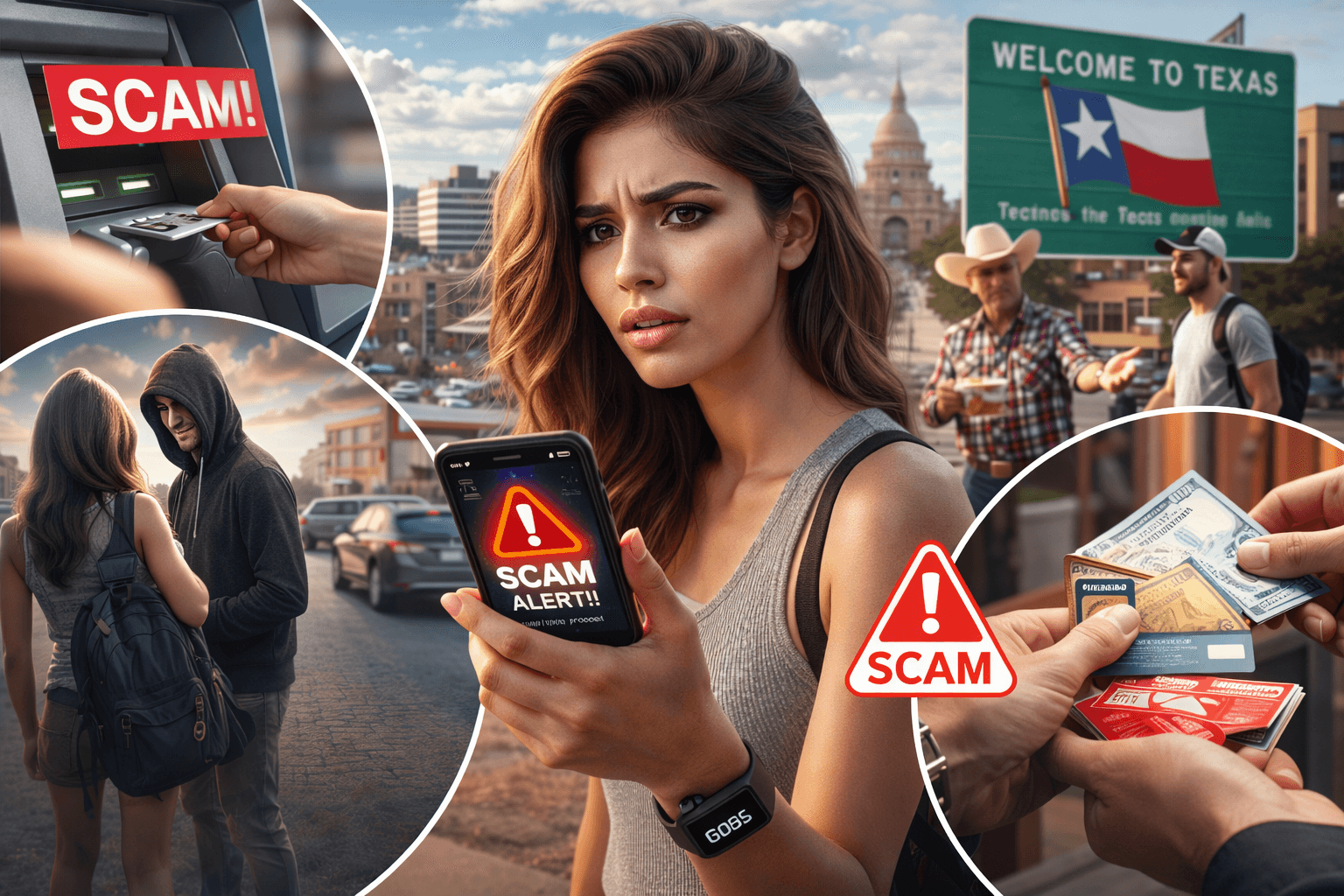
Travel scams rarely look dramatic in the moment. They often arrive disguised as friendliness, urgency, or small distractions that pull your attention just long enough to create an opening. For many solo women traveling through Texas from Austin, the discomfort isn’t just about money or belongings — it’s the feeling of being singled out while navigating an unfamiliar place alone. I’ve seen how even confident travelers can feel briefly shaken when a situation turns manipulative.
This guide gives you a calm, practical framework for recognizing common travel scams, spotting early warning signs, and responding without escalation. You’ll learn what patterns to watch for in Texas travel environments, how to create distance quickly, and how to rebuild your steadiness if something happens. The goal is not suspicion of everyone around you. It is clear awareness that lets you move through your trip feeling confident and in control.
Table of Contents
ToggleWhy Travel Scams Feel More Personal When You’re Alone
When you travel with other people, attention is shared. Decisions are discussed out loud, and your awareness spreads across the group. Solo travel changes that dynamic. Every interaction lands directly on you. I’ve seen many solo women describe scams as feeling more personal not because they are targeted more often, but because there is no buffer between the situation and your response.
A scam attempt compresses time. Someone creates urgency, friendliness, or confusion in a way that pushes you to decide quickly. When you’re alone, that pressure can feel amplified. Your brain is processing the environment, protecting your belongings, and managing social politeness all at once. That mental load is what scammers try to exploit.
What usually helps most is understanding that discomfort is information, not overreaction. Experienced solo travelers don’t walk around expecting deception. They simply recognize that manipulation follows patterns. When those patterns appear, they respond early and calmly instead of debating with themselves.
Travel scams are rarely about intelligence or naivety. They are about timing and distraction. Even seasoned travelers can be caught off guard during busy transitions, long days, or emotionally charged moments. Reframing scams as predictable behavioral scripts removes their mystique. Once you see the structure behind them, your reactions become steadier.
Awareness does not make travel cold or suspicious. It makes your boundaries clearer. And when your boundaries are clear, interactions feel lighter because you are not negotiating with uncertainty in the background.
The Most Common Travel Scams Solo Women Encounter in Texas
Most travel scams are not elaborate schemes. They are simple scripts repeated in busy places where attention is divided. I’ve seen many solo women assume scams are rare or extreme, when in reality they tend to be small, opportunistic interactions designed to catch you off balance. Knowing the common patterns in Texas travel environments removes their surprise factor.
The goal is not memorizing dozens of scenarios. It’s recognizing familiar structures. When you understand how a scam is built, you can spot the shape of it even when the details change.
Rideshare and Transportation Scams
Transportation transitions create natural moments of distraction. You are thinking about directions, timing, and movement, which makes small inconsistencies easier to miss.
Common transportation scams include:
-
Drivers Claiming The App Is Malfunctioning And Requesting Cash
-
Unmarked Vehicles Pretending To Be Your Rideshare
-
Taxi Drivers Taking Intentional Detours To Increase Fares
-
People Offering “Cheaper Private Rides” Outside Transit Hubs
-
Fake Parking Or Ticket Payment Requests
Legitimate services rarely pressure you to change payment methods mid-ride.
Street Distraction and Wallet Scams
Distraction scams rely on dividing your attention. One person engages you while another targets your belongings.
Typical distraction setups include:
-
Someone Spilling Something On You And Offering Help
-
Petition Or Clipboard Approaches That Block Movement
-
Crowding In Busy Areas Like Festivals Or Markets
-
Sudden Arguments Or Commotion Nearby
-
Requests To Sign Or Read Something Quickly
The common thread is forced closeness and urgency.
Accommodation and Booking Scams
These scams often happen digitally or at the edge of arrival, when you are focused on settling in.
Common booking scams include:
-
Messages Asking You To Pay Outside Official Platforms
-
Fake Rental Listings With Unusually Low Prices
-
Last-Minute “Upgrade” Requests For Additional Fees
-
Hosts Requesting Sensitive Personal Information
-
Unexpected Visitors Claiming To Represent Management
Professional accommodations keep transactions transparent.
“Helpful Stranger” Setups
Not every friendly approach is suspicious, but scammers often wear the mask of assistance.
Patterns to watch include:
-
Unsolicited Offers To Guide You To ATMs Or Offices
-
People Insisting They Can Fix A Problem You Didn’t Report
-
Pressure To Follow Someone To A Secondary Location
-
Overly Personal Questions Early In Conversation
-
Requests For Immediate Financial Help
Genuine help rarely comes with urgency or pressure.
Early Warning Signs That a Situation Is Becoming a Scam
Most scams don’t begin with obvious red flags. They start with small social cues that feel slightly off but easy to dismiss. I’ve seen many solo women replay scam attempts afterward and realize the early signals were present from the first few seconds. The challenge is not intelligence. It’s that scammers rely on politeness and hesitation to delay your response.
Early warning signs are less about the exact words someone uses and more about the emotional pressure they create. A scam almost always tries to rush you, confuse you, or isolate you from your normal decision-making pace. When you recognize that emotional pattern, you can step back before the situation develops.
Some early warning signs that deserve immediate attention include:
-
Urgency That Demands Instant Decisions without time to think
-
Requests To Break Normal Procedures like paying outside an app
-
Unsolicited Physical Closeness that invades personal space
-
Overfriendly Behavior That Escalates Too Quickly
-
Attempts To Redirect You Away From Public Areas
-
Conflicting Information Or Vague Explanations
-
Pressure Framed As “Helping You”
-
A Strong Gut Feeling Of Discomfort
What matters most is the pattern, not a single cue. One unusual detail might be harmless. A cluster of them is meaningful. Your nervous system is designed to detect inconsistencies long before you consciously label them. That quiet sense of unease is data, not drama.
Experienced solo travelers respond to early warning signs by slowing the interaction rather than speeding it up. They create space, ask neutral questions, or simply disengage. Scammers depend on momentum. When you interrupt that momentum calmly, the script begins to fall apart.
How to Respond in the First 10 Seconds of Suspicion
The first few seconds after you suspect a scam are more important than anything that follows. I’ve seen many solo women freeze here, trying to analyze the situation instead of acting. What usually feels safest is remembering that you don’t need to prove anything. You only need to create space. Your response is about interrupting momentum, not winning an argument.
Scammers rely on speed and social pressure. A calm, immediate shift in your behavior breaks their script. When you respond early, most attempts dissolve without confrontation. The goal is not escalation. It is quiet disengagement and repositioning.
Creating Physical Distance Calmly
Distance is your strongest protection. Even a small step back changes the dynamic of an interaction.
To create distance:
-
Take A Step Back Without Apologizing
-
Turn Your Body Slightly Toward An Exit Path
-
Keep Your Belongings Close To Your Body
-
Avoid Allowing Anyone To Block Your Movement
-
Continue Walking If Possible
Movement disrupts pressure.
Using Neutral Verbal Boundaries
Short, neutral phrases close conversations without inviting debate. You are ending the interaction, not negotiating it.
Effective boundary phrases include:
-
“No, Thank You.”
-
“I’m Not Interested.”
-
“I’m In A Hurry.”
-
Repeating The Phrase Calmly If Pressed
-
Avoiding Long Explanations
Neutral tone prevents escalation.
Moving Toward Staffed Spaces
Public structure weakens scam attempts. Staffed environments add witnesses and accountability.
To reposition safely:
-
Walk Into The Nearest Store Or Hotel Lobby
-
Stand Near Service Counters Or Security
-
Blend Into Groups Of People
-
Pause Only In Visible Areas
-
Use Doors As Boundaries Between You And The Person
Structure restores control.
What to Do If You Realize You’ve Been Targeted
There is a distinct emotional jolt when you realize someone has actively tried to scam you. Even if you avoided losing anything, the recognition can leave you shaken or angry. I’ve seen many solo women focus immediately on replaying the interaction in their head. What usually helps more is shifting your attention to stabilization first. Your priority is protecting what you have, documenting what matters, and calming your nervous system.
Being targeted does not mean you did something wrong. Scams are built to exploit timing, not intelligence. Your response now is about closing any remaining gaps and restoring your sense of control.
Protecting Your Belongings Immediately
Your first step is a quiet inventory. You are confirming that everything important is still where it should be.
Important protective actions include:
-
Checking Your Wallet, Phone, And Bag Zippers
-
Moving To A Secure, Visible Location
-
Reorganizing Your Belongings Calmly
-
Securing Loose Items Immediately
-
Avoiding Public Displays Of Panic
A quick inventory resets your baseline.
Contacting Support and Authorities
If money or documents are involved, early reporting protects you. Even attempted scams can be useful to document.
Supportive reporting steps include:
-
Informing Nearby Staff Or Security
-
Contacting Local Authorities If Necessary
-
Calling Your Bank For Suspicious Activity
-
Saving Relevant Details While Fresh
-
Notifying Your Accommodation If Relevant
Documentation strengthens your position.
Stabilizing Yourself Emotionally
The emotional aftershock of a scam attempt is real. Your body may still be in adrenaline mode even after the situation ends.
To stabilize emotionally:
-
Sit In A Calm, Populated Space
-
Drink Water And Breathe Slowly
-
Text A Trusted Contact Briefly
-
Acknowledge That You Handled The Situation
-
Return To Simple, Familiar Activities
Steadiness returns through small actions.
Texas-Specific Environments Where Scams Are More Likely
Scams don’t spread evenly across a city or state. They concentrate in environments where people are distracted, moving quickly, or emotionally elevated. I’ve seen many solo women feel surprised when a scam attempt happens in a place that otherwise feels fun or welcoming. The reality is that scammers follow opportunity, and opportunity tends to gather where travelers gather.
Understanding which Texas environments carry higher scam activity doesn’t mean avoiding them. It means adjusting your awareness slightly when you enter them. Most of these places are vibrant and enjoyable. A small shift in posture and pacing is enough to reduce your exposure.
Tourist hotspots are the most obvious concentration points. Areas like downtown entertainment districts, riverwalks, and major attractions bring together crowds, performers, and vendors. In these spaces, distraction is built into the atmosphere. Street performers drawing attention, pop-up vendors, and informal guides can blur the line between entertainment and solicitation. Keeping your belongings close and declining unsolicited offers quickly maintains your rhythm.
Transit hubs carry a different energy. Airports, bus stations, and train terminals are transitional spaces where people are juggling luggage and schedules. Scammers look for travelers who appear rushed or uncertain. Moving with deliberate pace, confirming official signage, and using staffed counters instead of informal assistance protects you here.
Nightlife districts add emotional factors. Music, alcohol, and social energy can soften boundaries and slow reactions. I’ve seen experienced travelers counter this by simplifying their movements: direct routes between venues, pre-booked rides, and visible pickup points. The goal is reducing decision fatigue in environments designed to overwhelm the senses.
Events and festivals create temporary micro-cities where normal routines disappear. Crowds compress, attention fragments, and physical closeness increases. In these settings, wallet and distraction scams become more common. Positioning your bag in front of your body and maintaining steady forward movement reduces vulnerability.
These environments are not inherently dangerous. They are simply dense with opportunity — for both enjoyment and opportunistic behavior. When you recognize the pattern, your awareness rises naturally without dampening the experience.
Preventive Habits That Quietly Reduce Scam Risk
The most effective scam protection rarely looks dramatic from the outside. I’ve seen many experienced solo women move through busy Texas travel environments with a kind of quiet steadiness. They are not tense or suspicious. They simply carry habits that make them harder to target. These habits work because scammers look for distraction, hesitation, and easy access. When those signals are missing, attention shifts elsewhere.
Prevention is less about reacting to threats and more about shaping how you move through space. Small adjustments in posture, pacing, and information sharing create a protective baseline that travels with you.
Strong preventive habits include:
-
Walking With A Steady Pace And Upright Posture
-
Keeping Bags Worn Across The Front Of Your Body
-
Holding Your Phone Securely Instead Of Loosely
-
Avoiding Displaying Cash Or Valuables Publicly
-
Pausing In Staffed Spaces When You Need Directions
-
Limiting Personal Information Shared With Strangers
-
Using Official Counters For Tickets And Services
-
Trusting Your Instinct To Decline Quickly
These habits signal awareness without aggression.
Payment behavior also matters. I’ve watched many scam attempts dissolve the moment a traveler insists on using official payment channels. Scammers depend on improvisation and off-platform transactions. Calmly redirecting every payment through verified systems closes that door.
What makes these habits powerful is consistency. You are not switching into “safety mode” only when something feels wrong. You are maintaining a steady travel rhythm that quietly discourages manipulation. Over time, this rhythm becomes automatic. Awareness blends into your natural movement instead of sitting on top of it.
Building a Personal Scam-Defense Ritual Before Trips
The most confident solo travelers don’t rely on improvisation when something feels off. They rely on ritual. A personal scam-defense ritual is a repeatable preparation sequence you run before leaving Austin that strengthens your awareness and reduces hesitation. I’ve seen many women describe a noticeable shift in calm once this ritual becomes habit. It removes guesswork and replaces it with familiarity.
A ritual is not about expecting to be targeted. It is about normalizing readiness so your brain recognizes suspicious situations faster and responds without overthinking. When preparation is built into your travel rhythm, awareness feels natural instead of forced.
Mental Rehearsal Techniques
Mental rehearsal trains your response before you ever encounter a scam attempt. You are not imagining dramatic scenarios. You are practicing your first calm moves.
Helpful rehearsal habits include:
-
Visualizing Yourself Recognizing A Red Flag Early
-
Imagining Creating Distance Smoothly
-
Rehearsing A Neutral Boundary Phrase
-
Picture Walking Into A Staffed Space
-
Ending The Scene With Calm Disengagement
Familiar sequences reduce hesitation.
Communication Plans With Home
A quiet communication framework adds emotional backup without constant monitoring. Knowing someone can see your movement strengthens your sense of support.
Supportive communication habits include:
-
Sharing Your General Itinerary Before Departure
-
Choosing One Default Safety Contact
-
Agreeing On Casual Check-In Windows
-
Sending Quick Arrival Updates In New Cities
-
Keeping Expectations Calm And Practical
Connection steadies decision-making.
Financial and Document Preparation
Scam resilience is partly logistical. When your finances and documents are structured well, the impact of any incident shrinks.
Smart preparation steps include:
-
Carrying Backup Payment Methods Separately
-
Saving Digital Copies Of Important Documents
-
Setting Bank Alerts For Transactions
-
Limiting Cash To Practical Amounts
-
Knowing How To Freeze Cards Quickly
Prepared systems absorb shock.
Final Thoughts: Awareness Without Suspicion
Travel is meant to feel expansive, not guarded. The purpose of scam awareness is not to make every interaction feel risky. It is to give you a framework that quietly supports your confidence. I’ve seen many solo women discover that once they understand scam patterns, their anxiety actually decreases. The unknown becomes familiar, and familiarity softens tension.
Everything in this guide returns to a simple principle: awareness is clarity, not suspicion. You are not walking through Texas expecting deception. You are moving with a steady sense of boundaries that lets you enjoy your surroundings fully. When something feels off, you know what to do. And when you know what to do, your attention is free to return to the experience itself.
Solo travel is an ongoing conversation between curiosity and self-trust. Each time you navigate an uncertain interaction calmly, that trust grows. And with trust in place, scams lose their power to disrupt your journey.
Related Posts
- How to Plan a Safe Solo Female Weekend Trip from Austin
- How to Track Your Weekend Trip Budget & Stay Organized
- Summer Weekend Trips from Austin for Solo Women Who Want Calm, Heat-Safe Escapes
- Car vs Bus vs Train for Solo Women Traveling from Austin
- Is It Safe to Travel Alone Near Austin? Honest Answers for Women
- Nature & Quiet Weekend Escapes Near Austin for Women Traveling Alone
- How to Choose a Weekend Destination That Feels Right When Traveling Alone
- Solo Female Travel Mistakes to Avoid on Austin Weekend Trips