
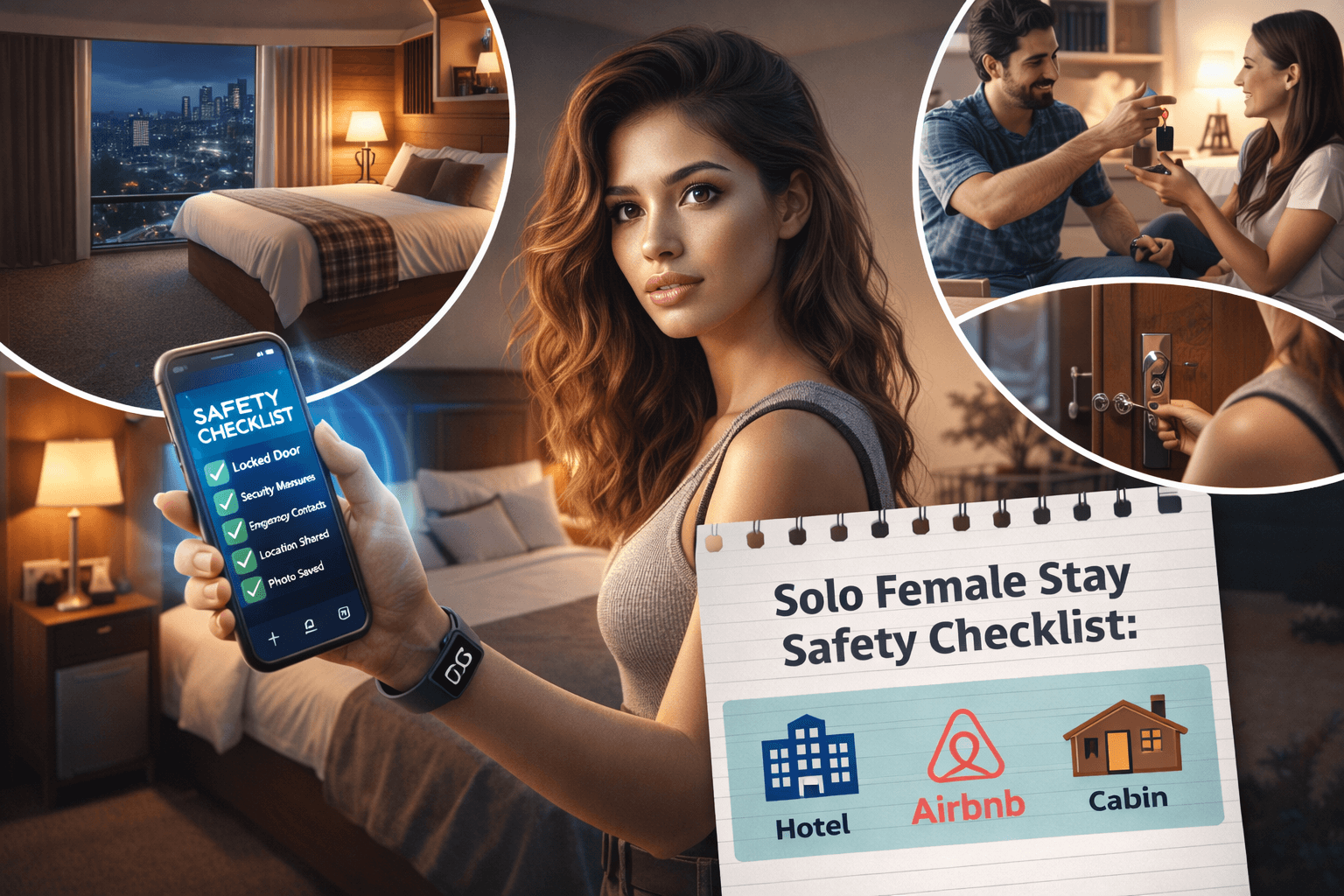
Arriving at a place where you’ll sleep alone in an unfamiliar city can trigger a quiet vulnerability that daytime travel rarely carries. For many solo women leaving Austin, the moment you close the door to a hotel room, Airbnb, or cabin is when awareness sharpens. I’ve seen travelers describe this as the point where a trip feels most personal, because rest requires trust in a new environment.
This guide gives you a calm, structured safety checklist designed specifically for overnight stays. You’ll learn a universal arrival routine, accommodation-specific habits, red flags to watch for, and simple rituals that make sleeping in new places feel steady and controlled. The goal is not hypervigilance. It is confidence — clear steps that help you settle into any stay knowing you’ve protected your comfort and safety.
Table of Contents
ToggleWhy Overnight Safety Feels Different When You Travel Alone
Daytime travel is built around movement. You are navigating streets, choosing routes, and interacting with public spaces that feel shared and visible. Overnight stays are different. When you step inside a room that is temporarily yours, the energy shifts from movement to stillness. I’ve seen many solo women feel this shift immediately. The door closes, the outside noise softens, and your awareness turns inward toward the space you’ll trust while you sleep.
That feeling is not weakness or fear. It is your brain recognizing that rest requires a different kind of safety than exploration. During the day, you can leave quickly if something feels off. At night, you are choosing to stay. That choice carries more emotional weight, especially when you’re alone in a new city or remote setting.
What helps most is reframing overnight safety as preparation rather than suspicion. Experienced solo travelers don’t obsess over worst-case scenarios. They run quiet routines that turn unfamiliar rooms into controlled environments. A few deliberate habits — checking entry points, organizing essentials, reading the space — replace ambiguity with structure.
Once structure is present, your nervous system relaxes. The room stops feeling like an unknown container and starts feeling like a temporary base. And when your base feels secure, sleep comes easier. Overnight safety is not about guarding against danger. It is about building enough certainty that your body believes it is safe to rest.
The Universal Arrival Routine Every Solo Woman Should Follow
The first few minutes inside any new stay shape how safe and settled the space will feel for the rest of the night. I’ve seen many solo women drop their bags and immediately start unpacking, only to notice details later that make them uneasy. What usually feels better is running a short arrival routine before you relax. This routine is not about searching for problems. It is about turning an unfamiliar space into a known one.
Think of this as your universal checklist — the same sequence whether you are entering a hotel room in a city, an Airbnb in a neighborhood, or a cabin outside Austin. Repetition is what builds calm. When you follow the same steps every time, your brain recognizes the pattern and settles faster.
First 60 Seconds Inside Any Stay
Your first minute inside is about orientation. You are mapping the space so nothing feels hidden or surprising later.
In the first 60 seconds:
-
Close And Lock The Door Immediately Behind You
-
Stand Still And Scan The Entire Room Slowly
-
Notice The Layout Of Furniture And Walkways
-
Locate The Main Exit And Any Secondary Exits
-
Listen For Unusual Sounds Before Moving Further
This quick pause replaces uncertainty with awareness.
Securing Doors, Windows, and Entry Points
Once you understand the layout, your next priority is reinforcing the boundaries of the space. Most accommodations are secure by default, but confirming it yourself adds psychological comfort.
Important entry checks include:
-
Testing All Door Locks And Deadbolts
-
Checking That Windows Fully Close And Lock
-
Closing Curtains Or Blinds For Privacy
-
Ensuring Balcony Doors Are Secured
-
Verifying Peepholes Or Door Viewers Work
Small confirmations create a strong sense of control.
Reading the Space Before Unpacking
Before you settle in, take a final pass through the room with fresh attention. This is about noticing details you might otherwise ignore.
A thoughtful space read includes:
-
Looking Behind Doors And Inside Closets Briefly
-
Checking Bathroom Locks And Lighting
-
Noting Where Emergency Exits Are Located
-
Identifying Light Switches For Night Use
-
Choosing A Clear Place For Your Essentials
Once this scan is complete, unpacking feels intentional rather than rushed.
Hotel-Specific Safety Habits That Experienced Travelers Use
Hotels carry a built-in layer of structure that many solo women find reassuring. There are staff members, cameras, and predictable routines. But I’ve seen experienced travelers add a few personal habits that quietly strengthen that structure. These habits are not obvious from the outside. They are subtle adjustments that protect privacy and increase awareness without changing the relaxed feel of your stay.
What makes hotel safety different is shared space. Hallways, elevators, and lobbies are transitional zones where you briefly overlap with strangers. When you move through these areas intentionally, your room becomes a stronger private base.
One of the most important habits happens at the front desk. When you check in, pay attention to how your room number is communicated. If it is spoken loudly or written where others can see, you are allowed to ask politely for discretion. Many experienced solo travelers also avoid saying their room number out loud in public spaces. Privacy begins with small boundaries.
Elevator and hallway awareness also matter. Entering an elevator with confidence, standing near control panels, and exiting promptly reduce awkward pauses. In hallways, walking with purpose and keeping keys ready prevents fumbling at your door. These micro-movements signal control and shorten exposure time in shared areas.
Inside the room, layering your door security adds psychological comfort. Even when hotel locks are strong, I’ve seen many solo women use portable door wedges or secondary locks as quiet reinforcement. Placing a small object near the door at night — like a shoe or bag — can also act as an early alert if the door moves unexpectedly.
Hotel safety is not about suspicion. It is about understanding how shared environments function and shaping your movement within them. When your habits match the rhythm of the space, the hotel feels less like a public building and more like a protected extension of your travel routine.
Airbnb and Rental Safety Checks Most Guests Skip
Airbnbs and short-term rentals feel different from hotels because they blur the line between private homes and temporary lodging. Many solo women leaving Austin choose rentals for comfort and neighborhood immersion, but I’ve seen travelers assume that a cozy space automatically equals a safe one. What usually feels best is running a few deliberate checks that match the informal nature of rentals.
Unlike hotels, rentals vary widely in layout, entry systems, and neighborhood context. Your job on arrival is to understand how this specific space functions. When you know the mechanics of entry and exit, the environment feels less ambiguous and more manageable.
Verifying Entry and Exit Points
The first priority in any rental is understanding how you would leave quickly if needed. This is not about expecting danger. It is about knowing your routes.
Important entry and exit checks include:
-
Confirming How The Main Door Locks From Inside
-
Testing Secondary Doors Or Patio Exits
-
Checking Window Locks On Ground Floors
-
Noting Stairways Or Building Exits
-
Keeping Keys Or Codes Easily Accessible
Clear exit knowledge reduces background tension.
Host Communication Boundaries
Most hosts are professional and respectful, but rentals sometimes involve closer communication than hotels. Setting quiet boundaries protects your privacy.
Healthy host communication habits include:
-
Keeping Messages Focused On Logistics Only
-
Avoiding Sharing Personal Travel Details
-
Using The Platform’s Messaging System Instead Of Private Apps
-
Declining In-Person Visits That Feel Unnecessary
-
Trusting Your Comfort Level With Interaction
Professional tone maintains distance.
Neighborhood Awareness
A rental places you directly inside a neighborhood rather than a managed building. Understanding your surroundings adds context to your stay.
Helpful neighborhood awareness steps include:
-
Walking A Short Loop In Daylight To Orient Yourself
-
Noting Nearby Open Businesses
-
Identifying Well-Lit Routes Back To The Property
-
Observing General Street Activity Patterns
-
Saving The Address On Paper
Context turns unfamiliar streets into mapped space.
Cabin and Remote Stay Safety Strategy
Cabins and remote stays offer something many solo women actively seek: quiet, privacy, and distance from crowds. But I’ve seen how isolation can feel different after sunset, especially when you’re far from the familiar rhythm of city noise. The goal in remote settings is not to eliminate that isolation — it’s to structure it so your environment feels intentional rather than uncertain.
Remote safety is built on anticipation. When you arrive at a cabin or secluded property, you are creating your own small perimeter of awareness. The more clearly you understand your surroundings, the less your imagination fills in the gaps at night.
One of the first priorities is lighting. Exterior lights are not just conveniences; they define the edges of your space. Turning on porch lights, checking motion sensors, and confirming that walkways are visible immediately changes how the property feels. Darkness becomes something outside your boundary instead of pressing against it.
Isolation also means planning for communication. Even if your phone signal is strong, it helps to identify where reception is best and where you would go if you needed help. I’ve seen many experienced travelers quietly note the nearest neighboring property, main road, or staffed location during daylight. This knowledge sits in the background and reduces nighttime anxiety.
Emergency access planning matters more in cabins than anywhere else. Knowing how to operate locks, alarms, heating systems, and backup lighting removes friction if something unexpected happens. Keeping keys, a flashlight, and your phone in the same predictable place each night turns your essentials into a small command center.
Remote stays reward routine. A consistent sequence — lights on, doors checked, essentials placed — transforms a quiet cabin into a controlled base. Once your environment feels defined, the silence outside becomes peaceful instead of uncertain.
Nighttime Rituals That Strengthen Overnight Safety
The moments before sleep are when your environment matters most. Daytime distractions fade, and small uncertainties can feel louder in the quiet. I’ve seen many solo women from Austin describe how a simple nighttime ritual changes the emotional tone of a stay. Instead of lying awake scanning unfamiliar sounds, they follow a predictable sequence that signals to their brain that the space is secure.
A nighttime ritual is not about checking obsessively. It is about closing the day with intention. When you repeat the same actions each night, your body recognizes the pattern and relaxes. Sleep becomes a continuation of routine rather than a leap of trust.
Strong nighttime safety habits include:
-
Doing A Final Door And Window Check Before Bed
-
Placing Your Phone And Keys Within Arm’s Reach
-
Keeping Shoes Or A Light Jacket Near The Bed
-
Turning On A Soft Night Light If The Space Is Dark
-
Positioning Your Bag Where You Can Access It Quickly
-
Charging Your Phone In A Visible, Reachable Spot
-
Lowering Curtains Fully For Privacy
These actions create a sense of readiness without tension.
The emotional side of nighttime safety matters just as much. I’ve watched many experienced travelers add a calming wind-down cue — tea, reading, or quiet music — to anchor their nervous system. This cue tells your body that the environment has been secured and it is safe to rest. Ritual transforms unfamiliar rooms into temporary homes.
Red Flags in Any Accommodation You Should Never Ignore
Most overnight stays feel ordinary within minutes of arrival. But I’ve seen experienced solo women develop a quiet skill: noticing when a space feels off before they can fully explain why. Red flags rarely announce themselves dramatically. They show up as inconsistencies between what you expected and what you actually see. Naming those signals clearly removes the temptation to rationalize discomfort.
This section is not about assuming danger in every unfamiliar room. It is about recognizing when a stay fails basic standards of safety, privacy, or professionalism. When those standards are missing, your best move is early adjustment rather than late regret.
Some accommodation red flags that deserve immediate attention include:
-
Door Locks That Feel Loose, Broken, Or Easy To Bypass
-
Windows That Do Not Close Or Secure Properly
-
Evidence Of Unauthorized Access such as tampered locks
-
Hosts Or Staff Entering Without Clear Permission
-
Hidden Or Unexplained Cameras In Private Spaces
-
Excessive Noise From Adjacent Units Late At Night
-
Poor Lighting Around Entrances Or Hallways
-
A Strong Gut Feeling That Something Is Off
Structural red flags affect the physical integrity of the space. Behavioral red flags involve how hosts, staff, or neighbors interact with boundaries. Both matter equally. I’ve seen many solo travelers try to talk themselves out of discomfort because they don’t want to overreact. The truth is that early relocation is far easier than enduring a night of unease.
Your intuition is not a flaw in your travel experience. It is a data point. When multiple red flags appear, treat them as actionable information. A safe stay should feel boring in the best way: predictable, secure, and uneventful.
What to Do If a Stay Suddenly Feels Unsafe
Even with careful planning, there may be moments when a stay that looked fine on arrival begins to feel uncomfortable. Maybe the environment changes at night, a host behaves unexpectedly, or something in the building shifts your sense of ease. I’ve seen many solo women hesitate in this situation because they don’t want to seem dramatic or inconvenience themselves. What usually feels safest is remembering that relocation is a practical decision, not a failure.
When a stay feels unsafe, your priority is calm transition. You are not confronting or accusing. You are repositioning yourself into a better environment. The smoother and quieter that transition is, the more control you keep.
Quiet Exit Planning
Leaving does not need to be rushed or visible. A quiet exit protects your privacy and emotional steadiness.
Effective exit planning includes:
-
Packing Essentials First And Discreetly
-
Keeping Your Phone And Keys In Hand
-
Choosing A Time When Hallways Or Common Areas Are Active
-
Booking Your Next Accommodation Before Leaving
-
Moving With Purpose Rather Than Hesitation
Preparation turns departure into a simple step.
Using Staff or Neighbors for Support
If you are in a hotel or populated building, you are not alone. Support systems exist inside the structure.
Supportive actions include:
-
Informing Front Desk Staff Calmly
-
Standing In Public Areas While Arranging Transport
-
Asking Staff To Help Call A Ride
-
Positioning Yourself Near Security Or Reception
-
Accepting Practical Assistance Without Overexplaining
Visible support stabilizes transitions.
Relocating Without Panic
The emotional tone of relocation matters as much as the logistics. Panic narrows options, while calm expands them.
To relocate steadily:
-
Focus On One Step At A Time
-
Choose A Well-Lit Pickup Location
-
Communicate With A Trusted Contact
-
Avoid Announcing Your Plans Publicly
-
Treat The Move As Routine
You are upgrading your environment, not escaping it.
Preventive Booking Habits That Reduce Risk
The safest overnight stays usually begin long before you arrive at the door. I’ve seen many solo women focus heavily on price and photos while overlooking small booking details that shape how secure a place will feel at night. Preventive booking habits are not about finding perfect accommodations. They are about filtering options through a safety lens that quietly protects your comfort.
When you book with intention, you reduce the number of surprises waiting for you on arrival. A good stay should feel predictable in structure, location, and management. The more information you confirm ahead of time, the less emotional energy you spend adjusting later.
Strong preventive booking habits include:
-
Reading Recent Reviews For Safety Clues, Not Just Amenities
-
Prioritizing Properties In Active, Walkable Areas
-
Choosing Buildings With 24-Hour Staff When Possible
-
Avoiding Ground-Floor Rooms In Isolated Locations
-
Looking At Exterior Photos For Lighting And Access Points
-
Checking Map Views For Nearby Open Businesses
-
Favoring Listings With Clear Professional Communication
-
Saving Backup Accommodation Options Before Arrival
These filters narrow your choices to places designed for steady, uneventful stays.
Experienced solo travelers also think about layout. Rooms near elevators or stairwells offer faster exits but may carry more hallway traffic. Higher floors often feel quieter and more private. There is no universal right answer. What matters is choosing consciously rather than randomly.
Preventive booking is not about eliminating risk entirely. It is about stacking small advantages in your favor. When your accommodation matches your safety preferences from the start, settling in feels natural instead of tentative.
Creating a Personal Stay Safety Ritual Before Trips
The calmest solo travelers rely less on memory and more on ritual. A personal stay safety ritual is a repeatable preparation sequence you follow before leaving Austin. I’ve seen many women describe a noticeable shift in confidence once this ritual becomes automatic. It transforms overnight safety from a reactive concern into a proactive habit.
A ritual is not about expecting danger. It is about normalizing readiness so unfamiliar rooms feel manageable from the moment you enter.
Mental Rehearsal
Mental rehearsal removes the shock of unfamiliar spaces. You briefly walk through your arrival routine in your mind so it feels familiar.
Helpful rehearsal habits include:
-
Visualizing Your Arrival Safety Check Calmly
-
Imagining Securing Doors And Windows
-
Rehearsing Your Nighttime Ritual
-
Picture Organizing Essentials By The Bed
-
Ending With A Calm Sleep Scene
Familiarity softens uncertainty.
Communication Plans With Home
A quiet communication framework adds emotional backup without constant monitoring.
Supportive communication habits include:
-
Sharing Your Accommodation Address
-
Sending A Short Arrival Confirmation
-
Agreeing On Daily Check-In Windows
-
Choosing One Default Emergency Contact
-
Keeping Expectations Calm And Practical
Connection travels with you.
Packing Safety Essentials
Small physical tools reinforce your arrival routine.
Useful packing items include:
-
A Portable Door Lock Or Wedge
-
A Compact Flashlight
-
A Phone Charger And Backup Battery
-
A Printed Copy Of Your Address
-
Emergency Contact Cards
Essentials turn preparation into action.
Final Thoughts: Sleeping Calmly in New Places
Sleeping alone in unfamiliar places is one of the most intimate parts of solo travel. It asks you to trust both your environment and your preparation. I’ve seen many solo women discover that confidence at night grows not from eliminating uncertainty, but from managing it thoughtfully.
Everything in this guide returns to a simple principle: structure creates calm. Your arrival routine, nighttime rituals, and booking habits are not signs of fear. They are expressions of self-trust. You are shaping your environment so your body recognizes it as safe enough to rest.
Solo travel from Austin is ultimately about expanding your comfort zone without abandoning your instincts. Each steady overnight stay reinforces a deeper belief: you can build security wherever you go. And when that belief settles in, unfamiliar rooms begin to feel like temporary homes rather than unknown territory.
Related Posts
- Nature & Quiet Weekend Escapes Near Austin for Women Traveling Alone
- Local Food Experiences for Solo Female Travelers Near Austin
- What to Avoid as a Solo Female Traveler Near Austin
- Quiet Cabins & Nature Stays Near Austin for Solo Women (Calm, Comfort-First)
- Holiday Weekend Planning for Solo Women Travelers From Austin
- Solo Female-Friendly Festivals & Events Near Austin That Feel Comfortable Alone
- What to Do If Your Car Breaks Down on a Solo Road Trip from Austin: A Women’s Texas Safety Plan
- Offbeat & Uncrowded Weekend Trips from Austin for Solo Women